How to Do a T-Bar Row
A T-bar row is a bent-over row on a landmine barbell or a plate-loaded T-bar machine. Hinge to 30 to 45 degrees, hold that angle and pull the handle to your lower chest with your elbows close. It trains the lats, mid traps, rhomboids and rear delts. Most lifters do 3 to 4 sets of 8 to 12 reps.
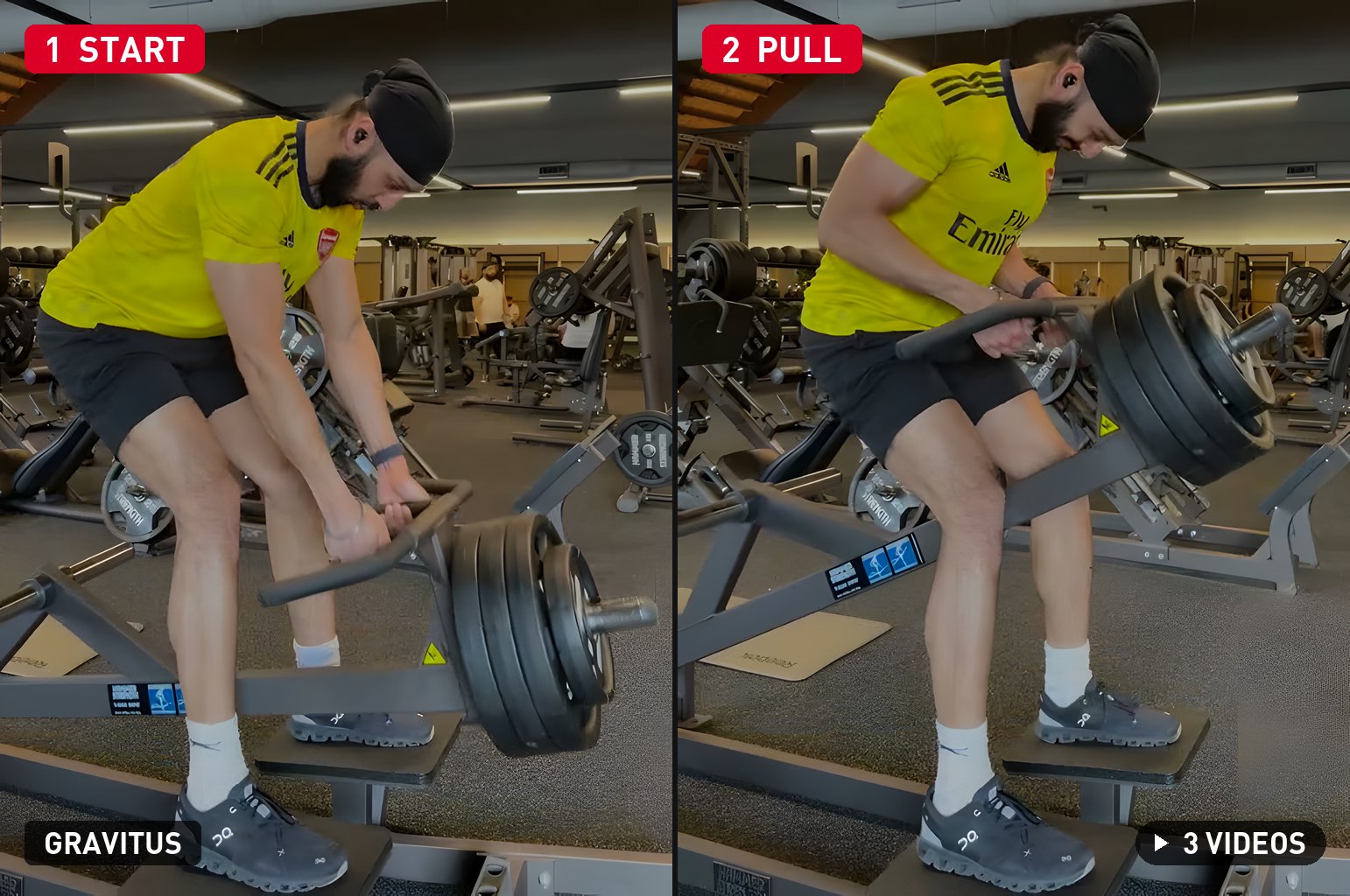
- 1Start. Feet on the platforms, knees soft, hips back. Arms hang straight from the close handles with your back flat.
- 2Pull. Drive your elbows back along your sides until the handles reach your lower chest, then lower under control.
Watch 3 video demonstrations
Find more video demonstrations in the Gravitus app
How to do a T-bar row
- Wedge one end of a barbell into a landmine or a corner and load plates on the other end. On a T-bar machine, load the plate horn and stand on the foot platforms.
- Straddle the bar facing the plates. Hook a V-handle under the bar right behind the collar, or grip the bar there with both hands.
- Push your hips back with soft knees until your torso is 30 to 45 degrees above the floor. Brace, keep your back flat and let your arms hang straight.
- Drive your elbows back along your sides until the handle reaches your lower chest or upper stomach. Keep your torso at the same angle.
- Lower over 2 to 3 seconds until your arms are straight, without letting the plates touch the floor.
What torso angle to use
The plates always pull straight down, but your torso tilts. The part of the load that pulls across your torso is what your upper back rows. The rest pulls along your torso toward the floor, and your upper traps hold it the way they hold a shrug. Your lower back holds the load on the same lever as the row part, so standing taller cuts both by the same share. At 30 degrees you row 87% of the load; at 60 degrees you row half of it.
Hinge to 30 degrees, no higher than 45, and keep that angle for the whole set. Standing up as you tire does spare your lower back, but it takes the same share off the row and gives it to the upper traps. In a seated cable row, leaning back only 20 degrees nearly tripled upper trap activity and cut lower trap activity by a quarter (Park 2022). If your lower back gives out before your upper back, switch to the chest-supported T-bar instead of standing up. If the plates hit your chest before the handle reaches it, swap 45 lb (20 kg) plates for 25s (10 kg): iron 25s are smaller, while bumper plates are all the same size.
Which grip to use
The handle decides how far your elbows can flare, and the elbows decide what the row trains. In a cable row study, elbows close to the body produced the most force and the most upper and lower lat activity with an overhand, underhand or neutral grip alike; flaring them 60 to 90 degrees moved the work to the traps and rear delts (Vasconcelos 2023). Grip width alone is a weaker signal: a narrow grip drew more lat activity in the seated row, but the one bent-over row study found the reverse (Di Fonza 2026). Pick the handle for where you want your elbows to go.
Landmine vs T-bar machine vs chest-supported T-bar
| Attribute | Landmine T-bar row | Standing T-bar machine | Chest-supported T-bar |
|---|---|---|---|
| What holds you | Your lower back, bent over | Your lower back, feet on platforms | A chest pad |
| Handles | V-handle, grip attachment or the bar | Fixed close and wide handles | Fixed close and wide handles |
| What you log | Plates only, the bar adds about 30 lb (12.5 kg) | Plates only, the lever weight varies by brand | Plates only, the lever weight varies by brand |
| Best for | Any gym with a barbell and a corner | Heavy rows with a choice of grips | Upper back work when your lower back is tired |
The landmine and the standing machine are the same lift: you hold a hinge while you row, so your lower back works in both. The chest pad is what takes the lower back out. In a free-weight bent-over row, lower back muscle activity was 34% higher than in a machine row (Saeterbakken 2015). Use the standing versions when you want that work and the chest-supported T-bar when you do not. For padded dumbbell and machine options, see the chest-supported row.
How much weight should you T-bar row?
On Gravitus, the median man lifts 105 lb (47.5 kg) for 10 reps on the T-bar row, and the median woman 55 lb (25 kg).
- Most lift
- 80 to 135 lb
- Top 10% lift
- 165 lb or more
- Starting out
- under 80 lb
- Most lift
- 35 to 70 lb
- Top 10% lift
- 90 lb or more
- Starting out
- under 35 lb
- Most lift
- 37.5 to 60 kg
- Top 10% lift
- 75 kg or more
- Starting out
- under 37.5 kg
- Most lift
- 16 to 32.5 kg
- Top 10% lift
- 42.5 kg or more
- Starting out
- under 16 kg
Muscles worked
Three T-bar row claims that do not hold up
- The pivot takes the load off your lower back. The anchored end steadies the bar's path, but you still hold a hinge. When 16 lifters did landmine and barbell Romanian deadlifts at their 8-rep max, lower back activity and lumbar bending did not differ, and the weights they lifted were nearly the same (McCurdy 2025). The bent-over row put the most load on the lower spine of three rows tested (Fenwick 2009). A chest pad is what takes the lower back out.
- A close grip trains the inner back and a wide grip builds width. In a cable row, both the upper and lower lats worked hardest with the elbows close, whatever the grip, and flared elbows shifted the work to the traps and rear delts (Vasconcelos 2023). Grip width studies disagree between exercises (Di Fonza 2026). Your elbow path matters more than the handle.
- The pivot holds part of the plates. It holds part of the bar. Plates sit at the end of the lever, just past your hands, so you hold all of their weight and a little more. What the pivot saves you is the bar: you hold a bit over half of it. That is why T-bar numbers logged as plates only look lower than barbell row numbers.
Sets, reps and progression
Use the T-bar row as the main row on a pull day, early in the session while your lower back is fresh. Because your lower back holds the hinge, use the chest-supported version the day after heavy deadlifts. Stop each set 0 to 2 reps short of failure. Sets taken close to failure build muscle across a wide range of reps (Schoenfeld 2021), so pick a range you can keep strict.
Add reps before weight. When every set reaches 12 at the same torso angle, add a 5 lb (2.5 kg) plate and drop back to 8. Hook the handle in the same spot every session, or the new number means nothing.
Common mistakes
-
Standing up as you pullYour torso rises on each rep and the row turns into a shrug. Hold your angle, and go lighter if you cannot.
-
Rounding your lower backYour back rounds at the bottom as the plates reach for the floor. Brace before each rep, or move to the chest-supported T-bar.
-
Plates hitting your chestBig plates stop the handle short of your body. Use 25 lb (10 kg) iron plates instead of 45s (20 kg).
-
Moving the handle down the barHooking the V-handle 6 in (15 cm) closer to the pivot makes the same load about 10% heavier. Hook it right behind the collar every time.
-
Kicking with your legsYour knees and hips drive the bar up. Keep your legs still and let your back move the weight.
-
Shrugging at the topYour shoulders ride up toward your ears. Pull your elbows toward your hips and keep your shoulders down.
T-bar row variations
Questions people ask
What grip for t bar row?
A close neutral grip on a V-handle for the standard row. Your elbows stay close, which gives the most force and lat activity. Use wide pronated handles when you want more upper back and rear delt work, and expect to lift less (Vasconcelos 2023).
Does t bar row target rear delts?
Yes, as a helper. The lats and mid back do most of the work with a close grip. Wide pronated handles with your elbows flared 60 to 90 degrees give the rear delts and traps more of it (Vasconcelos 2023).
Do t bar rows work traps?
Yes, mostly the middle and lower traps. Standing more upright shifts the work to the upper traps, because more of the load pulls your shoulders toward the floor like a shrug.
Is t bar row compound or isolation?
Compound. Your shoulders, shoulder blades and elbows all move, and your hips, lower back and legs hold the hinge.
What does chest supported t-bar row work?
The same lats, mid traps, rhomboids and rear delts as the standing T-bar row. The pad holds your torso, so your lower back does far less. A free-weight bent-over row drew 34% more lower back activity than a machine row (Saeterbakken 2015).
Is the T-bar row better than the barbell row?
Neither is better overall. Both are bent-over rows that train the same upper back muscles, and your lower back holds the hinge in both. The T-bar gives you a neutral handle and a steadier bar path. For less lower back work, use a chest-supported T-bar.
Do you count the bar weight when logging T-bar rows?
Log only the plates, and log them the same way every time. On a landmine you hold all of the plates and about 30 lb (12.5 kg) of a 45 lb (20 kg) bar, and on a T-bar machine the lever weight varies by brand, so a total that includes the bar is an estimate anyway.
How much weight should I T-bar row?
For 10 reps, the median on Gravitus is 105 lb (47.5 kg) for men and 55 lb (25 kg) for women. The strongest quarter lifts 135 lb (60 kg) and 70 lb (32.5 kg) or more.
Log every set and see your percentile on every lift, T-bar row included.
Get GravitusRelated exercises
- Park and Kim 2022. J Musculoskelet Sci Technol 6(1):22-31.
- Vasconcelos et al. 2023. Int J Strength Cond 3(1).
- Di Fonza et al. 2026. J Funct Morphol Kinesiol 11(3):315.
- Saeterbakken et al. 2015. Int J Sports Med 36(11):900-905.
- Fenwick, Brown and McGill 2009. J Strength Cond Res 23(2):350-358.
- McCurdy and Koldenhoven 2025. Int J Strength Cond 5(1).
- Schoenfeld et al. 2021. Sports 9(2):32.