How to Do a One-Arm Dumbbell Row
A one-arm dumbbell row is a back exercise done one side at a time. Brace a hand on a bench, hinge until your torso is near parallel to the floor and row the dumbbell to your hip. It trains the lats and upper back. Most lifters do 3 to 4 sets of 8 to 12 reps per arm.
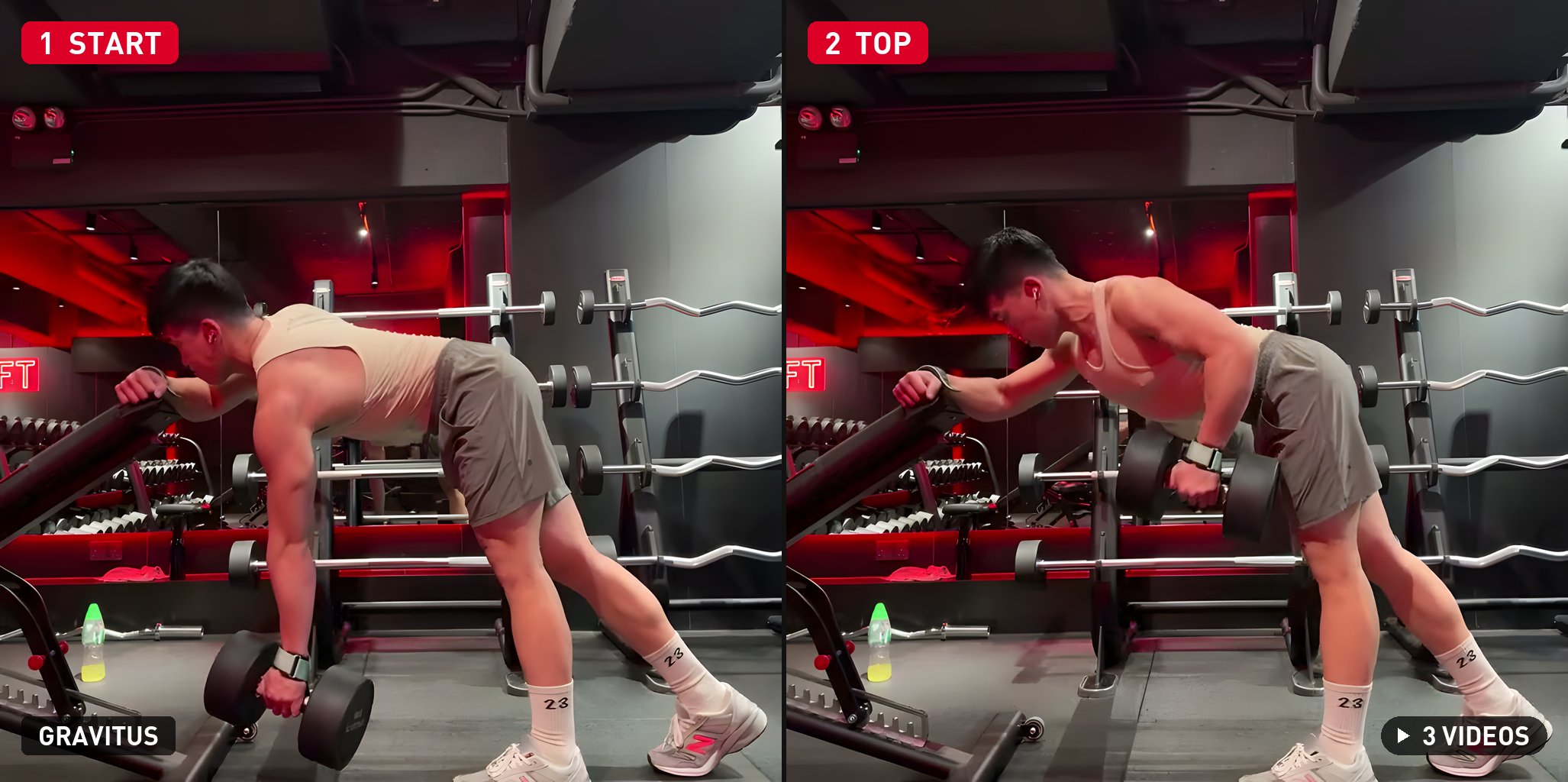
- 1Start. One hand braced on a bench, feet split, torso hinged close to parallel. The dumbbell hangs straight below your shoulder.
- 2Top. Drive your elbow back to your hip with your forearm vertical, then lower it until your arm is straight.
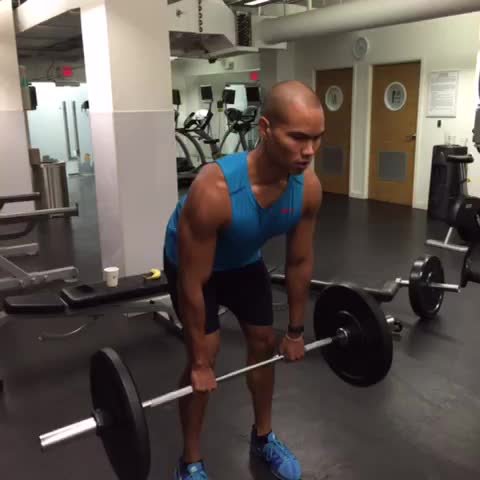
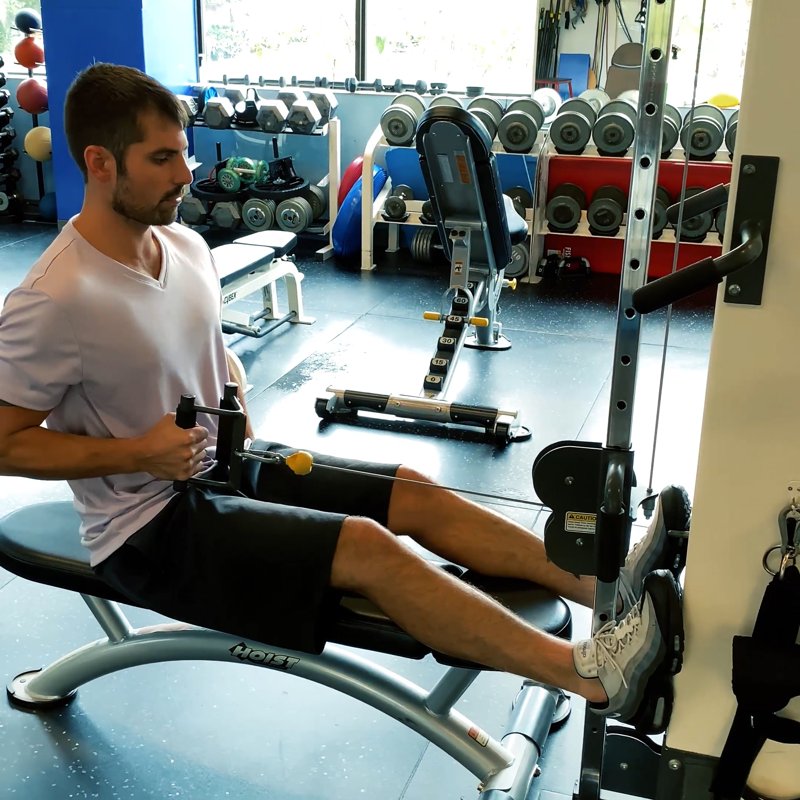
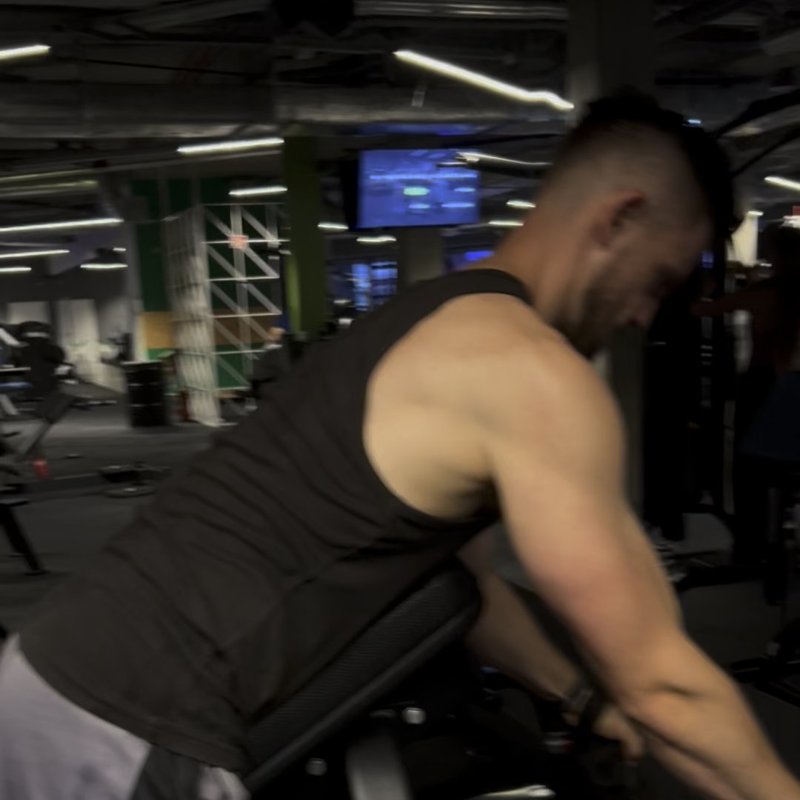
Watch 3 video demonstrations
Find more video demonstrations in the Gravitus app
How to do a one-arm dumbbell row
- Put one hand and the same-side knee on a flat bench, or stand in a split stance with that hand on the bench. Hold the dumbbell in the other hand, palm facing in.
- Hinge until your torso is close to parallel with the floor. Keep your back flat and let the arm hang straight down from your shoulder.
- Pull your elbow back toward your hip. Keep it close to your side and your forearm vertical.
- Stop when the dumbbell reaches your hip and your elbow is just past your torso. Keep your shoulders and hips square to the floor.
- Lower over 2 seconds until your arm is straight and your shoulder blade slides forward. Finish all reps, then switch sides.
How far you hinge changes the row
A dumbbell pulls straight down, so your shoulder works hardest when your upper arm is level with the floor. At the bottom, with the arm hanging, the lats hold almost nothing. Your torso angle decides how far the arm travels and how much load reaches the top. The curves are modelled for the same dumbbell, forearm vertical, finishing with the elbow just past your torso.
Hinge until your torso is close to parallel, with a hand on a bench to hold it there. Let the arm hang straight at the bottom and pause for a second at your hip, where the row is hardest.
How much weight should you use for one-arm dumbbell rows?
On Gravitus, the median man lifts 65 lb (30 kg) for 10 reps on the one-arm dumbbell row, and the median woman 30 lb (14 kg).
- Most lift
- 50 to 80 lb
- Top 10% lift
- 100 lb or more
- Starting out
- under 50 lb
- Most lift
- 22.5 to 40 lb
- Top 10% lift
- 50 lb or more
- Starting out
- under 22.5 lb
- Most lift
- 22.5 to 37.5 kg
- Top 10% lift
- 45 kg or more
- Starting out
- under 22.5 kg
- Most lift
- 10 to 18 kg
- Top 10% lift
- 22.5 kg or more
- Starting out
- under 10 kg
Muscles worked
Which setup to use
We found no study that compared these setups for growth. Pick the one that keeps your torso still and close to parallel.
Hip or chest? What the research says
Pull to your hip for the lats and toward your chest for the upper back. That comes from anatomy, not from a study of this lift. With your elbow tucked, the arm moves back along your side, which is the job of the lats and teres major. Flare the elbow out 45 to 90 degrees and pull toward your chest, and the rear delts, mid traps and rhomboids take more of the work.
Research on the dumbbell row itself is thin. A 2026 review of lat activation studies lists none that measured it (Di Fonza 2026). Two claims you will read elsewhere that no study we found backs:
- Dumbbell rows match barbell rows for lat activation. No study has compared the two.
- Pulling to your hip builds the lower lats. No study has tested regional lat growth from this row.
What has been measured is the core. In two-arm rows, external oblique activity was 37 to 41% of the one-arm versions (Saeterbakken 2015).
One-arm dumbbell row vs barbell row vs seated cable row
| Attribute | One-arm DB row | Barbell row | Seated cable row |
|---|---|---|---|
| Support | Hand on a bench | None, you hold the hinge | Seat and foot plate |
| Hardest point | Top, elbow at your hip | Top, bar at your stomach | More even through the rep |
| Lower back | Low with a bench | Highest of three rows in one study | Low |
| Best for | One side at a time | Most total weight | Small weight jumps, drop sets |
We found no study that compared these rows for muscle growth, so pick the one you can progress. The standing bent-over row put the most load on the lower back of three rows tested (Fenwick 2009). Use the one-arm row when your lower back is tired or one side lags.
Sets, reps and progression
Do the row after your main pull of the day. Stop each set 0 to 2 reps short of failure. Sets taken close to failure build muscle across a wide range of reps (Schoenfeld 2021), so pick a range you can keep strict. Start with your weaker side and match its reps on the other.
Dumbbells jump 5 lb (2.5 kg) at a time, which is 10% or more under 50 lb (22.5 kg). Add reps first: when every set reaches 12, move up one dumbbell and drop back to 8.
Common mistakes
-
Twisting the torsoYour hips and shoulder open toward the ceiling to lift the weight. Keep both square to the floor and go lighter.
-
Standing too uprightThe arm travels less and the top of the rep goes light. Hinge until your torso is close to parallel.
-
Curling the weight upThe hand gets ahead of the elbow and the biceps take over. Keep your forearm vertical and lead with the elbow.
-
Shrugging at the topThe upper traps finish the rep. Drive the elbow back toward your hip, not up toward your ear.
-
Cutting the bottom shortLet the arm hang straight and the shoulder blade slide forward before every rep.
One-arm dumbbell row variations
Questions people ask
What do single arm rows work?
The lats and teres major most, with the mid traps, rhomboids, rear delts and biceps helping. Your obliques keep your torso from twisting, more than in two-arm rows (Saeterbakken 2015).
Are one arm rows effective?
Yes. They train the lats and upper back through a long range, one side at a time, with a bench taking the load off your lower back. We found no study that compared them with other rows for growth, so use the row you can progress.
What are single arm rows good for?
Building the lats and upper back, evening out a weaker side and training your core to resist twisting. A bench lets you row heavy without holding a barbell hinge.
Should I pull the dumbbell to my hip or my chest on a one arm row?
To your hip for the lats, with your elbow close to your side. Pulling toward your chest with the elbow flared shifts the work to the rear delts and upper back. Both are useful; pick one per set.
Is the one arm dumbbell row better than the barbell row?
Neither is better for growth; we found no study that compared them. The barbell row moves more total weight, and the standing bent-over row had the highest lower back load of three rows in one study (Fenwick 2009). Braced on a bench, the dumbbell row lets each side work alone.
How much weight should I use for one arm dumbbell rows?
For 10 reps, the median on Gravitus is 65 lb (30 kg) for men and 30 lb (14 kg) for women. The strongest quarter lifts 80 lb (37.5 kg) and 40 lb (18 kg) or more.
Log every set and see your percentile on every lift, one-arm dumbbell row included.
Get Gravitus