One-Arm Seated Cable Row: The Ultimate Guide
A one-arm seated cable row is a unilateral back exercise on a low pulley. Hold a single handle, sit tall and drive your elbow back past your side without letting your torso turn. It trains the lats, mid back and rear delts, while your obliques resist the twist. Most lifters do 3 sets of 8 to 12 reps per arm.
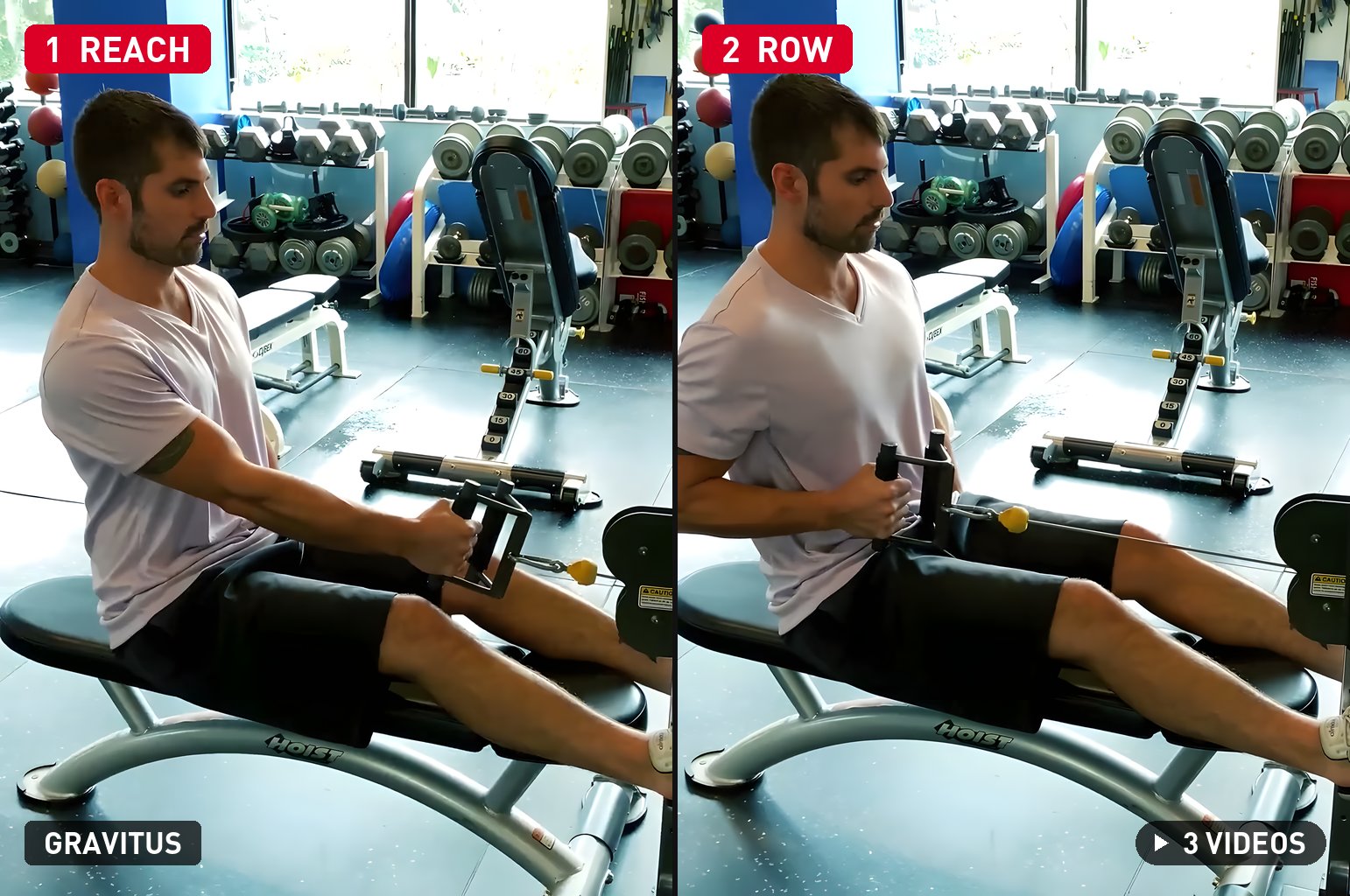
- 1Reach. Low pulley, single handle, feet on the platform. Let the arm straighten all the way while your chest keeps facing the stack.
- 2Row. Drive the elbow back past your side toward your hip, then let the handle return over 2 to 3 seconds.
Watch 3 video demonstrations
Find more video demonstrations in the Gravitus app
How to do a one-arm seated cable row
- Clip a single D handle to the low pulley of a seated row station. On a cable column, set the pulley to the lowest notch and sit on a bench facing it.
- Sit tall with your feet on the platform and your knees slightly bent. Hold the handle palm in and rest your free hand on your thigh.
- Let your arm straighten fully in front of you. Your chest keeps facing the stack.
- Drive your elbow back past your side toward your hip, keeping it close to your body. Your torso stays still.
- Return over 2 to 3 seconds until the arm is straight again. Finish every rep on one arm, then switch.
Stay square, reach or twist?
| Attribute | Stay square | Small reach | Twist to finish |
|---|---|---|---|
| What moves | Arm and shoulder blade only | Working shoulder turns a little forward at the stretch | Torso swings back to pull the handle |
| Trains more | Obliques, holding the twist off | More range at the stretch, less anti-twist work | Your torso, not your back muscles |
| Use it for | Most sets, and every heavy set | Lighter, controlled sets | Nothing. Go lighter. |
Pulling with one arm tries to turn your torso toward the handle, so stay square by default. Two-arm rows drew only 37 to 41% of the external oblique activity of one-arm rows (Saeterbakken 2015), and rotating gives that work away. A small reach at the stretch is fine if you turn back square before the elbow bends. No study has tested the reach, and in a two-arm seated row, keeping the shoulder blades set drew more lat activity on the way back than letting them move freely (Padovan 2025).
How much weight should you use for one-arm seated cable rows?
On Gravitus, the median man lifts 75 lb (35 kg) for 10 reps on the one-arm seated cable row, and the median woman 40 lb (18 kg).
- Most lift
- 55 to 110 lb
- Top 10% lift
- 145 lb or more
- Starting out
- under 55 lb
- Most lift
- 30 to 55 lb
- Top 10% lift
- 75 lb or more
- Starting out
- under 30 lb
- Most lift
- 25 to 50 kg
- Top 10% lift
- 65 kg or more
- Starting out
- under 25 kg
- Most lift
- 14 to 25 kg
- Top 10% lift
- 35 kg or more
- Starting out
- under 14 kg
Muscles worked
Which handle to use
The handle matters because it sets your elbow path. In seated rows with the elbow close to the body, lifters produced more force and more lat activity. With the elbow out at 60 to 90 degrees, the upper and mid traps and rear delts worked harder (Vasconcelos 2023).
One-arm cable row vs two-arm seated row vs dumbbell row
| Attribute | One-arm cable row | Two-arm seated row | One-arm dumbbell row |
|---|---|---|---|
| Load | More than half your two-arm row, per arm | Heaviest, both arms together | Capped by your heaviest dumbbell |
| Torso | Upright, resisting the twist | Upright, nothing to resist | Bent over, braced on a bench |
| Best for | Each side alone, core work | Loading the back heaviest | Training without a cable |
Use both. Over 10 weeks, untrained women who trained one arm at a time and those who trained both arms together gained seated row strength with no difference between groups (Saeterbakken 2026). Make the two-arm row your heavy row and the one-arm row your side-by-side check.
Sets, reps and progression
Start with your weaker arm and give the stronger arm the same reps, so it does not pull further ahead. Stop each set 0 to 2 reps short of failure. Sets taken close to failure build muscle across a wide range of reps (Schoenfeld 2021).
Add reps before weight. When both arms reach 12 on every set with your torso square, move up one pin and drop back to 8.
Common mistakes
-
Twisting to finish the repYour torso pulls the handle, not your back. Go lighter until your chest keeps facing the stack.
-
Leaning backYour hips and lower back swing the weight. Sit tall and hold the torso still.
-
ShruggingThe upper traps take over. Keep the working shoulder down, away from your ear.
-
Cutting the front of the rep shortStraighten your arm fully every rep so the back works through the whole range.
-
Letting the stack pull you forwardReturn over 2 to 3 seconds without letting the plates touch.
One-arm row variations
Questions people ask
What muscles does the single arm cable row work?
The lats, mid traps and rhomboids, with the rear delts and biceps helping. Your obliques work hard to stop the torso turning, far more than in a two-arm row (Saeterbakken 2015).
Should you rotate your torso on a single arm cable row?
Mostly no. Stay square for most sets, since resisting the twist is what trains your obliques. A small reach at the stretch is fine on lighter sets if you turn back square before you pull. Never twist to finish the rep.
Is the single arm cable row better than the seated cable row?
Neither is better for strength. In a 10-week study of untrained women, one-arm and two-arm training raised seated row strength with no difference between groups (Saeterbakken 2026). The two-arm row loads more weight; the one-arm row trains each side alone and works the obliques more.
Are single arm cable rows good?
Yes. They train the lats and mid back one side at a time, show you if one side is weaker, and make your core resist the twist.
How much weight should I use for a single arm cable row?
For 10 reps, the median on Gravitus is 75 lb (35 kg) for men and 40 lb (18 kg) for women. The strongest quarter lifts 110 lb (50 kg) and 55 lb (25 kg) or more.
Log every set and see your percentile on every lift, one-arm seated cable row included.
Get GravitusRelated exercises
- Saeterbakken et al. 2015. Int J Sports Med 36:900-905.
- Padovan et al. 2025. J Funct Morphol Kinesiol 11(1):6.
- Vasconcelos et al. 2023. Int J Strength Cond 3(1).
- Saeterbakken et al. 2026. J Funct Morphol Kinesiol 11(2):232.
- Uysal et al. 2026. J Strength Cond Res 40(7):843-873.
- Schoenfeld et al. 2021. Sports 9(2):32.