How to Use the Lateral Raise Machine
A lateral raise machine is a seated side delt machine. Set the seat so your shoulders line up with the pivots, rest your upper arms on the pads and raise them out to shoulder height. It trains the side delts, helped by the front delts and upper traps. Most lifters do 3 to 4 sets of 10 to 20 reps.
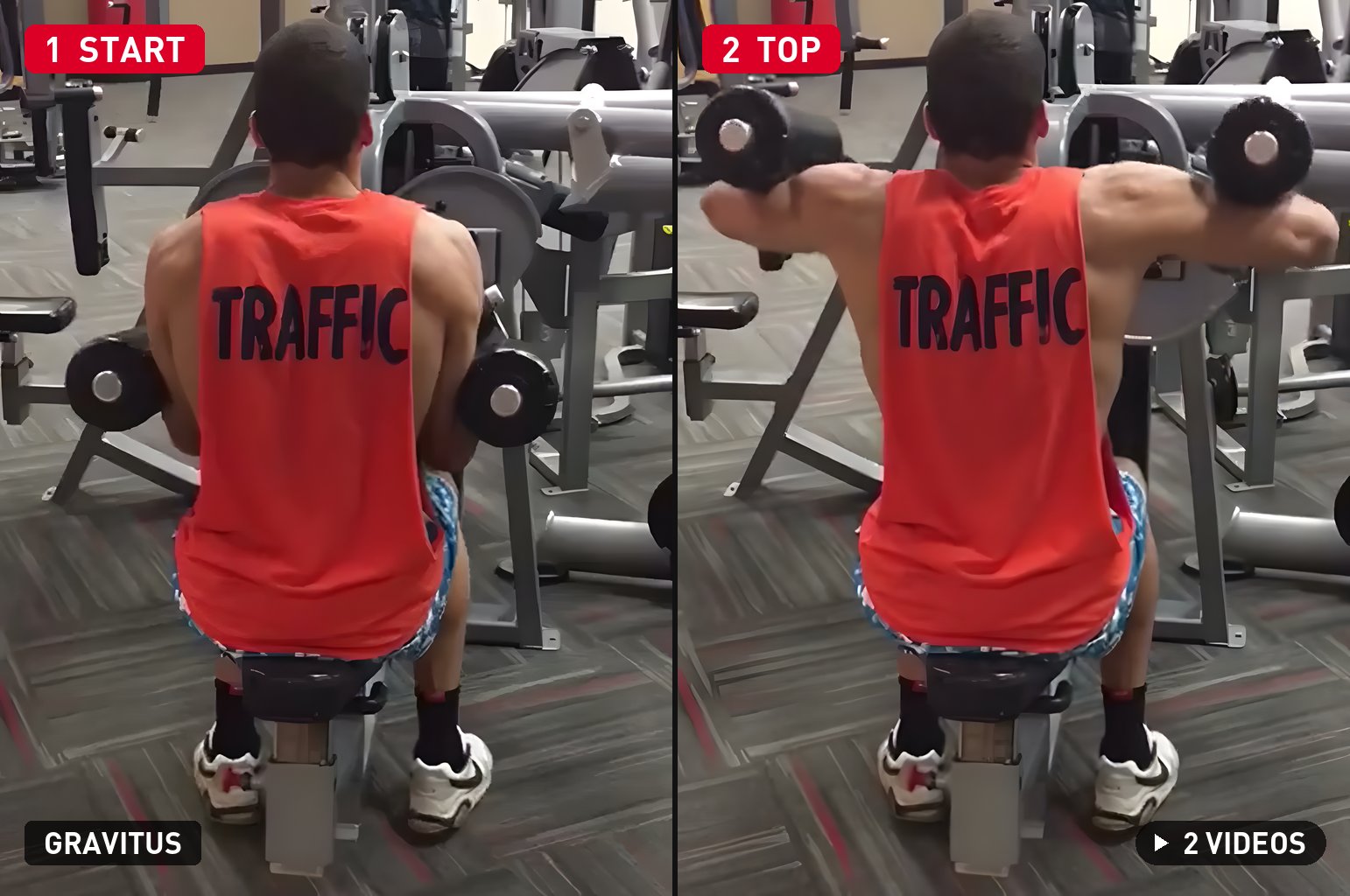
- 1Start. Seat set so the machine's pivots line up with your shoulders. Upper arms against the pads, elbows bent.
- 2Top. Push the pads out to the sides until your upper arms are level with your shoulders, then lower over 2 to 3 seconds.
Watch 2 video demonstrations
How to use the lateral raise machine
- Set the pin to a weight you can raise for at least 10 strict reps.
- Sit down and move the seat until the pivot each machine arm turns on sits level with your shoulder joint (see below). Lock the seat in place.
- Sit tall against the pad, feet flat. Rest the outside of your upper arms on the pads, just above your elbows, and hold the handles loosely if there are any.
- Push the pads out to the sides with your elbows until your upper arms are level with your shoulders. Keep your shoulders down, away from your ears.
- Lower over 2 to 3 seconds and stop just before the plates touch, then raise again.
How to set the seat height
Set the seat so your shoulder joint sits level with the machine's pivot, the axle each arm turns on. Manufacturers print the same rule: Hoist's instructions say to align your shoulders with the pivot points, and Hammer Strength marks the axis with a red indicator. Your shoulder joint sits a little below the bony point on top of your shoulder, so line the pivot up with the middle of your shoulder, not the top.
When the two line up, the pads stay in one spot on your arms and the machine loads your shoulder the way it was built to. With the seat too low, the pads slide out toward your elbows as you lift, and your arms end up above level when the machine arms are level. With the seat too high, the pads slide in toward your shoulders. A little sliding near the top is normal, because your shoulder blade rotates up as your arm rises and carries the joint with it.
Set the lightest pin and do two slow reps. If the pads rub along your arms, move the seat one notch and try again.
Pads or handles, cam or plates
Pads or handles do not change the load on your side delt. Once your shoulder lines up with the pivot, the machine's pull reaches your shoulder wherever your arm touches it; pads only take your grip and forearms out of the set. The cam is what changes the rep. When researchers measured eight cam knee extension machines from six brands, the resistance curves varied widely and none matched the muscle's strength curve (Folland 2008). No study has measured lateral raise machines, so expect the same machine-to-machine differences.
How much weight should you use on the lateral raise machine?
On Gravitus, the median man lifts 85 lb (37.5 kg) for 10 reps on the machine lateral raise, and the median woman 37.5 lb (16 kg).
- Most lift
- 60 to 110 lb
- Top 10% lift
- 140 lb or more
- Starting out
- under 60 lb
- Most lift
- 27.5 to 50 lb
- Top 10% lift
- 60 lb or more
- Starting out
- under 27.5 lb
- Most lift
- 27.5 to 50 kg
- Top 10% lift
- 62.5 kg or more
- Starting out
- under 27.5 kg
- Most lift
- 13 to 22.5 kg
- Top 10% lift
- 27.5 kg or more
- Starting out
- under 13 kg
Muscles worked
Constant tension, the perfect cam and other myths
Four claims that most lateral raise machine guides repeat, including our old one:
- Machines give constant tension. The load follows the cam, so it changes through the rep. On eight cam knee extension machines, resistance changed by as much as 38% across the range, and the curves varied widely between brands (Folland 2008). The stack pulls the whole rep, but not evenly.
- The cam matches your strength curve. In the same study, every machine's curve was flatter than the strength curve of the muscle it trained and significantly different from it (Folland 2008). Where your machine feels hardest depends on its cam and on you.
- Machines build less than dumbbells. No study has compared them for growth. Dumbbell and cable raises load the rep very differently and still grew the side delt by the same 3 to 5% over 8 weeks (Larsen 2025), which points to hard sets mattering more than the curve.
- Going above shoulder height hurts your shoulder. In a fluoroscopy study of 40 people raising their arms, the space for the rotator cuff tendons was smallest below 70 degrees of elevation, a range every rep passes through (Lawrence 2019). Stop with your upper arms level with your shoulders because that is the standard endpoint, and go a little higher only if it feels fine.
Machine vs dumbbell vs cable lateral raise
| Attribute | Machine | Dumbbell | Cable |
|---|---|---|---|
| Hardest point | Set by the cam | Shoulder height | You choose, by pulley height |
| Load at the bottom | Yes on a weight stack | None | True |
| Weight jumps | 5 to 10 lb per pin | 2.5 to 5 lb per dumbbell | 5 to 10 lb per pin |
| Best for | Stable sets to failure | Training anywhere | Loading the bottom, one arm at a time |
No trial has tested the machine for growth, and dumbbell and cable raises grew the side delt by the same amount (Larsen 2025). Use the machine when you want to take sets close to failure without balancing or swinging, and the dumbbell or cable lateral raise when it is taken.
Sets, reps and progression
Do machine lateral raises after your presses, or on their own day. Stop each set 0 to 2 reps short of failure. Sets taken close to failure build muscle across a wide range of reps (Schoenfeld 2021), and the machine holds you still, so the last reps stay strict.
Stack jumps of 5 to 10 lb are big for the side delt. Add reps first: when every set reaches the top of your range, move up one pin and drop back to the bottom of the range. On a plate-loaded machine, use the smallest plates you have.
Common mistakes
-
Seat at the wrong heightThe pads slide along your arms and the load shifts. Move the seat until the pivots sit level with your shoulders.
-
ShruggingYour upper traps take over. Keep your shoulders down and stop with your upper arms level.
-
Pulling with your handsYour forearms and grip start doing the work. Push the pads with your elbows and hold the handles loosely.
-
Leaning off the padYour torso helps lift the weight. Stay against the pad for the whole set and go lighter.
-
Resting the stack between repsThe plates touching unloads your side delts. Stop just above the stack and raise again.
-
Dropping the weightLower over 2 to 3 seconds instead of letting the stack fall.
Lateral raise machine variations
Questions people ask
Is the lateral raise machine better than dumbbells?
Not proven either way. No study has compared them for growth, and dumbbell and cable raises, which load the rep very differently, grew the side delt by the same amount (Larsen 2025). The machine makes it easier to take sets close to failure without swinging.
Is lateral raise machine or cable better?
Neither is proven better for growth. The cable lets you choose where the rep is hardest by pulley height. On the machine the cam decides it for you, and the machine holds you still, so sets to failure stay strict.
How do I set the seat height on a lateral raise machine?
Move the seat until the pivot each machine arm turns on sits level with the middle of your shoulder joint, just below the bony point on top. If the pads slide along your arms as you lift, move the seat one notch and try again.
Why are machine lateral raises easier?
The machine holds your torso and sets the arm path, so none of your effort goes into balancing or bracing. The stack number will not match your dumbbells either. The cam or lever decides how heavy each plate feels, and on most two-arm machines one pin loads both arms.
Does lateral raise machine work traps?
Yes, a little. The upper traps rotate your shoulder blade up as your arm rises. They do much more if you shrug, so keep your shoulders down and stop with your upper arms level.
Is lateral raise machine push or pull?
Neither. It raises the arm out to the side, a movement called abduction. Most programs put it on push or shoulder day, after the presses.
How much weight should I use on the lateral raise machine?
For 10 reps, the median on Gravitus is 85 lb (37.5 kg) for men and 37.5 lb (16 kg) for women. The strongest quarter lifts 110 lb (50 kg) and 50 lb (22.5 kg) or more.
Log every set and see your percentile on every lift, machine lateral raise included.
Get GravitusRelated exercises

- Folland and Morris 2008. J Sports Sci 26(2):163-169.
- Larsen et al. 2025. Front Physiol 16:1611468.
- Lawrence, Braman and Ludewig 2019. J Orthop Sports Phys Ther 49(3):180-191.
- Campos et al. 2020. J Hum Kinet 75:5-14.
- Schoenfeld et al. 2021. Sports 9(2):32.
- Hoist Fitness. RS-1502 Lateral Raise, usage instructions.
- Life Fitness. Hammer Strength Select Lateral Raise, product features.