How to Do Single-Arm Cable Lateral Raises
A single-arm cable lateral raise, also called a unilateral cable lateral raise, trains one side delt at a time. Stand side-on to a low pulley, raise the handle in your far hand to shoulder height, elbow slightly bent. The front delts and upper traps help. Most lifters do 3 to 4 sets of 10 to 20 reps per arm.
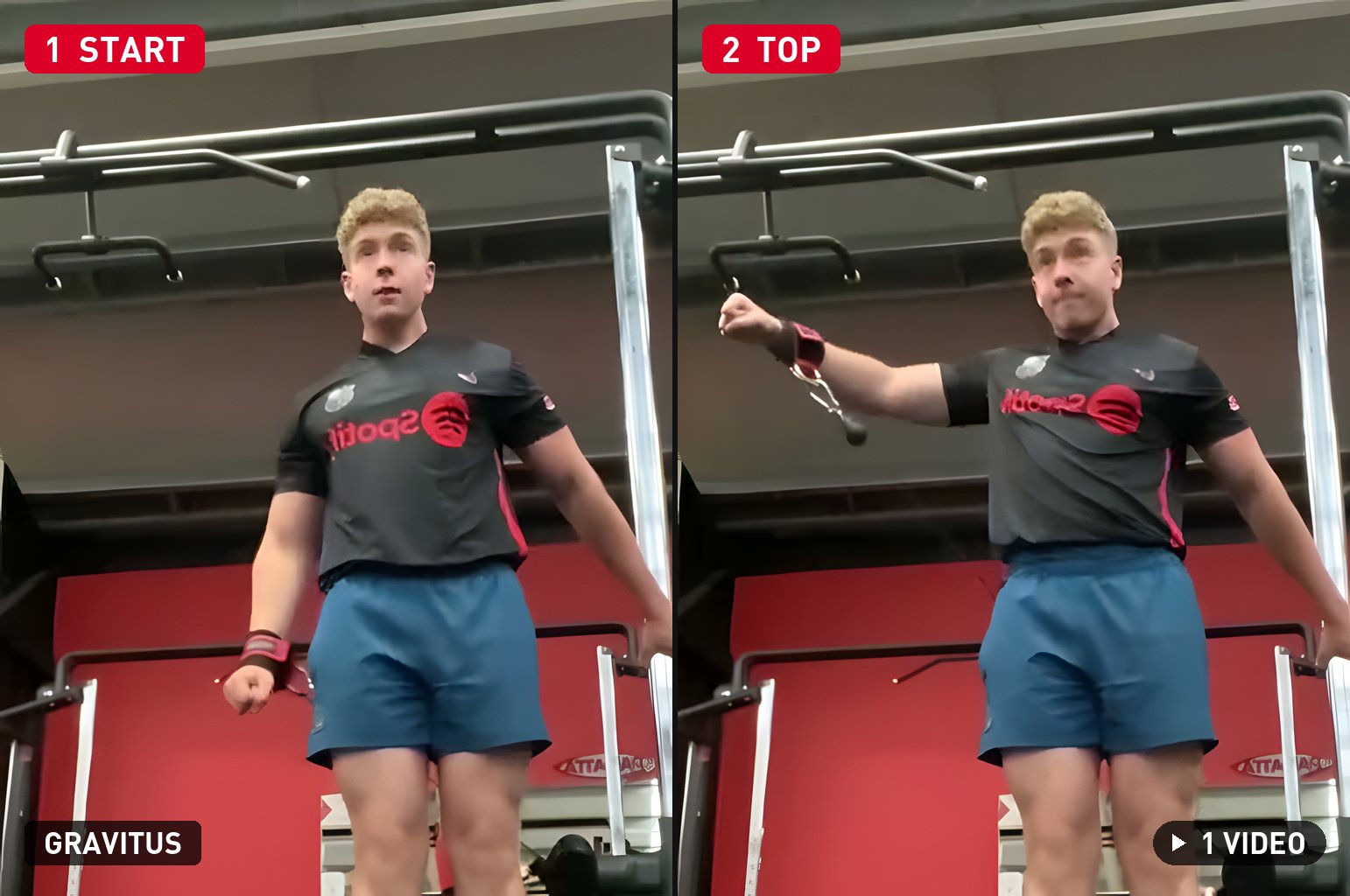
- 1Start. Stand side-on to a low pulley with the handle or cuff on your far arm. Hold the frame with your free hand.
- 2Top. Raise the arm out to the side until your hand reaches shoulder height, then lower it over 2 to 3 seconds.
Watch 1 video demonstration
How to do a single-arm cable lateral raise
- Set the pulley to the lowest notch and clip on a D handle or a wrist cuff.
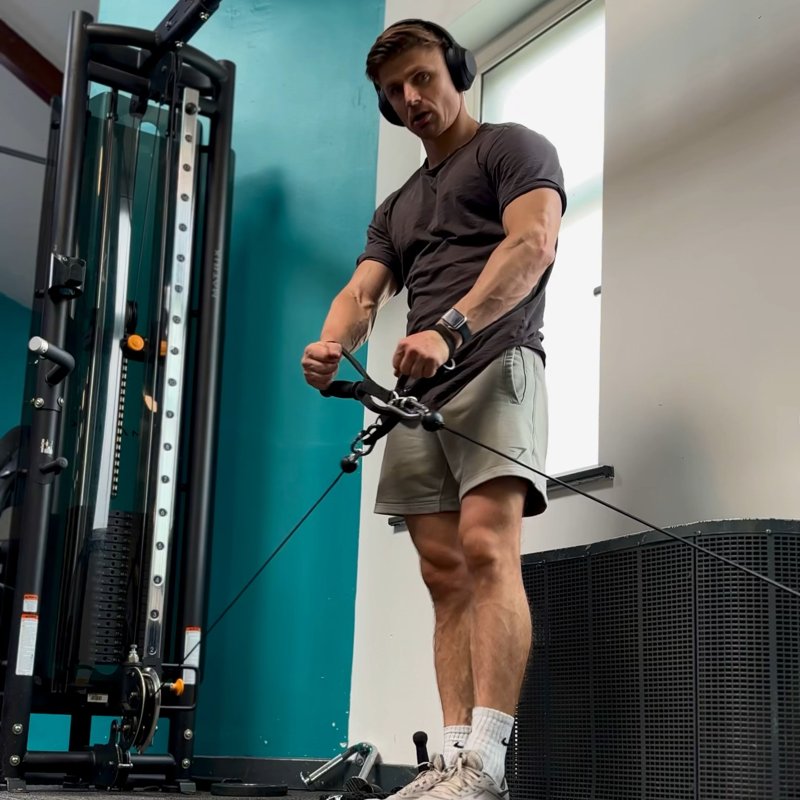
- Stand side-on to the stack, about a foot (30 cm) away. Take the handle in the hand farther from the machine, so the cable crosses in front of your hips.
- Hold the frame with your near hand and set a slight bend in your working elbow. Stand tall, or lean a little away from the stack, and hold that position for the whole set.
- Raise your arm out to the side until your hand is level with your shoulder, leading with your elbow. Keep your shoulder down and your chest facing forward, not turned toward the stack.
- Lower over 2 to 3 seconds until your hand is back in front of your hips. Finish every rep on one arm, then switch.
Should you lean away or step out?
Standing side-on with one hand free gives you two setup choices the two-arm version does not: how far you lean and how far you stand from the stack. In our model, only the distance changes the rep. The curves are for the lowest pulley and a straight arm, each scaled to the same hardest point, which is equally hard in all three.
Lean for balance, not for load. To load the start of the rep, step farther from the stack, or raise the pulley to hip or hand height as shown in our cable lateral raise guide. A dumbbell is different: leaning changes a dumbbell lateral raise a lot, because gravity always pulls straight down.
How much weight should you use for single-arm cable lateral raises?
On Gravitus, the median man lifts 25 lb (12 kg) for 10 reps on the single-arm cable lateral raise, and the median woman 20 lb (9 kg).
- Most lift
- 20 to 35 lb
- Top 10% lift
- 45 lb or more
- Starting out
- under 20 lb
- Most lift
- 17.5 to 27.5 lb
- Top 10% lift
- 37.5 lb or more
- Starting out
- under 17.5 lb
- Most lift
- 9 to 16 kg
- Top 10% lift
- 22.5 kg or more
- Starting out
- under 9 kg
- Most lift
- 8 to 12 kg
- Top 10% lift
- 17 kg or more
- Starting out
- under 8 kg
Muscles worked
Behind the back, lean-away and other one-arm myths
Three claims that single-arm cable lateral raise guides repeat, including our old one:
- Behind the back isolates the side delt better. The raise itself is loaded almost the same either way, as our cable lateral raise guide shows. What changes is a small sideways pull: in front, the cable tugs your arm forward and your rear delt holds it back; behind, it tugs your arm back and your front delt holds it. Use the side that feels better on your shoulder.
- Leaning away stretches the side delt more. The stretch comes from how far your hand crosses your body at the bottom, and a lean does not change that. In our model a 20 degree lean barely moves the load (see the chart). It helps you stay still, which is reason enough to use it.
- One arm at a time builds more muscle. A 2025 meta-analysis of 9 studies found no difference in muscle growth between one-limb and two-limb training. One-limb training made people stronger on one-limb tests, and two-limb training on two-limb tests (Kassiano 2025). The cable vs dumbbell lateral raise trial trained one arm with each, and both arms grew the same (Larsen 2025).
Four ways to set it up
Single-arm cable vs two-arm cable vs dumbbell
| Attribute | Single-arm cable | Two-arm cable | Dumbbell |
|---|---|---|---|
| Hardest point | You choose, by stance and pulley height | You choose, by pulley height | Shoulder height |
| Free hand | Holds the frame | None | None |
| Time per round | Two sets | One set | One set |
| Best for | Strict reps, uneven sides | Saving time | Training anywhere |
A tie for growth. One-arm and two-arm training built the same muscle (Kassiano 2025), and cable and dumbbell raises grew the side delt by the same 3 to 5% over 8 weeks (Larsen 2025). Go one arm at a time when you want the free hand for balance or your sides differ, and use the two-arm cable lateral raise when time is short.
Sets, reps and progression
Stop each set 0 to 2 reps short of failure. Hard sets build muscle across a wide range of reps (Schoenfeld 2021), so use a weight you can raise strictly at least 10 times. In the 2025 trial, lifters did 5 sets of 12 to 16 reps per arm to failure, twice a week (Larsen 2025).
Start with your weaker arm and stop the stronger arm at the same number of reps. Switch arms straight away: each arm rests while the other works. When both arms reach the top of your range on every set, move up one pin and drop back to the bottom of the range.
Common mistakes
-
Leaning further as you liftYour body moves the weight, not your shoulder. Set the lean before the first rep and hold it.
-
Turning toward the stackThe cable twists your chest toward the machine. Keep your chest facing forward and your hips square.
-
Standing right over the pulleyThe cable runs along your arm and the bottom of the rep goes slack. Stand at least a foot (30 cm) from the stack.
-
ShruggingYour upper traps take over. Keep your shoulder down and stop at shoulder height.
-
Doing more reps on your strong sideThe gap between your arms stays. Start with the weaker arm and match its reps.
-
Letting the cable pull you back downLower over 2 to 3 seconds without letting the plates touch.
Single-arm cable lateral raise variations
Questions people ask
Can I do lateral raises one arm at a time?
Yes. Training one limb at a time built as much muscle as training both together in a 2025 meta-analysis (Kassiano 2025), and the main cable lateral raise trial trained each arm on its own (Larsen 2025). One arm at a time takes twice as long per round.
Is it better to do lateral raises one arm at a time?
Not for growth, which was the same either way (Kassiano 2025). It is better if one side is weaker, because you can match reps, and on a cable, because your free hand holds the frame and keeps you still.
Should the cable be in front of or behind my body on single arm cable lateral raises?
Either. The raise is loaded almost the same both ways. In front, your rear delt holds the arm against a small forward pull; behind, your front delt holds it against a backward pull. Most lifters use the front, and behind is worth trying if the front feels awkward on your shoulder.
Should I lean away on single arm cable lateral raises?
If it helps you stay still. In our model a 20 degree lean barely changes where the rep is hardest or how hard it is. Set the lean before the first rep and hold it. Leaning further as you lift lets your body move the weight.
What muscles does the one arm cable lateral raise work?
The side delt, with the front delt, supraspinatus and upper traps helping. Your rear delt or front delt holds the arm against the cable, and your obliques stop your torso tipping toward the stack.
Is the single arm cable lateral raise better than the dumbbell lateral raise?
Not for growth. In the 2025 trial that compared them, lifters trained one arm with a cable and the other with a dumbbell, and both side delts grew by the same amount over 8 weeks (Larsen 2025). The cable loads the bottom of the rep; the dumbbell needs no machine.
How much weight should I use for single arm cable lateral raises?
For 10 reps, the median on Gravitus is 25 lb (12 kg) for men and 20 lb (9 kg) for women. The strongest quarter lifts 35 lb (16 kg) and 27.5 lb (12 kg) or more.
Log every set and see your percentile on every lift, single-arm cable lateral raise included.
Get Gravitus