How to Do Cable Lateral Raises
A cable lateral raise is a side delt isolation exercise. Stand side-on to a low pulley, hold the handle in your far hand and raise your arm out to shoulder height, elbow slightly bent. It trains the side delt, helped by the front delt and upper traps. Most lifters do 3 to 4 sets of 10 to 20 reps.
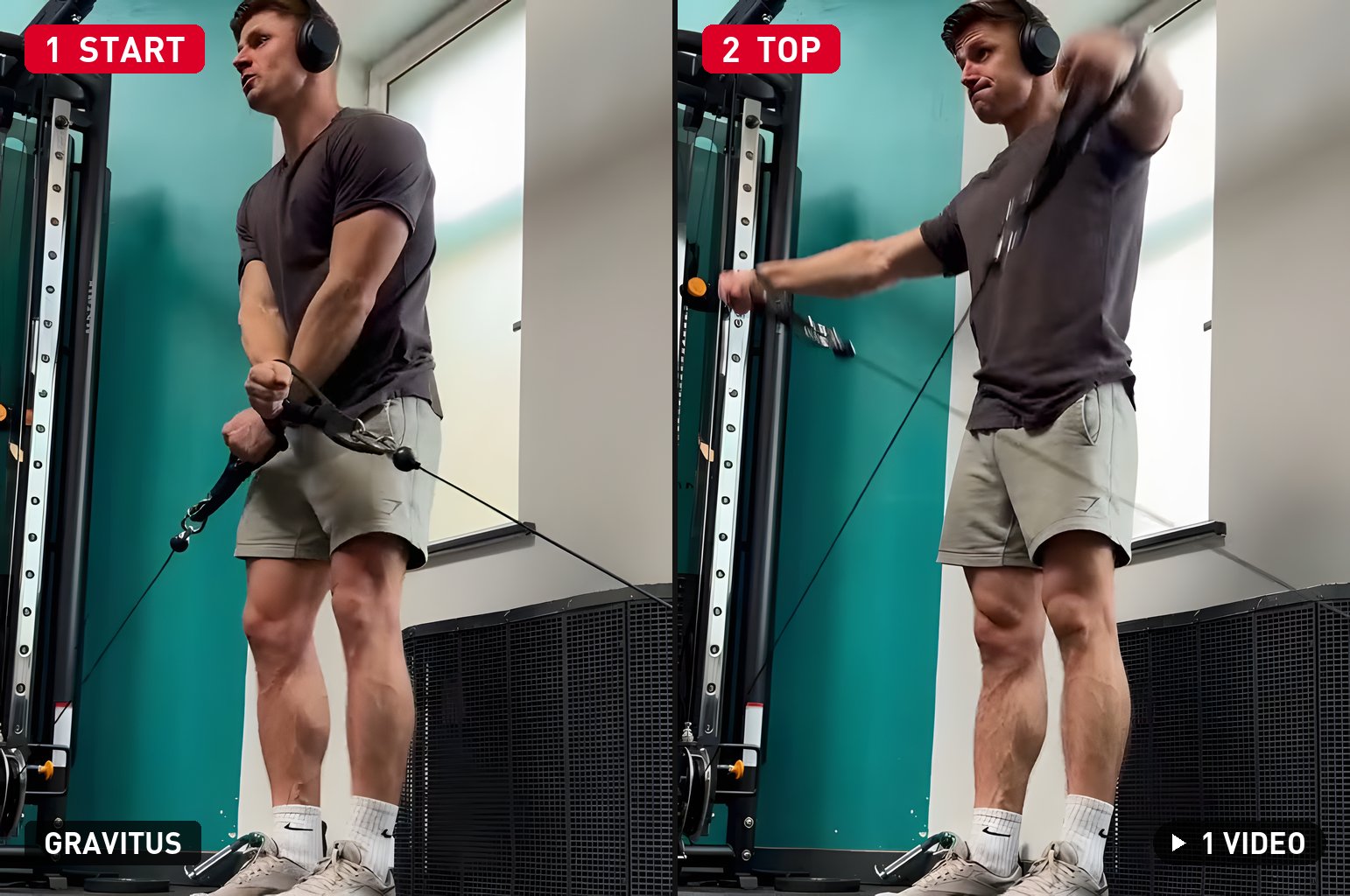
- 1Start. Low pulleys on both sides, cables crossed in front of your hips. Stand tall with a slight bend in your elbows.
- 2Top. Raise your arms out to the sides to shoulder height, leading with the elbows, then lower under control.
Watch 1 video demonstration
How to do a cable lateral raise
- Set the pulley to the lowest notch, or to hip height (see below), and clip on a D handle or a wrist cuff.
- Stand side-on to the stack with the pulley about a foot (30 cm) from your body. Take the handle in the hand farthest from the machine, so the cable crosses in front of your hips.
- Stand tall, hold the frame with your free hand and set a slight bend in your elbow. Keep that bend for the whole set.
- Raise your arm out to the side until your hand is level with your shoulder, leading with your elbow. Keep your shoulder down, away from your ear.
- Lower over 2 to 3 seconds until your hand is back in front of your hips, without letting the plates touch.
Which pulley height to use
The weight stack pulls with the same force all rep, but not with the same leverage. Your shoulder feels it most where the cable runs at a right angle to your arm, so pulley height moves the hardest part of the rep. The curves are modelled for a lifter standing side-on with the pulley a foot (30 cm) from the body, each scaled to its own hardest point.
Use the lowest pulley for load through the whole rep, or hip height to load the bottom, where the side delt is stretched. Set at hand height, the cable grew the side delt as much as a dumbbell over 8 weeks (Larsen 2025). Stepping farther from the stack also loads the bottom more and the top less.
How much weight should you use for cable lateral raises?
On Gravitus, the median man lifts 25 lb (11 kg) for 10 reps on the cable lateral raise.
- Most lift
- 20 to 35 lb
- Top 10% lift
- 55 lb or more
- Starting out
- under 20 lb
- Most lift
- 9 to 16 kg
- Top 10% lift
- 25 kg or more
- Starting out
- under 9 kg
Muscles worked
Constant tension, in front or behind, and other myths
Four claims that most cable lateral raise guides repeat, including our old one:
- Cables give constant tension. The stack pulls with the same force, but its leverage on your shoulder changes through the rep. On the lowest pulley, the rep is only a little over half as hard with your arm at your side as it is halfway up. Pulley height decides where the rep is hardest, as the chart above shows.
- In front or behind changes the muscle. In our model, running the cable a foot (30 cm) behind your body instead of in front barely moves the resistance curve. Pick the one that feels better on your shoulder. Raising straight out to the side drew slightly more side delt activity (5% of maximum) than raising 30 degrees forward (Reed 2016).
- Pour the water at the top. Tipping the thumb down raised upper trap activity above every other lateral raise variation, while side delt activity was higher with the arm in neutral rotation than turned out or with the elbow bent (Coratella 2020). Keep your palm facing the floor at the top, thumb forward.
- You must stop at shoulder height. It is the standard endpoint and where the training studies stop (Larsen 2025), not a proven injury line. Stop there by default, and go a little higher only if it feels fine.
Handle, cuff or two cables
Cable vs dumbbell vs machine lateral raise
| Attribute | Cable | Dumbbell | Machine |
|---|---|---|---|
| Hardest point | You choose, by pulley height | Shoulder height | Set by the cam |
| Load at the bottom | True | None | Depends on the machine |
| Weight jumps | 5 to 10 lb per pin | 2.5 to 5 lb | 5 to 10 lb per pin |
| Best for | Loading the stretch, one arm at a time | Training anywhere | Stable sets to failure |
A tie for growth. Over 8 weeks, cable and dumbbell raises grew the side delt by 3 to 5% with no difference between them (Larsen 2025). Use the one you can keep adding weight or reps to, or both.
Sets, reps and progression
Do lateral raises after your presses, or on their own day. Stop each set 0 to 2 reps short of failure. Sets taken close to failure build muscle across a wide range of reps (Schoenfeld 2021). In the cable vs dumbbell trial, lifters did 5 sets of 12 to 16 reps to failure, twice a week (Larsen 2025).
Stack jumps of 5 to 10 lb are big for the side delt. Add reps first: when every set reaches the top of your range, move up one pin and drop back to the bottom of the range.
Common mistakes
-
ShruggingYour upper traps take over. Keep your shoulder down and stop at shoulder height.
-
Swinging the torsoYour hips lift the weight. Hold the frame, stand still and go lighter.
-
Standing right over the pulleyThe cable runs along your arm and the bottom goes slack. Step out until the cable crosses in front of your hips.
-
Tipping the thumb downMore trap work, not more side delt (Coratella 2020). Keep your palm facing the floor at the top.
-
Bending the elbow as you liftIt shortens the lever and turns the raise into a row. Set a slight bend and hold it.
-
Dropping the weightLower over 2 to 3 seconds without letting the plates touch.
Cable lateral raise variations
Questions people ask
Is cable lateral raise better than dumbbell?
Not for growth. In the one trial that compared them, cable and dumbbell raises grew the side delt by the same amount over 8 weeks (Larsen 2025). The cable lets you load the bottom of the rep. The dumbbell needs no machine.
What pulley height should I use for cable lateral raises?
The lowest notch for load through the whole rep, hardest halfway up. Hip or hand height to make the bottom of the rep the hardest part, the setup the 2025 cable study used (Larsen 2025).
Should the cable be in front of or behind my body?
Either. The resistance through the rep is almost the same, so pick the side that feels better on your shoulder. Most lifters run it in front.
What muscles does the cable lateral raise work?
The side delts, with the front delts, supraspinatus and upper traps helping. The core and forearms hold you still.
Why are cable lateral raises so hard?
The cable loads the start of the rep, where a dumbbell has no load, so there is no easy part to rest in. Pin weights also vary between machines, so the number on the stack will not match your dumbbells.
Is cable lateral raise push or pull?
Neither. It raises the arm out to the side, a movement called abduction. Most programs put it on push or shoulder day, after the presses.
How much weight should I use for cable lateral raises?
For 10 reps, the median on Gravitus is 25 lb (11 kg) for men. The strongest quarter lifts 35 lb (16 kg) or more.
Log every set and see your percentile on every lift, cable lateral raise included.
Get Gravitus