Rear Delt Machine: The Ultimate Guide
The rear delt machine, or reverse pec deck, is a seated fly done facing the pad. With the handles at shoulder height and a slight elbow bend, sweep your arms back until they line up with your body. It trains the rear delts, with the middle traps and rhomboids helping. Most lifters do 3 sets of 10 to 15 reps.
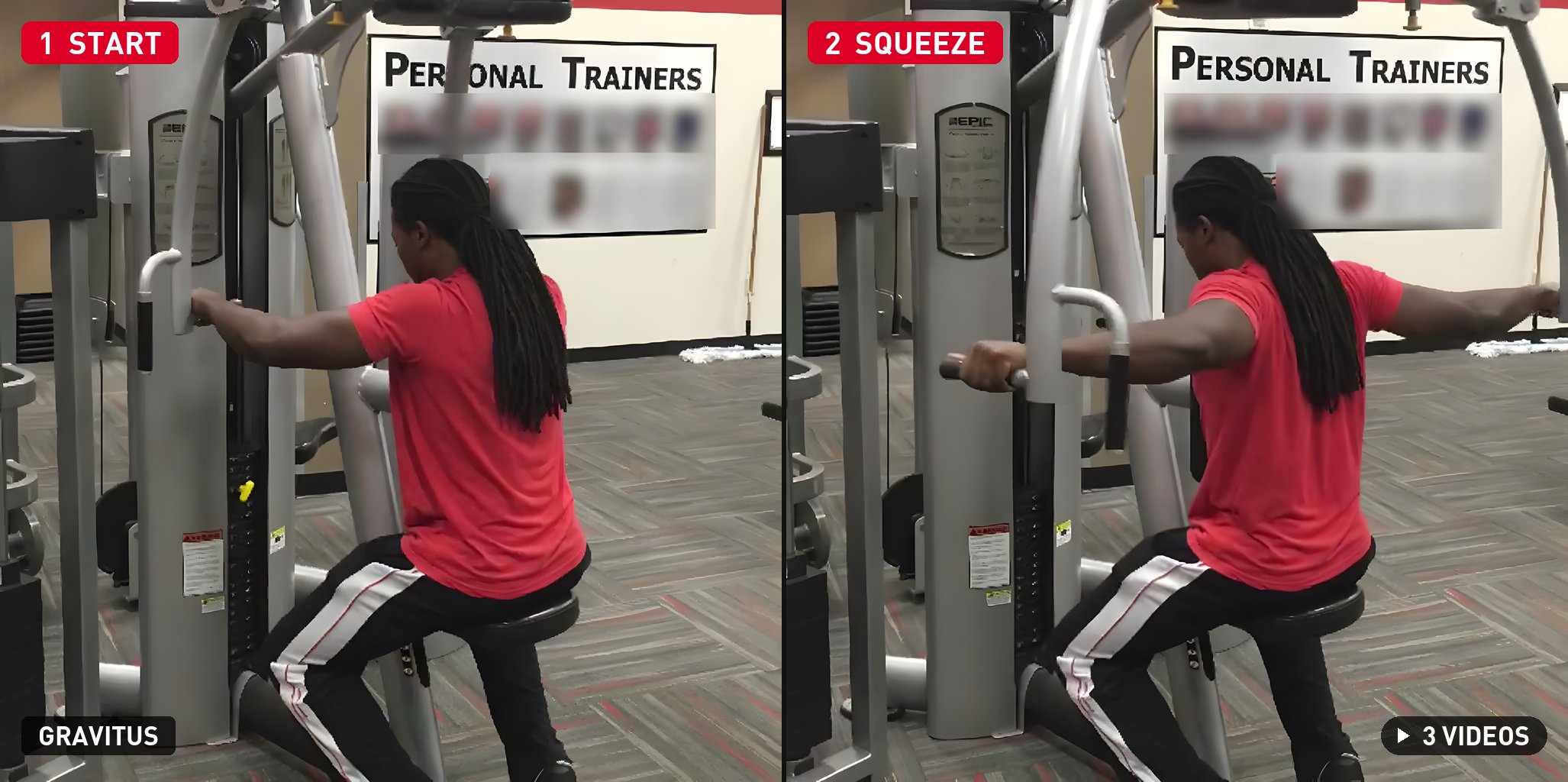
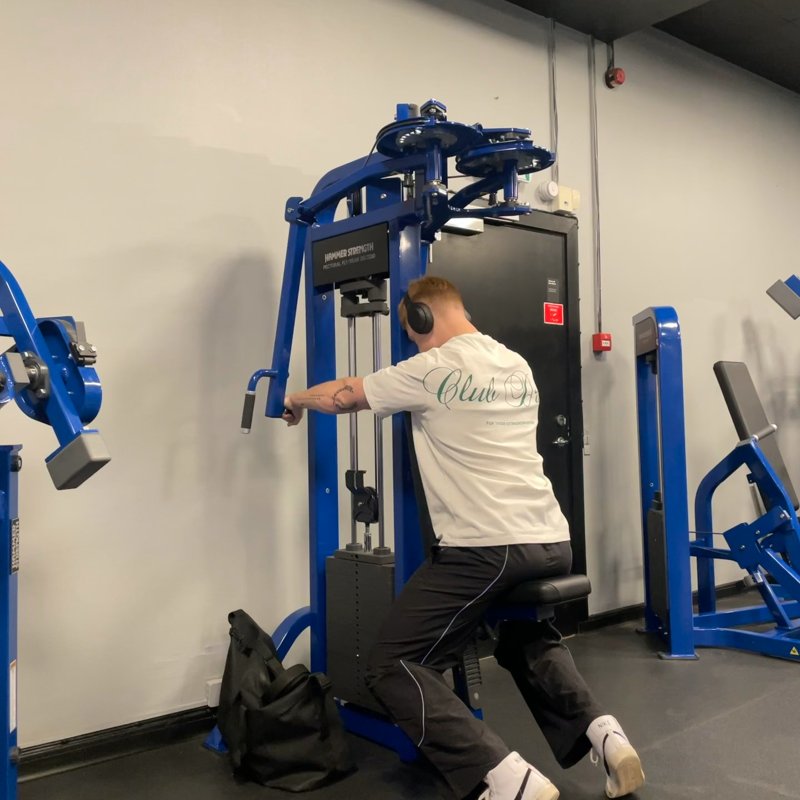
- 1Start. Chest on the pad, seat set so your arms are level with your shoulders. Hold the handles in front of you with a slight bend in your elbows.
- 2Squeeze. Sweep your arms out and back until they line up with your body, pause for a second, then let them come forward under control.
Watch 3 video demonstrations
Find more video demonstrations in the Gravitus app
How to use the rear delt machine
- Set the seat so the handles sit at shoulder height. With your chest on the pad and your arms reaching forward, your arms should be level with the floor.
- On a combined pec deck, move the arms to their front position with the start lever, so the handles begin close together in front of your chest.
- Sit facing the pad with your chest against it and your feet flat. Take the handles with a slight bend in your elbows and keep that bend for the whole set.
- Sweep your arms out and back in a wide arc until they line up with your body. Pause for a second.
- Let the handles come forward over 2 to 3 seconds, until you feel a stretch across the back of your shoulders, without letting the plates touch.
Grip, arm height and elbow bend
Grip makes a small difference, and the studies disagree on its direction. On a reverse fly machine, trained men drew 90% of their maximum rear delt activity with a thumbs-up grip and 87% with palms down, a small but significant gap, and the infraspinatus worked harder with thumbs up (Schoenfeld 2013). In a band pull-apart study, palms down drew the most rear delt activity, and grip did not change middle trap activity (Fukunaga 2022). The path of your arms mattered more there: level and upward pulls both drew about 30% more middle trap activity than a downward pull, while the rear delts did not change significantly (Fukunaga 2022). On the machine, the seat sets that path. Use the grip your machine has or the one that feels better, and spend your attention on seat height.
How far back to go
Stop when your arms line up with your body. That is where each rep ended in the reverse fly machine study (Schoenfeld 2013).
The rear delts move your upper arm. The middle traps and rhomboids move your shoulder blades. Past the line of your body, more and more of the movement comes from pinching your shoulder blades together, so that last part of the rep is mostly upper back work. Both are useful; decide which one you are training.
At the front of the rep, let the handles come forward until you feel a stretch across the back of your shoulders, while your chest stays on the pad.
For rear delts, keep your arms level, let your shoulder blades stay wide and stop with your arms in line with your body. For the upper back, finish by pinching your shoulder blades together and hold for a second.
How much weight should you use on the rear delt machine?
On Gravitus, the median man lifts 100 lb (45 kg) for 10 reps on the rear delt machine, and the median woman 45 lb (20 kg).
- Most lift
- 75 to 130 lb
- Top 10% lift
- 160 lb or more
- Starting out
- under 75 lb
- Most lift
- 35 to 60 lb
- Top 10% lift
- 75 lb or more
- Starting out
- under 35 lb
- Most lift
- 35 to 60 kg
- Top 10% lift
- 72.5 kg or more
- Starting out
- under 35 kg
- Most lift
- 16 to 27.5 kg
- Top 10% lift
- 35 kg or more
- Starting out
- under 16 kg
Rear delt machine muscles worked
What the research says about the rear delt machine
- "Palms down isolates the rear delts, and thumbs up shifts the work to the traps." Neither study backs this. On the machine, thumbs up drew slightly more rear delt activity (Schoenfeld 2013). With a band, palms down did, and grip did not change middle trap activity at all (Fukunaga 2022).
- "Squeeze your shoulder blades together to hit the rear delts." The rear delts move the arm, not the shoulder blades. A hard squeeze at the end trains the middle traps and rhomboids, which is useful, but it is upper back work.
- "The rear delts need the stretch loaded." Over 10 weeks of reverse fly machine training, the rear delts grew with the machine set hardest near the stretch or hardest near the squeeze, with no difference between the two (Jones 2025, a preprint not yet peer reviewed).
- "The rear delts are slow-twitch, so they need high reps." No study we found shows this. Sets taken close to failure build muscle across a wide range of reps (Schoenfeld 2021), and the 10-week study used 8 to 12 (Jones 2025).
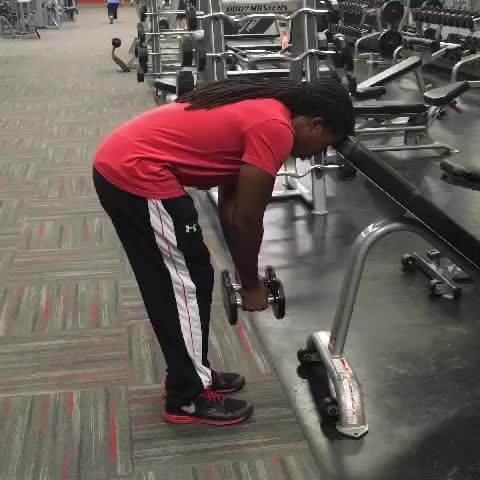
Rear delt machine vs cable reverse fly vs dumbbell rear delt fly
| Attribute | Rear delt machine | Cable reverse fly | Dumbbell rear delt fly |
|---|---|---|---|
| Hardest point | Set by the machine | Set by pulley height and stance | At the top, nothing at the bottom |
| Balance needed | None, chest on a pad | Some, standing | Most, bent over |
| Angles | One fixed path | High, mid or low pulley | How far you bend over |
| Best for | Taking sets to failure safely | Choosing the angle, one arm at a time | Training without a machine |
No study has compared the three for growth. The machine is the easiest to set up the same way every week, and 10 weeks of reverse fly machine training grew the rear delts in new lifters (Jones 2025). Use the cable or dumbbell version when the machine is taken.
Rear delt machine sets, reps and progression
Stop each set 0 to 2 reps short of failure. Sets taken close to failure build muscle across a wide range of reps (Schoenfeld 2021), so 10 to 15 is a range, not a rule. In the 10-week study, 4 to 5 sets of 8 to 12 reps to failure, twice a week, grew the rear delts (Jones 2025).
Do the rear delt machine near the end of a pull or shoulder day, or first if your rear delts lag.
Add reps before weight. Stack jumps are big for a small muscle. When every set reaches 15 with the same seat and start setting, move up one plate and drop back to 10.
Common mistakes
-
Seat too lowYour arms travel above your shoulders and the traps take over. Raise the seat until your arms stay level.
-
ShruggingYour shoulders ride up toward your ears. Keep them down and go lighter.
-
Bending and straightening the elbowsThe fly turns into a row and your arms do the work. Set a slight bend and keep it.
-
Pulling past your bodyGoing further back mostly means pinching your shoulder blades, which moves the work to the upper back. For rear delts, stop in line with your body.
-
Chest leaving the padLeaning back swings the weight up. Keep your chest on the pad the whole set.
-
Letting the stack touchResting the plates between reps unloads the stretch. Stop just short and start the next rep.
Rear delt machine variations
Questions people ask
What does the rear delt machine work?
The rear delts, with the middle traps, rhomboids and rotator cuff helping. The side delts hold your arms up and your core keeps you on the pad.
Is rear delt machine push or pull?
Pull. You pull your arms out and back, and the rear delts and upper back do the work, so it fits on pull day or shoulder day.
Does rear delt fly work traps?
Yes, the middle and lower traps. Moving the arm back with the thumb up drew the highest middle trap activity of 10 exercises (Ekstrom 2003). A seat set too low, or pinching your shoulder blades at the end, gives the traps more work.
What is the best grip for the rear delt fly machine?
Either. On the machine, thumbs up drew slightly more rear delt activity (Schoenfeld 2013); with a band, palms down did (Fukunaga 2022). Seat height changes more than grip.
How do you adjust the rear delt machine?
Set the seat so the handles sit at shoulder height and your arms are level with the floor. On a pec deck, move the arms to their front position so the handles start together in front of your chest.
Is rear delt shoulder or back?
Shoulder. The rear delt is the back part of the deltoid. The rear delt machine trains it together with the upper back, so it fits on either day.
How much weight should I use on the rear delt machine?
For 10 reps, the median on Gravitus is 100 lb (45 kg) for men and 45 lb (20 kg) for women. The strongest quarter lifts 130 lb (60 kg) and 60 lb (27.5 kg) or more.
Log every set and see your percentile on every lift, rear delt machine included.
Get GravitusRelated exercises
- Schoenfeld et al. 2013. J Strength Cond Res 27(10):2644-2649.
- Fukunaga et al. 2022. Int J Sports Phys Ther 17(3):400-408.
- Ekstrom, Donatelli and Soderberg 2003. J Orthop Sports Phys Ther 33(5):247-258.
- Jones et al. 2025. SportRxiv preprint, not peer reviewed.
- Schoenfeld et al. 2021. Sports 9(2):32.
- Life Fitness. Insignia Series owner's manual, Pectoral Fly / Rear Deltoid.