How to Do Cable Reverse Flys
The cable reverse fly, or reverse cable crossover, is a rear delt exercise. Set two pulleys at shoulder height, hold each cable in the opposite hand and open your arms out to the sides with a slight bend in your elbows. It trains the rear delts, middle traps and rhomboids. Most lifters do 3 sets of 10 to 15 reps.
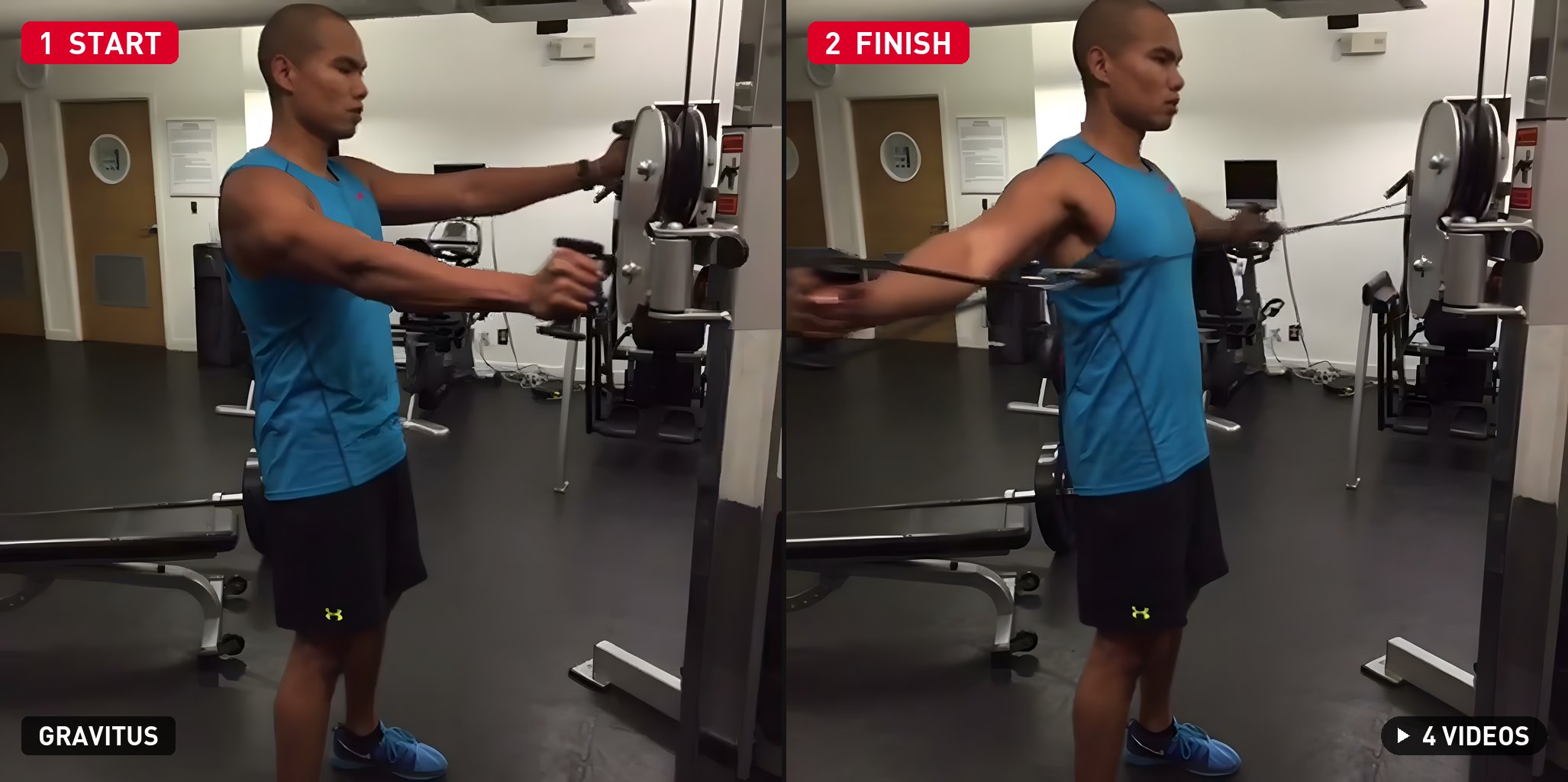
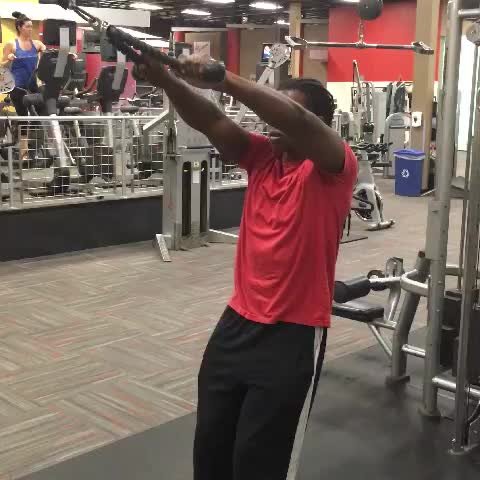
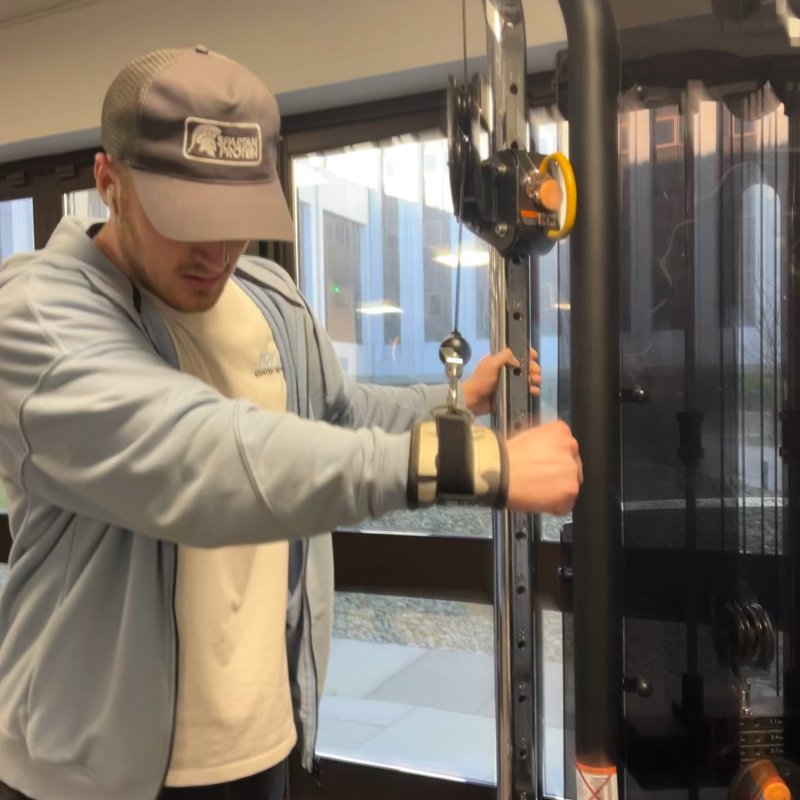
- 1Start. Pulleys at shoulder height, each hand holding the opposite cable. Arms in front of your chest with a slight bend in your elbows.
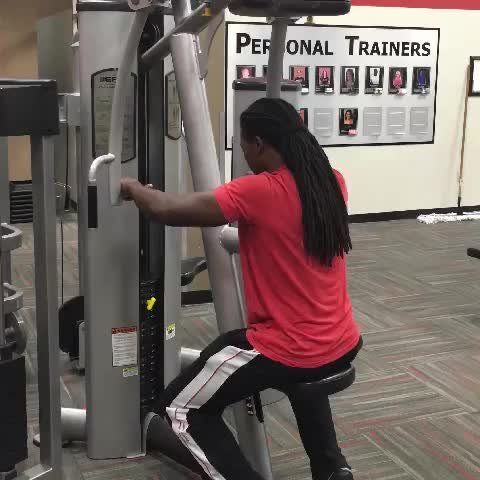
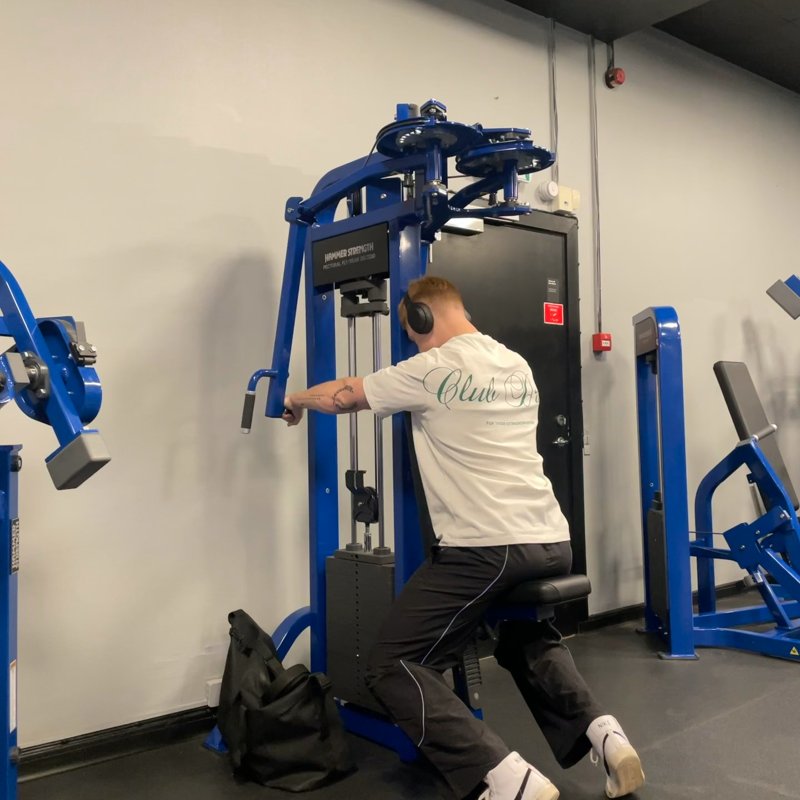
- 2Finish. Open your arms out to the sides until they line up with your body, then let them come back across under control.
Watch 3 video demonstrations
How to do a cable reverse fly
- Set both pulleys at shoulder height and clip a D handle to each, or hold the cable balls without handles.
- Take the left cable in your right hand and the right cable in your left, so the cables cross in front of your chest.
- Step one or two steps back from the line of the towers, until the weights lift with your arms reaching forward. Stand tall and set a slight bend in your elbows that stays the same all set.
- Open your arms out and back in a wide arc at shoulder height, until they line up with your body. Keep your shoulders down, away from your ears.
- Let your arms come back across over 2 to 3 seconds, without letting the plates touch.
Where you stand changes the reverse fly
A cable pulls with the same force all rep, but not with the same leverage. Your shoulder feels it most when the cable runs at a right angle to your arm, so where the pulleys sit relative to you moves the hardest part of the rep. The curves are modelled for pulleys at shoulder height, crossover towers 3 m (10 ft) apart and arms reaching 65 cm (26 in) from the shoulder, each scaled to its own hardest point.
On a crossover station, stand one or two steps behind the towers so the finish keeps some load. For the most even rep, use both pulleys on one tower. Which part of the rep is hardest matters less than going close to failure: over 10 weeks, the rear delts grew with a reverse fly machine set hardest at the stretch or hardest at the squeeze, with no clear difference (Jones 2025, a preprint).
How much weight should you use for cable reverse flys?
On Gravitus, the median man lifts 30 lb (13 kg) per side for 10 reps on the cable reverse fly, and the median woman 22.5 lb (10 kg).
- Most lift
- 20 to 45 lb
- Top 10% lift
- 70 lb or more
- Starting out
- under 20 lb
- Most lift
- 20 to 37.5 lb
- Top 10% lift
- 55 lb or more
- Starting out
- under 20 lb
- Most lift
- 9 to 20 kg
- Top 10% lift
- 32.5 kg or more
- Starting out
- under 9 kg
- Most lift
- 9 to 17 kg
- Top 10% lift
- 25 kg or more
- Starting out
- under 9 kg
Reverse cable fly muscles worked
Pulley height, grip and body position
Pulley height changes the traps more than the rear delts. In a band pull-apart study, pulling on a path angled up drew more upper and lower trap activity than a path angled down, and pulling level or up drew about 30% more middle trap activity than pulling down, with no clear difference in rear delt activity between paths (Fukunaga 2022). Grip is a small effect: on a reverse fly machine, thumbs up drew more rear delt and infraspinatus activity than palms down (Schoenfeld 2013), while with a band palms down drew the most rear delt activity (Fukunaga 2022).
How far back to go
Stop when your arms line up with your body, in a T. That is where each rep ended in the reverse fly machine study (Schoenfeld 2013).
The rear delts move your upper arm. The middle traps and rhomboids move your shoulder blades. Past the line of your body, most of the extra movement comes from pinching your shoulder blades together, so that last part of the rep is upper back work. Standing between the towers, the cable also runs along your arms by then, so there is little load left to pull against.
At the front of the rep, let your hands cross in front of your chest until you feel a stretch across the back of your shoulders.
For rear delts, keep your arms at shoulder height, let your shoulder blades stay wide and stop with your arms in line with your body. For the upper back, finish by pinching your shoulder blades together and hold for a second.
Constant tension, crossing the cables and other myths
Five claims most reverse cable fly guides repeat, including our old one:
- Cables give constant tension. The stack pulls with the same force, but its leverage on your shoulder changes through the rep. Standing between the towers, the rep is hardest with your arms in front and has almost no load with your arms out to the sides, as the chart above shows.
- Crossing the cables is optional. On a crossover station, holding each cable on its own side puts the pulleys outside your hands. For the first three quarters of the rep the cable then pulls your arms open instead of resisting them, so the rear delts have little to work against. Cross them. On one tower with the pulleys close together, it matters much less.
- Squeeze your shoulder blades together to hit the rear delts. The rear delts move the arm, not the shoulder blades. A hard squeeze at the end trains the middle traps and rhomboids, which is useful, but it is upper back work.
- Higher pulleys hit the rear delts harder. In the band study, the angle of the pull changed trap activity, not rear delt activity (Fukunaga 2022).
- The rear delts need high reps. No study we found shows this. Sets taken close to failure build muscle across a wide range of reps (Schoenfeld 2021), and the 10-week reverse fly study used 8 to 12 (Jones 2025).
Cable reverse fly vs rear delt machine vs face pull
| Attribute | Cable reverse fly | Rear delt machine | Face pull |
|---|---|---|---|
| Movement | Straight arms open wide | Straight arms open wide | Pull, then rotate out |
| Hardest point | Set by where you stand | Set by the machine | Set by pulley height and stance |
| Balance needed | Some, standing | None, chest on a pad | Some, standing |
| Best for | Choosing the angle, one arm at a time | Taking sets to failure safely | Rear delts and external rotators together |
No study has compared the three for growth. Straight-arm reverse flys on a machine grew the rear delts over 10 weeks (Jones 2025), and the cable version is the same movement with the angle up to you. Add face pulls to train the external rotators too.
Sets, reps and progression
Stop each set 0 to 2 reps short of failure. Sets taken close to failure build muscle across a wide range of reps (Schoenfeld 2021), so 10 to 15 is a range, not a rule. In the 10-week study, 4 to 5 sets of 8 to 12 reps to failure, twice a week, grew the rear delts (Jones 2025).
Do cable reverse flys near the end of a pull or shoulder day, or first if your rear delts lag.
Add reps before weight. Pin jumps of 5 to 10 lb are big for a small muscle. When every set reaches 15 from the same spot on the floor, move up one pin and drop back to 10.
Common mistakes
-
Holding each cable on its own sideOn a crossover station the cable pulls your arms open for most of the rep. Take each cable in the opposite hand.
-
Standing in line with the towersThe finish goes slack as the cable lines up with your arms. Step one or two steps back.
-
ShruggingYour upper traps take over. Keep your shoulders down and your arms at shoulder height.
-
Bending and straightening the elbowsThe fly turns into a row and your arms do the work. Set a slight bend and keep it.
-
Pulling past your bodyThe extra range is mostly your shoulder blades pinching. For rear delts, stop with your arms in line with your body.
-
Leaning backYour body weight moves the stack. Stand still, or stagger your feet, and go lighter.
Cable reverse fly variations
Questions people ask
What muscles does the reverse cable fly work?
The rear delts, with the middle traps, rhomboids and rotator cuff helping. The side delts hold your arms up and your core keeps you still.
Are reverse flys push or pull?
Pull. You pull your arms out and back, and the rear delts and upper back do the work, so they fit on pull day or shoulder day.
What pulley height should I use for cable reverse flys, and should the cables cross?
Shoulder height, and yes. On a crossover station, uncrossed cables pull your arms open for most of the rep. Arms that travel higher add trap work, not rear delt work (Fukunaga 2022).
Should I do reverse cable flies standing or seated?
Standing is the default. Seated on a bench, your legs and hips cannot help, which suits strict sets. Bent over with low pulleys loads the top of the rep more but asks more of your lower back.
What's more effective for my rear delts, face pulls or reverse cable flies?
No study has compared them for growth. The reverse fly trains the rear delts through a longer arc. The face pull adds external rotation for the rotator cuff. Many programs use both.
Should I keep my arms straight or bent during reverse cable flies?
Nearly straight, with a slight bend that stays the same all set. More bend makes the same pin feel lighter, and bending and straightening mid-rep turns the fly into a row.
How much weight should I use for cable reverse fly?
For 10 reps, the median on Gravitus is 30 lb (13 kg) per side for men and 22.5 lb (10 kg) for women. The strongest quarter lifts 45 lb (20 kg) and 37.5 lb (17 kg) or more.
Log every set and see your percentile on every lift, cable reverse fly included.
Get Gravitus