How to Do Face Pulls
A face pull is a cable exercise for the rear delts and the rotator cuff. Pull a rope from a pulley at face height to your forehead, elbows high, and finish with your hands rotated up beside your ears. It also trains the middle traps and rhomboids. Most lifters do 3 to 4 sets of 10 to 20 reps.
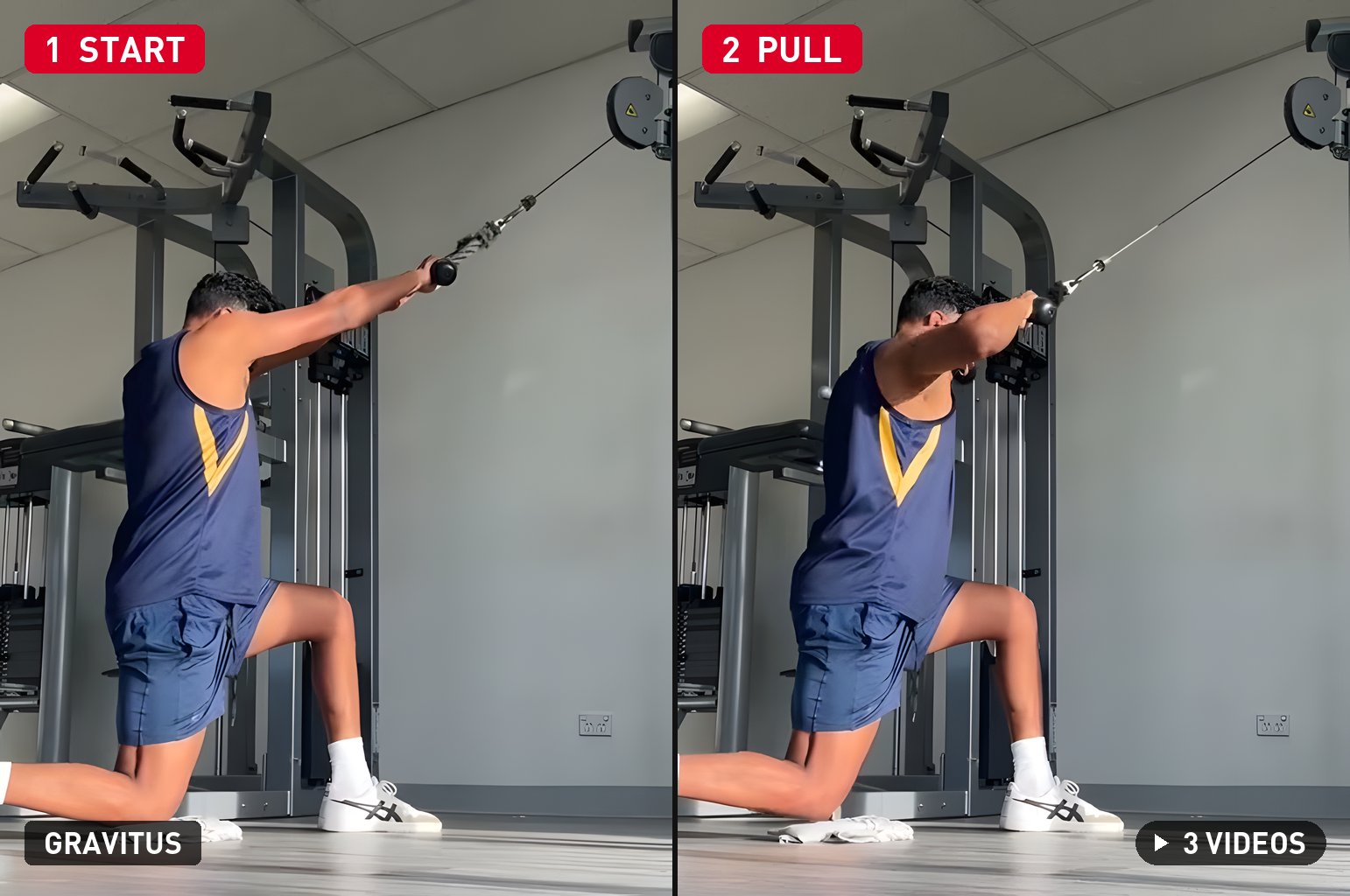
- 1Start. Rope on a pulley at face height or higher. Stand or half-kneel facing the stack with your arms straight and your thumbs pointing back toward you.
- 2Pull. Pull the rope to your forehead with your elbows high and wide, and finish with your hands beside your ears, higher than your elbows.
Watch 3 video demonstrations
Find more video demonstrations in the Gravitus app
How to do a face pull
- Clip a rope to a cable pulley set at face height or a little higher.
- Hold the rope with your palms facing each other and your thumbs pointing back toward you. Step back until the weight lifts off the stack and your arms are straight.
- Stand tall with your feet staggered or shoulder-width apart, or half-kneel. Keep your shoulders down, away from your ears.
- Pull the rope toward your forehead, leading with your elbows. Keep them high and wide, at about shoulder height.
- As the rope reaches your face, pull the ends apart and rotate your hands up and back. Finish with your hands beside your ears and your knuckles higher than your elbows. Hold for a second.
- Let your arms straighten over 2 to 3 seconds, without letting the plates touch.
Which pulley height to use
The stack pulls along the cable, but at the finish only the level part of that pull works the rear delts and tries to turn your forearms forward, which your external rotators resist. The rest pulls your arms up or down. With the cable tilted 30 degrees, 87% of the weight still trains the target muscles. At 45 degrees, 71% does. A higher pulley does not add rotator cuff work: with your forearms upright at the finish, the upward part of the pull runs along them and turns nothing. Set the pulley at face height or a little above, and stand far enough back that the cable is close to level when your hands reach your face.
How much weight should you use for face pulls?
On Gravitus, the median man lifts 65 lb (30 kg) for 10 reps on the face pull, and the median woman 45 lb (20 kg).
- Most lift
- 45 to 100 lb
- Top 10% lift
- 130 lb or more
- Starting out
- under 45 lb
- Most lift
- 32.5 to 70 lb
- Top 10% lift
- 90 lb or more
- Starting out
- under 32.5 lb
- Most lift
- 20 to 45 kg
- Top 10% lift
- 60 kg or more
- Starting out
- under 20 kg
- Most lift
- 15 to 32.5 kg
- Top 10% lift
- 40 kg or more
- Starting out
- under 15 kg
Muscles worked
Do face pulls protect your shoulders?
The evidence is indirect. No trial has tested face pulls for shoulder pain, injury or posture. What the research does show:
- Lifters with shoulder pain had weaker external rotators. Weight trainers with shoulder impingement had weaker external rotators and lower traps than weight trainers without it (Kolber 2017). That is an association, not proof that training those muscles prevents pain.
- Typical programs undertrain these muscles. Recreational lifters had more lopsided shoulder strength ratios than non-lifters. The authors point to programs that favor the chest and delts over the external rotators and lower traps (Kolber 2009).
- The face pull pattern works the right muscles. Its closest lab-tested relative, a prone raise with the arms out and rotated up, drew the most rear delt (88% of max) and supraspinatus (82%) activity of seven external rotation exercises (Reinold 2004). The same prone movement worked the middle and lower traps with little upper trap (Cools 2007).
- Posture is a weak target. A systematic review found moderate evidence of no difference in upper back rounding between people with and without shoulder pain (Barrett 2016).
Do face pulls to build the rear delts and external rotators that pressing-heavy programs train least. If your shoulder already hurts, they are a reasonable exercise to include, not a treatment on their own.
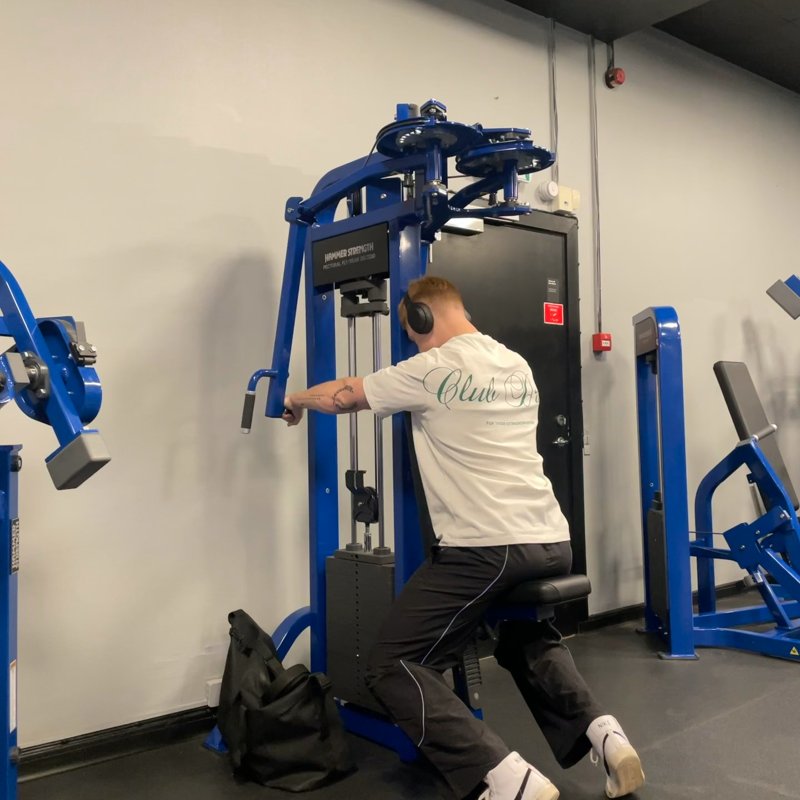
Face pull vs reverse pec deck vs band pull-apart
| Attribute | Face pull | Reverse pec deck | Band pull-apart |
|---|---|---|---|
| Movement | Pull, then rotate out | Straight arms open wide | Straight arms open wide |
| External rotation | Yes at the finish | False | Only with palms up |
| Load | Cable stack, same all rep | Machine stack | Band, hardest at the end |
| Best for | Rear delts and external rotators together | Rear delts close to failure | Warm-ups, training at home |
Close to a tie for the rear delts. In a model of 10 men, the standing face pull and the bent-over dumbbell raise produced the same rear delt force, both more than a dumbbell row (Zhu 2025). Pick the face pull to train the external rotators too, and the pec deck to take the rear delts close to failure.
Sets, reps and progression
Do face pulls after your main presses and rows, or as part of a warm-up with a light weight. Stop each set 0 to 2 reps short of failure. Sets taken close to failure build muscle across a wide range of reps (Schoenfeld 2021), so pick a weight you can hold at the finish for a second.
Stack jumps of 5 to 10 lb are big for the rear delts. Add reps first: when every set reaches the top of your range, move up one pin and drop back to the bottom of the range.
Common mistakes
-
Elbows droppingThe face pull turns into a row and the lats take over. Keep your elbows at about shoulder height.
-
Skipping the rotationStopping with your hands in front of your chin leaves out the external rotators. Finish with your hands beside your ears, higher than your elbows.
-
Leaning backYour body weight moves the stack, and the lean tilts the cable like a lower pulley. Stand still and go lighter.
-
ShruggingYour upper traps take over. Keep your shoulders down, away from your ears.
-
Standing under a high pulleyThe cable runs steeply up and your lats take the load. Step back until the cable is close to level at the finish.
-
Letting the stack pull you forwardThe weight is too heavy. Drop a pin and let your arms straighten over 2 to 3 seconds.
Face pull variations
Questions people ask
Are face pulls good for rotator cuff?
They train the infraspinatus and teres minor, the rotator cuff muscles that turn the arm out, along with the rear delts. No trial has tested face pulls for cuff injuries. Weight trainers with shoulder impingement had weaker external rotators than those without (Kolber 2017).
Are face pulls for the shoulders or back?
Both. The rear delts and rotator cuff are shoulder muscles, and the middle traps and rhomboids are upper back muscles. Most programs put face pulls on pull or shoulder day.
What pulley height should I use for face pulls?
Face height or a little above, with the cable close to level when your hands reach your face. A higher pulley makes your lats work, and a lower one makes your side delts and upper traps work.
What grip should I use for face pulls?
Palms facing each other on the rope, thumbs pointing back toward you. On a reverse fly machine, a neutral grip drew more rear delt and infraspinatus activity than palms down (Schoenfeld 2013).
Do face pulls fix rounded shoulders?
No study shows that they do. Upper back rounding also showed no clear link to shoulder pain in a systematic review (Barrett 2016). Train face pulls for the rear delts and rotator cuff, not to change your posture.
Am I supposed to lean back on face pulls?
No more than a few degrees. Leaning back lets your body weight move the stack and tilts the cable like a lower pulley. Stagger your feet or half-kneel to stay still.
How much weight should I use for face pulls?
For 10 reps, the median on Gravitus is 65 lb (30 kg) for men and 45 lb (20 kg) for women. The strongest quarter lifts 100 lb (45 kg) and 70 lb (32.5 kg) or more.
Log every set and see your percentile on every lift, face pull included.
Get GravitusRelated exercises
- Reinold et al. 2004. J Orthop Sports Phys Ther 34(7):385-394.
- Cools et al. 2007. Am J Sports Med 35(10):1744-1751.
- Kolber et al. 2017. J Strength Cond Res 31(4):1024-1032.
- Kolber et al. 2009. J Strength Cond Res 23(1):148-157.
- Barrett et al. 2016. Man Ther 26:38-46.
- Zhu et al. 2025. Acta Bioeng Biomech 27(4):135-147.
- Schoenfeld et al. 2013. J Strength Cond Res 27(10):2644-2649.
- Fukunaga et al. 2022. Int J Sports Phys Ther 17(3):400-408.
- Schoenfeld et al. 2021. Sports 9(2):32.