How to Do a Machine Row
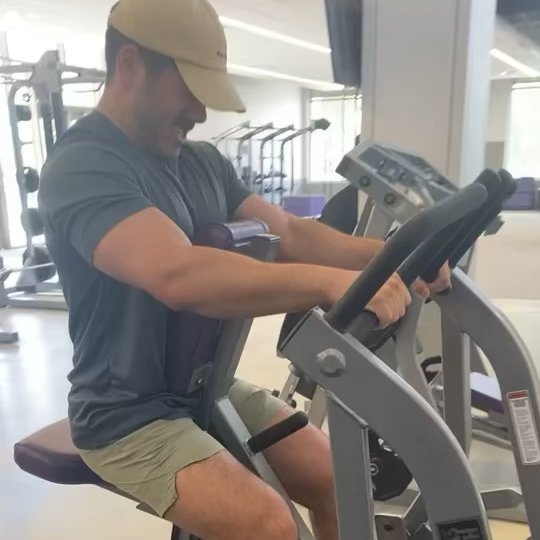
A machine row is a seated row on a plate-loaded or weight-stack machine, usually with a chest pad. Set the seat so the handles meet your lower chest, then pull them to your torso with your elbows close. It trains the lats, mid traps, rhomboids and rear delts. Most lifters do 3 to 4 sets of 8 to 12 reps.
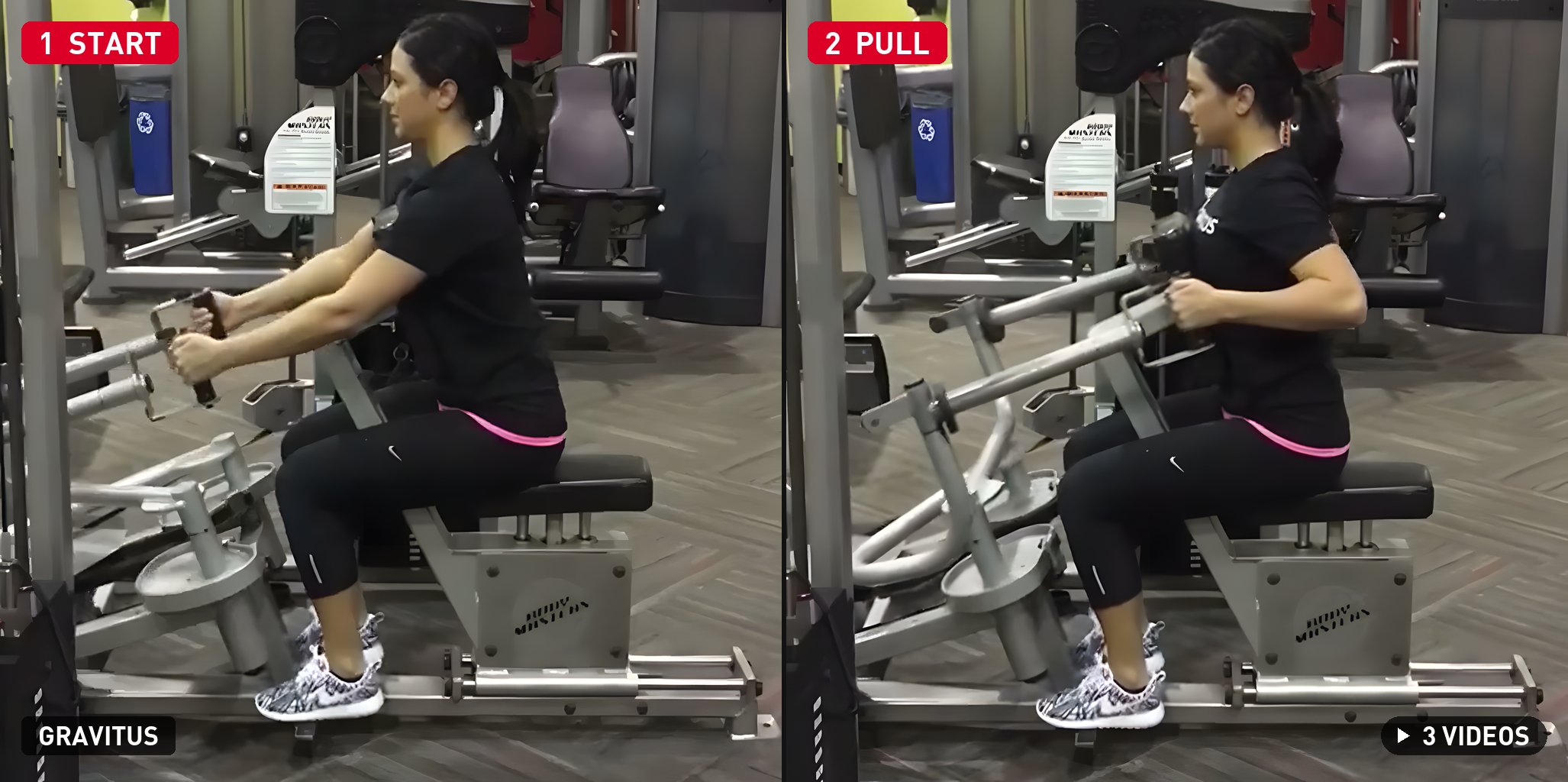
- 1Start. Seat set so the handles meet your lower chest. Feet planted, arms straight and shoulder blades reaching forward.
- 2Pull. Sit tall and drive your elbows back until the handles reach your torso, then let them go forward under control.
Watch 3 video demonstrations
Find more video demonstrations in the Gravitus app
How to do a machine row
- Set the seat so the handles line up with your lower chest when you sit tall. On a plate-loaded machine, put the same plates on both arms.
- Set the chest pad so your arms are straight when you hold the handles with your chest on the pad. Plant your feet on the floor or the footplate.
- Take the vertical handles with your palms facing each other. Let your shoulder blades slide forward at the start.
- Drive your elbows back along your sides until the handles reach your torso. Keep your chest on the pad and your shoulders down.
- Let the handles go forward over 2 to 3 seconds until your arms are straight, without letting the plates or the stack touch down.
How to set the seat and chest pad
| Attribute | Seat low | Seat in the middle | Seat high |
|---|---|---|---|
| Handles meet your | Upper chest | Lower chest | Stomach |
| Elbows travel | Out, near shoulder height | Partway out, 30 to 45 degrees | Close to your sides |
| Works most | Upper and middle traps, rear delts | Lats and mid back | Lats |
| Use it for | Upper back days | Your default setting | Lat focus, the heaviest weight |
The handles stay where the machine puts them, so the seat decides where they meet your torso and how high your elbows travel. Start with the handles at your lower chest. Elbows kept close to the body produced the most force and the most lat activity, while flaring them 60 to 90 degrees shifted the work to the traps and rear delts (Vasconcelos 2023). Then set the chest pad for reach: your arms should be straight at the start with your chest touching the pad. If you have to lift off the pad to reach the handles, move it closer. If your arms stay bent at the start, move it back.
Which handles to use
On a row machine the handle mostly decides where your elbows can go. Pick vertical handles for the lats and overhand handles for the upper back. If the handles do not suit you, move the seat: a higher seat brings the elbows closer to your sides on any grip. For more on elbow angle in a free-path row, see the seated cable row.
Plate-loaded vs stack machine vs cable row
| Attribute | Plate-loaded lever row | Stack row machine | Seated cable row |
|---|---|---|---|
| Loaded with | Plates on each arm | A pin in a weight stack | A pin in a weight stack |
| Arms | Usually independent, each arm moves alone | Linked or independent, by model | One handle, both hands together |
| Chest pad | True | Usually | No, your lower back holds you upright |
| Weight number | Plates only, the arms add their own weight | The pin, after the maker's pulleys and cams | The pin, after the pulley |
| Best for | Heavy rows, one arm at a time | Fast weight changes and drop sets | Changing handles and elbow path |
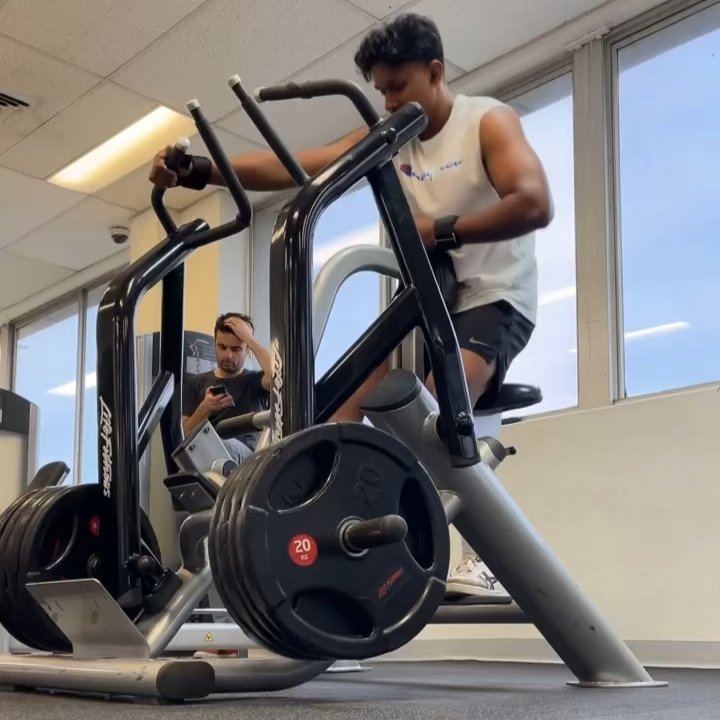
Use the machine your gym has; the row is the same. A plate-loaded lever like the Hammer Strength Iso-Lateral Row has two arms that move separately, so each side does its own share (Life Fitness). Many stack machines now do the same, like the Life Fitness Insignia Row with its independent diverging arms (Life Fitness). A cable row gives you the most handle choices but no chest pad; see the chest-supported row for other padded options.
How much weight should you machine row?
On Gravitus, the median man lifts 130 lb (60 kg) for 10 reps on the machine row, and the median woman 65 lb (30 kg).
- Most lift
- 100 to 175 lb
- Top 10% lift
- 215 lb or more
- Starting out
- under 100 lb
- Most lift
- 50 to 85 lb
- Top 10% lift
- 110 lb or more
- Starting out
- under 50 lb
- Most lift
- 45 to 77.5 kg
- Top 10% lift
- 97.5 kg or more
- Starting out
- under 45 kg
- Most lift
- 22.5 to 40 kg
- Top 10% lift
- 50 kg or more
- Starting out
- under 22.5 kg
Muscles worked
Three machine row claims the research does not back
- Machines build less muscle than free weights. In a meta-analysis of studies lasting 6 weeks or more, machine and free-weight training built muscle about equally. Strength gains were specific: each group improved most on the kind of lift it trained (Haugen 2023).
- A machine keeps the same tension through the rep. A plate-loaded lever pulls hardest where the plates sit furthest out from the pivot, and that changes as the arm swings. A stack machine's feel is set by its cams and pulleys. That is why two row machines feel different at the same number.
- Rowing one arm at a time loads your lower back more. It loads it less. In trained men, lower back muscle activity in one-arm machine and cable rows was 60 to 78% of the two-arm version, while the obliques worked more than twice as hard to stop the twist (Saeterbakken 2015).
Sets, reps and progression
Use the machine row as the main row on a pull day, or after a vertical pull like the lat pulldown. The chest pad takes the lower back out of the job, so it also fits the day after heavy deadlifts. Stop each set 0 to 2 reps short of failure. Sets taken close to failure build muscle across a wide range of reps (Schoenfeld 2021), so pick a range you can keep strict.
Add reps before weight. When every set reaches 12 with your chest on the pad, add the smallest plate to each arm or move up one pin, and drop back to 8. Keep the seat and pad notches the same, or the new number means nothing.
Common mistakes
-
Seat too lowThe handles meet your upper chest, your elbows ride up and your shoulders shrug. Raise the seat until the handles line up with your lower chest.
-
Chest pad too far awayYou lift your chest off the pad to reach the handles, and your lower back takes over. Move the pad closer.
-
Chest pad too closeYour arms never straighten, so you lose the stretch at the start. Move the pad back until your arms are straight.
-
Leaning back to finishYour chest leaves the pad and your hips swing the weight. Keep your chest on the pad and go lighter.
-
One arm leadingOn independent arms your stronger side finishes first. Pull both handles at the same pace, or row one arm at a time.
-
Letting the weight crashReturn over 2 to 3 seconds without letting the plates or the stack touch down.
Machine row variations
Questions people ask
What are machine rows?
A seated back exercise on a plate-loaded or weight-stack machine, usually with a chest pad in front of you. You pull the handles to your torso. It is not the rowing machine, or erg, used for cardio.
What does machine row target?
The lats, middle and lower traps and rhomboids, with the rear delts and biceps helping. Vertical handles with your elbows close favor the lats. Overhand handles with your elbows out favor the traps and rear delts (Vasconcelos 2023).
How high should the chest pad be on a row machine?
Set the seat so the handles meet your lower chest, then set the pad so your arms are straight at the start with your chest on it. Your chin should clear the top of the pad. If your elbows ride up toward your shoulders, raise the seat.
Should I use neutral or overhand grip on row machine?
Neutral for the standard row. Your elbows stay close, which gives the most force and lat activity. Use overhand handles when you want more upper back and rear delt work, and expect to lift less (Vasconcelos 2023).
Is the machine row better than the seated cable row?
Neither is better overall. The machine row's chest pad holds your torso still, and many machines let each arm move on its own. The cable row lets you change handles and set your own elbow path, but your lower back holds you upright.
How much weight should I machine row?
For 10 reps, the median on Gravitus is 130 lb (60 kg) for men and 65 lb (30 kg) for women. The strongest quarter lifts 175 lb (77.5 kg) and 85 lb (40 kg) or more.
Log every set and see your percentile on every lift, machine row included.
Get GravitusRelated exercises
- Vasconcelos et al. 2023. Int J Strength Cond 3(1).
- Saeterbakken et al. 2015. Int J Sports Med 36(11):900-905.
- Haugen et al. 2023. BMC Sports Sci Med Rehabil 15(1):103.
- Schoenfeld et al. 2021. Sports 9(2):32.
- Life Fitness. Hammer Strength Plate-Loaded Iso-Lateral Row, product specifications.
- Life Fitness. Insignia Series Row, product specifications.