How to Do a Machine Fly
A machine fly, also called a pec fly or chest fly machine, is a seated chest fly. Set the seat so your elbows sit just below your shoulders, keep your back on the pad and bring the handles together in front of your chest. It trains the chest and front delts. Most lifters do 3 sets of 10 to 15 reps.
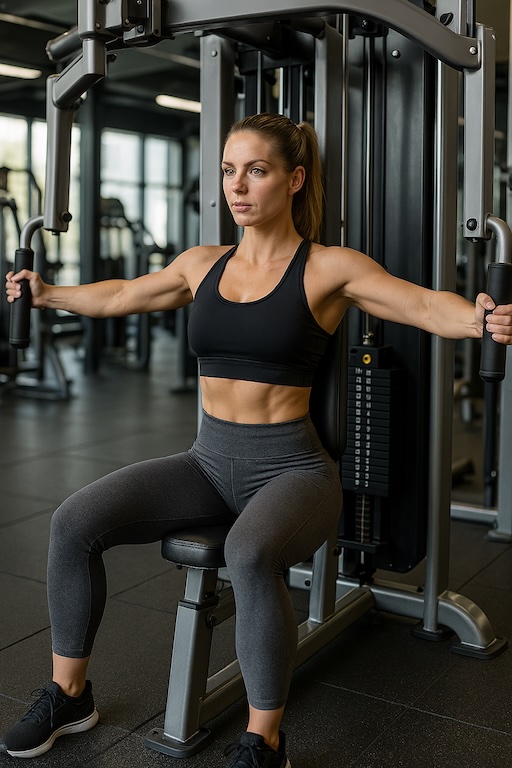
- 1Start. Back on the pad, elbows level with or just below your shoulders, arms wide with a soft bend.
- 2Squeeze. Sweep the handles together until they almost touch in front of your chest, then let them open slowly.
Watch 3 video demonstrations
Find more video demonstrations in the Gravitus app
How to do a machine fly
- Set the seat so that, holding the handles, your elbows sit level with or slightly below your shoulders. Your upper arms should slope down a little, never up.
- Set the start lever so the handles begin level with your chest or a little behind it, where you feel a stretch across your chest with your back still on the pad.
- Sit with your head, upper back and hips on the pad and your feet flat. Take the handles with a slight bend in your elbows.
- Bring the handles together in a wide arc until they almost touch in front of your chest. Squeeze for a second.
- Let them open over 2 to 3 seconds back to the stretch, without letting the plates touch.
Why arm bend works differently on a machine
On a fly machine each arm swings around a pivot above your shoulder. With your shoulders lined up under those pivots, the distance from your shoulder to the handle stays fixed, so the pin, not your arm, decides how hard the rep is. The Life Fitness instructions for its pec fly set the start position with overhead range-of-motion adjusters and have you keep your elbows slightly bent (Life Fitness manual). On a cable fly or a dumbbell fly, the bend is yours to choose, and it changes the load.
How much weight should you machine fly?
On Gravitus, the median man lifts 135 lb (60 kg) for 10 reps on the machine fly, and the median woman 55 lb (25 kg).
- Most lift
- 100 to 175 lb
- Top 10% lift
- 215 lb or more
- Starting out
- under 100 lb
- Most lift
- 40 to 70 lb
- Top 10% lift
- 90 lb or more
- Starting out
- under 40 lb
- Most lift
- 45 to 80 kg
- Top 10% lift
- 97.5 kg or more
- Starting out
- under 45 kg
- Most lift
- 18 to 32.5 kg
- Top 10% lift
- 40 kg or more
- Starting out
- under 18 kg
Machine fly muscles worked
Machine fly vs pec deck vs cable fly
| Attribute | Machine fly | Pec deck | Cable fly |
|---|---|---|---|
| You hold | Handles, arms nearly straight | Pads, elbows bent to 90 degrees | Two cable handles |
| Arm bend | Set by the machine | Set by the pads | Your choice, and it changes the load |
| Balance needed | None, back on a pad | None, back on a pad | Some, split stance |
| Best for | Heavy sets you can repeat | Chest work without the biceps | Choosing the angle |
Same muscle, same job. Many gyms use both names for one machine. The pec deck and bent-forward cable crossovers drew chest activity similar to the bench press (Schanke 2012). Log handle machines as a machine fly and forearm-pad machines as a pec deck, so your history stays on one exercise.
What the research says about machine flys
- "Machines build less muscle than free weights." A meta-analysis of studies lasting at least 6 weeks found no difference in muscle growth between machine and free-weight training (Haugen 2023).
- "The machine gives constant tension." The pin stays the same, but a cam or pulley decides how hard each part of the rep is, and brands differ. When eight cam knee extension machines from six makers were measured, their resistance through the rep varied widely and none matched the muscle's own strength curve (Folland 2008). Nobody has measured fly machines this way, so note where the rep gets hard on yours and keep the same start setting.
- "Straighter arms make the machine fly better than the pec deck." No study has compared them. On both machines the start lever, not your arm, sets how far you stretch.
- "Do flys first to pre-exhaust the chest." Pec deck flys right before a chest press did not raise chest activity during the press; the triceps worked harder instead (Gentil 2007).
Machine fly sets, reps and progression
Stop each set 0 to 2 reps short of failure. Sets taken close to failure build muscle across a wide range of reps (Schoenfeld 2021), so 10 to 15 is a range, not a rule. In untrained men, one hard set of pec deck flys grew the chest as much as three sets over 12 weeks (Pinto 2025), so 2 to 3 sets is plenty.
Put it where your priority is. In trained men doing 5 sets of each, the bench press got more reps when it came first and the machine chest fly got more reps when it came first; total reps were about the same (Senna 2019).
Add reps before weight. When every set reaches 15 with the same start setting, move up one plate and drop back to 10.
Common mistakes
-
Seat too lowYour elbows ride above your shoulders and the front delts take over. Raise the seat until your elbows sit just below your shoulders.
-
Shoulders coming off the padYour elbows fold and your shoulder blades start pushing. Keep your upper back on the pad, and go lighter if you cannot.
-
Start lever too far backThe stretch lands in the front of the shoulder instead of across the chest. Move it forward a notch.
-
Cutting the stretch shortStopping halfway open skips the stretched part of the rep. Open until the handles are level with your chest or just behind it.
-
Letting the stack touchResting the plates between reps unloads the stretch. Stop just short and start the next rep.
Machine fly variations
Questions people ask
What is a fly machine?
A seated machine with two swinging arms that you bring together in front of your chest. Gyms call it a machine fly, pec fly, chest fly machine or pec deck; the version with forearm pads is usually the pec deck.
Is machine fly push or pull?
Push. Your chest and front delts move your arms forward and across your body, so it belongs on push or chest day. The same machine set up for rear delts is a pull.
What muscles does the pec fly machine work?
The chest (pectoralis major), upper and lower portions, with the front delts helping. The biceps hold the slight bend in your elbows.
How high should chest fly machine be?
Set the seat so your elbows sit just below your shoulders when you hold the handles, as the Life Fitness pec fly instructions do. If your arms slope up toward the handles, raise the seat.
Is the machine fly better than the cable fly?
Not for growth. No study has compared the two, and machines and free weights built muscle equally in a meta-analysis (Haugen 2023). The machine is easier to set up the same way and take close to failure; cables let you choose the angle.
How much weight should I machine fly?
For 10 reps, the median on Gravitus is 135 lb (60 kg) for men and 55 lb (25 kg) for women. The strongest quarter lifts 175 lb (80 kg) and 70 lb (32.5 kg) or more.
Log every set and see your percentile on every lift, machine fly included.
Get GravitusRelated exercises
- Haugen et al. 2023. BMC Sports Sci Med Rehabil 15(1):103.
- Folland and Morris 2008. J Sports Sci 26(2):163-169.
- Pinto et al. 2025. J Strength Cond Res 39(5):523-530.
- Schanke 2012. MS thesis, University of Wisconsin-La Crosse.
- Gentil et al. 2007. J Strength Cond Res 21(4):1082-1086.
- Senna et al. 2019. J Hum Kinet 66:223-231.
- Schoenfeld et al. 2021. Sports 9(2):32.
- Life Fitness. Insignia Series owner's manual, Pectoral Fly / Rear Deltoid.