How to Do Cable Flys
A cable fly, also called a cable crossover, is a chest isolation exercise done between two pulleys. Hold a handle in each hand, keep a slight fixed bend in your elbows and sweep your hands together in a wide arc. It trains the chest, with the front delts helping. Most lifters do 3 sets of 10 to 15 reps.
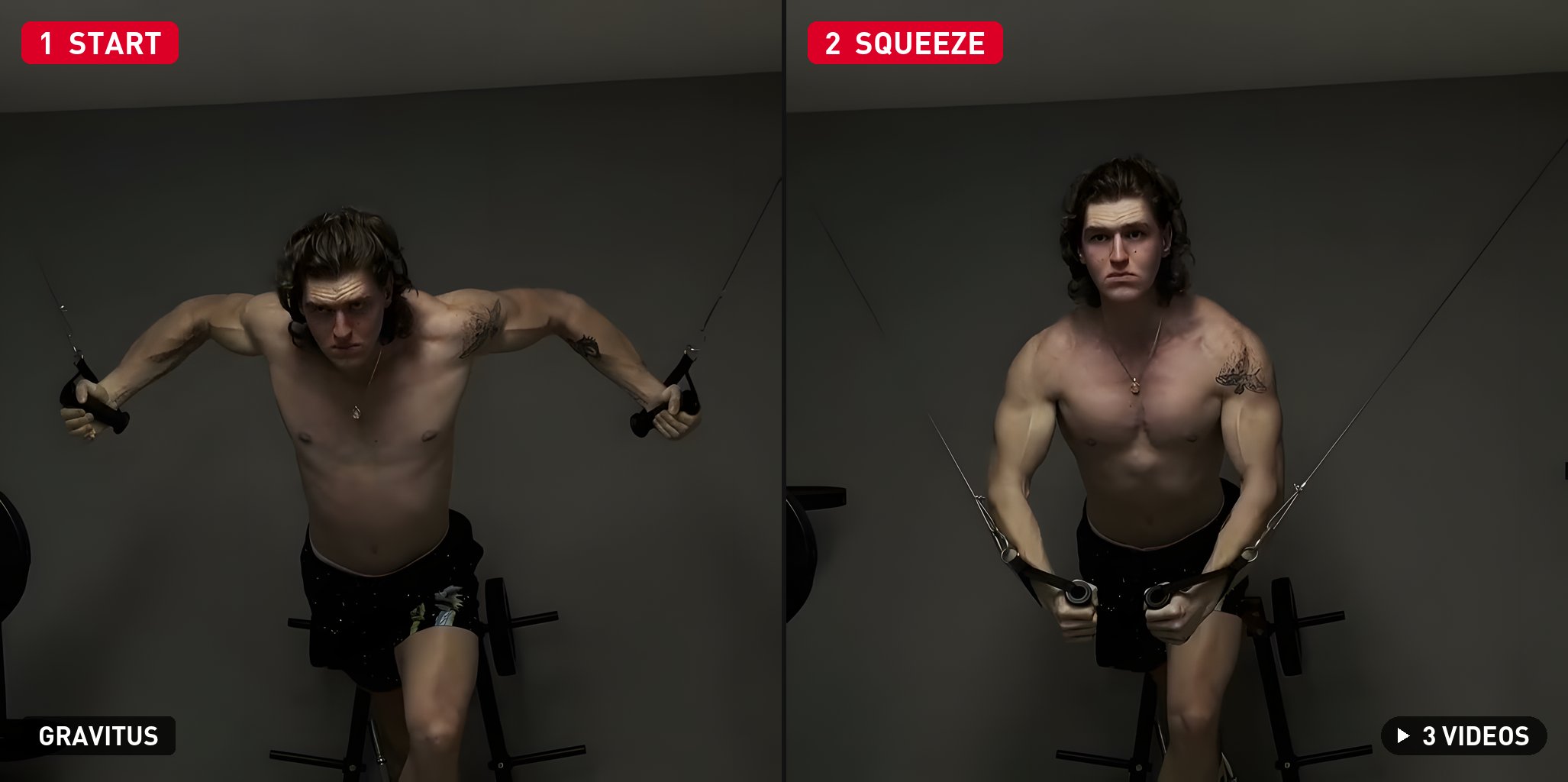
- 1Start. Pulleys set high, one foot forward, arms out wide with a slight bend in the elbows.
- 2Squeeze. Sweep your hands down and together in front of your hips, then let them open slowly.
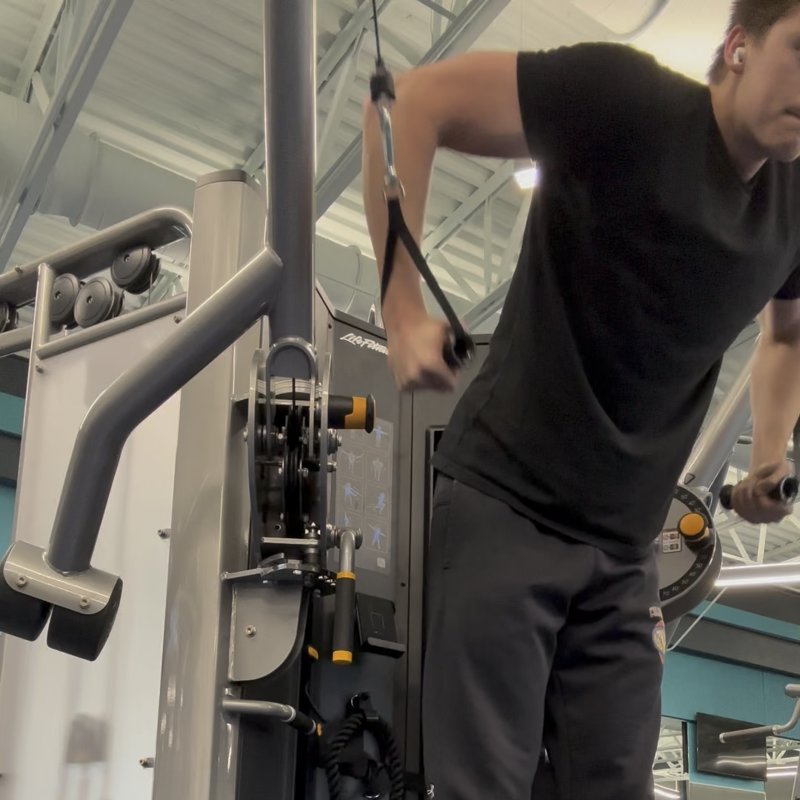
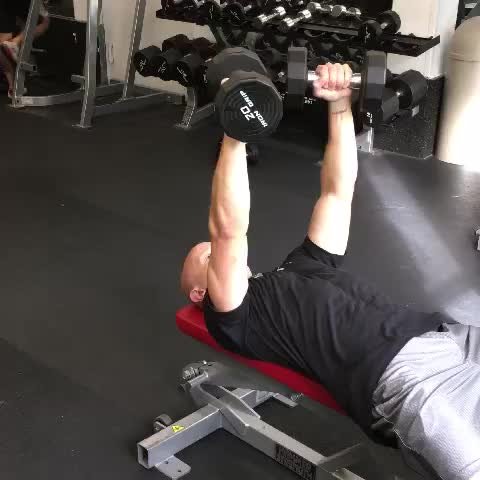
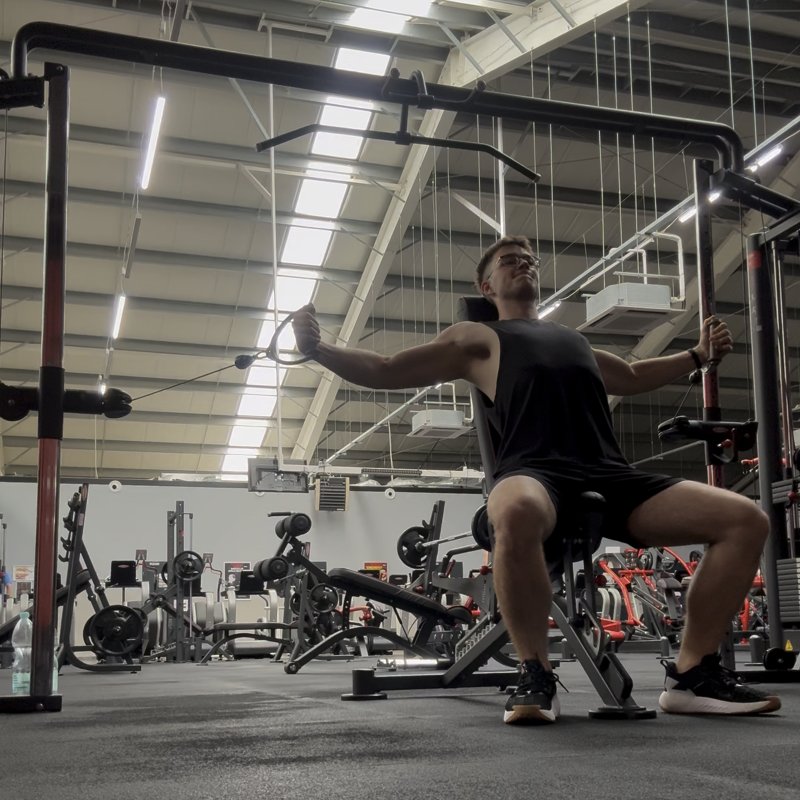
Watch 3 video demonstrations
Find more video demonstrations in the Gravitus app
How to do a cable fly
- Set both pulleys at shoulder height or a little above and clip a D handle to each.
- Take a handle in each hand and step forward into a split stance until both weights lift off the stacks with your arms out wide. Lean forward slightly from the hips.
- Unlock your elbows a little, palms facing forward. Keep that bend for the whole set.
- Sweep your hands together in a wide arc until they meet in front of your chest. Squeeze for a second.
- Let your arms open over 2 to 3 seconds until your hands are level with your shoulders and you feel a stretch across your chest.
Which pulley height to use
The fibers of the chest fan out from the collarbone to the lower ribs. The upper fibers work most when the arm lifts, the lower fibers when it pulls down, and the middle fibers when it moves straight across (Paton 1994). Pick the pulley height that matches the path.
How much weight should you cable fly?
On Gravitus, the median man lifts 45 lb (20 kg) per side for 10 reps on the cable fly, and the median woman 27.5 lb (12 kg).
- Most lift
- 30 to 65 lb
- Top 10% lift
- 100 lb or more
- Starting out
- under 30 lb
- Most lift
- 20 to 37.5 lb
- Top 10% lift
- 55 lb or more
- Starting out
- under 20 lb
- Most lift
- 14 to 30 kg
- Top 10% lift
- 45 kg or more
- Starting out
- under 14 kg
- Most lift
- 9 to 17 kg
- Top 10% lift
- 25 kg or more
- Starting out
- under 9 kg
Muscles worked
What the research says about cable flys
No study has measured the chest at different pulley heights on a cable fly. The high-to-low and low-to-high advice rests on two things that have been measured:
- Fiber direction. The upper fibers of the chest work most when the arm lifts, the lowest fibers when it pulls down from overhead, and the middle fibers when it moves across the body (Paton 1994).
- Incline pressing. Lifting the arm at an angle, as a low-to-high fly does, raises upper chest activity. Upper chest activity peaked at a 30 degree bench, and the middle and lower chest worked hardest flat (Rodríguez-Ridao 2020). Steeper inclines shifted work to the front delts (Trebs 2010). Over 8 weeks, incline pressing grew the upper chest more than flat pressing (Chaves 2020).
So a low-to-high fly is a reasonable way to add upper chest work, but a flat, mid-height fly already trains the whole muscle. Twelve weeks of pec deck flys grew the upper chest by 17 to 18% and the middle chest by 21% (Pinto 2025).
Two more claims to correct:
- Cables give constant tension. The weight on the stack stays the same, but its leverage on your shoulder changes with the angle between the cable and your arm. A dumbbell fly goes slack when your hands meet over your chest. A cable fly still pulls outward there, which is why the squeeze feels harder.
- It trains the pec minor. No fly study has measured it, and surface EMG cannot reach it. It pulls the shoulder blade forward, which the "shoulders back" cue works against.
Cable fly vs dumbbell fly vs pec deck
| Attribute | Cable fly | Dumbbell fly | Pec deck |
|---|---|---|---|
| Hardest point | Set by pulley height and stance | In the stretch, nothing at the top | Set by the machine |
| Angles | High, mid or low, one or two arms | Flat, incline or decline bench | One fixed path |
| Best for | Choosing the angle, load at the squeeze | Loading the stretch | Taking sets to failure safely |
All three train the whole chest. Bent-forward cable crossovers, the pec deck and the bench press drew similar chest activity (Schanke 2012). Pick the one you can keep adding weight or reps to.
Sets, reps and progression
Do cable flys after your presses. Stop each set 0 to 2 reps short of failure. Sets taken close to failure build muscle across a wide range of reps (Schoenfeld 2021), so pick a range you can keep strict. In untrained men, one hard set of pec deck flys grew the chest as much as three (Pinto 2025), so 2 to 3 sets after pressing is plenty.
Add reps before weight. When every set reaches 15 with the same elbow bend, move up one pin on each side and drop back to 10.
Common mistakes
-
Bending and straightening the elbowsThe fly turns into a press and the triceps take over. Set a slight bend at the start and keep it.
-
Rolling the shoulders forwardThe front delts take over at the squeeze. Keep your chest up and your shoulders down.
-
Letting the handles pull you backStop the stretch with your hands level with your shoulders. If the weight yanks your arms past that, go lighter.
-
Standing too close to the stacksThe weights touch down when your arms open. Step forward until they stay lifted at the widest point.
-
Rocking the torsoYour body weight moves the handles. Brace in a split stance and go lighter.
Cable fly variations
Questions people ask
Are cable flys push or pull?
Push. Your chest and front delts move your arms forward and across your body, the same muscles as the bench press, so it belongs on push day.
Is cable fly compound or isolation?
Isolation. Only the shoulder moves; your elbows stay fixed. That is why it works best after a compound press like the bench press.
Where should the height of the handle be for cable flys?
Start with the pulleys at shoulder height or a little above. Set them high to bias the lower chest and low to bias the upper chest. That advice comes from fiber direction and incline pressing studies (Paton 1994, Rodríguez-Ridao 2020); no study has tested pulley heights on the cable fly itself.
Is cable fly better than dumbbell fly?
No study has compared them for growth. The cable keeps pulling when your hands meet, where a dumbbell goes slack, and lets you change the angle. The dumbbell fly loads the stretch harder. Use the one you can progress.
What muscles does the cable fly work?
The chest (pectoralis major), with the front delts helping. The biceps hold the elbow bend, and the core holds your stance.
How much weight should I cable fly?
For 10 reps, the median on Gravitus is 45 lb (20 kg) per side for men and 27.5 lb (12 kg) for women. The strongest quarter lifts 65 lb (30 kg) and 37.5 lb (17 kg) or more.
Log every set and see your percentile on every lift, cable fly included.
Get GravitusRelated exercises
- Paton and Brown 1994. J Electromyogr Kinesiol 4(3):161-169.
- Rodríguez-Ridao et al. 2020. Int J Environ Res Public Health 17(19):7339.
- Trebs et al. 2010. J Strength Cond Res 24(7):1925-1930.
- Chaves et al. 2020. Int J Exerc Sci 13(6):859-872.
- Pinto et al. 2025. J Strength Cond Res 39(5):523-530.
- Schanke 2012. MS thesis, University of Wisconsin-La Crosse.
- Solstad et al. 2020. J Sports Sci Med 19(4):645-651.
- Schoenfeld et al. 2021. Sports 9(2):32.