How to Do Barbell Wrist Curls
A barbell wrist curl is a forearm exercise. Sit with your forearms on your thighs, palms up and wrists just past your knees, and curl a barbell by bending only at the wrists. It trains the wrist flexors on the palm side of your forearm, and the finger flexors too if you let the bar roll into your fingers. Most lifters do 3 sets of 12 to 20 reps.
How to do a barbell wrist curl
- Sit on the end of a flat bench with your feet flat and about hip-width apart.
- Hold the bar palms up, hands a little narrower than shoulder-width. Rest your forearms on your thighs so your wrists hang just past your knees.
- Lower the bar by letting your wrists bend back as far as is comfortable. For more range, let the bar roll down to your fingertips, then close your hands around it.
- Curl the bar up by bending only at the wrists, as high as you can without lifting your forearms off your thighs. Squeeze for a second.
- Lower over 2 seconds and repeat. Keep your forearms still for the whole set.
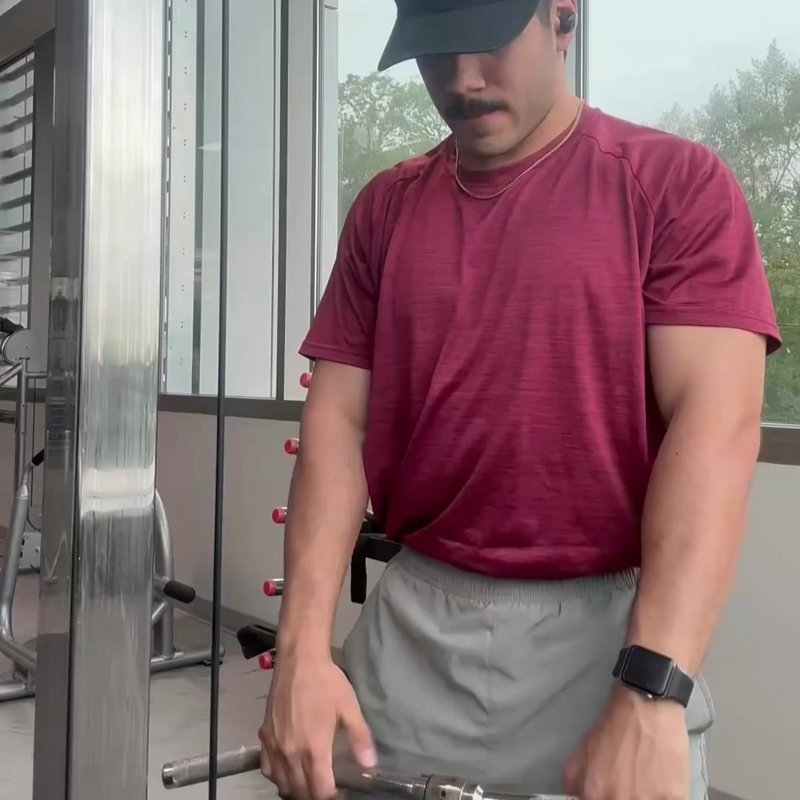
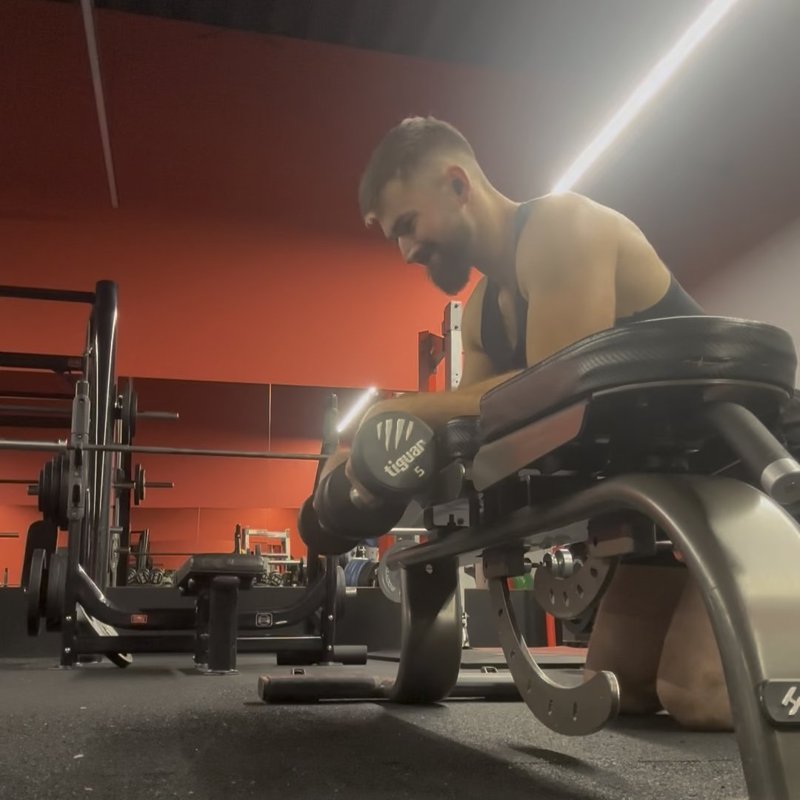
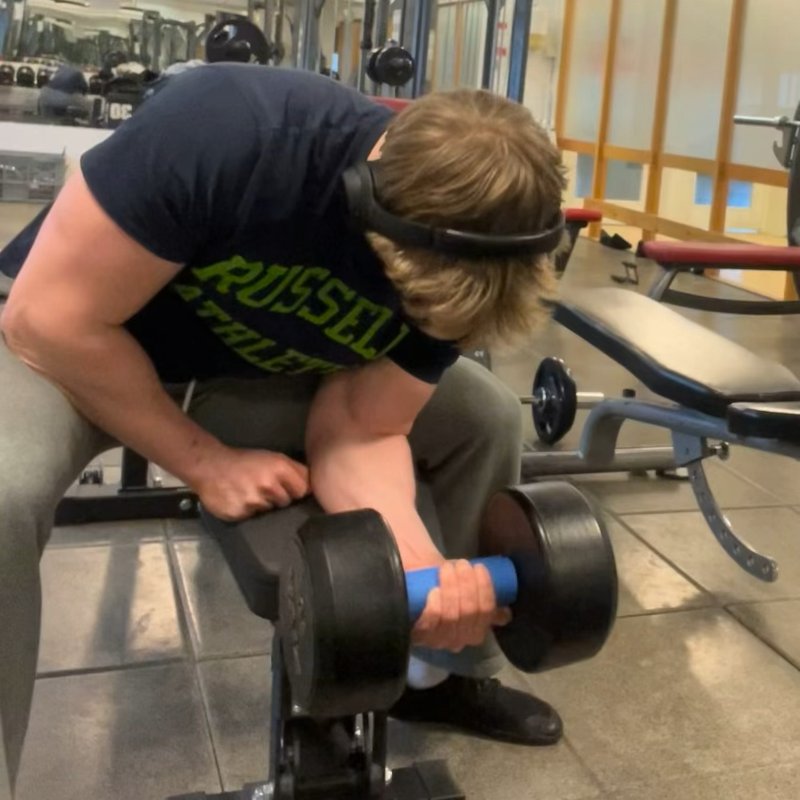
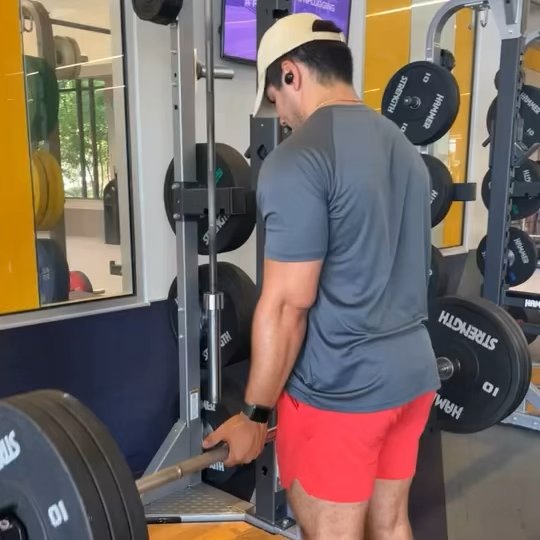
Wrist curl setups
No study has compared these setups. Pick the one where your forearms stay still and your wrists move through a full range.
How much weight should you wrist curl?
On Gravitus, the median man lifts 50 lb (22.5 kg) for 10 reps on the wrist curl.
- Most lift
- 35 to 75 lb
- Top 10% lift
- 100 lb or more
- Starting out
- under 35 lb
- Most lift
- 16 to 35 kg
- Top 10% lift
- 45 kg or more
- Starting out
- under 16 kg
What wrist curls do, and what they do not
Wrist curls grow the forearm flexors. In 14 men, 6 weeks of wrist-flexion training (5 sets of 8 at 70 to 80% of max, 3 times a week) made the wrist flexors thicker (Yamane 2015). In another study, 4 weeks of lowering-only wrist-flexion training made the trained wrist flexors 30.8% stronger and 7.1% thicker (Andrushko 2018).
Three common claims the research does not back:
- Wrist curls build grip strength. Not on their own. In 43 high school baseball players, adding wrist and forearm exercises to 12 weeks of lifting built more wrist and forearm strength than lifting alone, but no more grip strength (Szymanski 2004). For grip, train holding heavy things: deadlifts, rows, carries and hangs.
- Wrist curls are bad for your wrists. No study has linked them to wrist injury. Use a weight you can lower under control and a range that feels comfortable.
- Your forearms get enough work from pulling. For grip, maybe. But adding direct wrist and forearm work raised wrist strength more than a lifting program alone did (Szymanski 2004).
Muscles worked
Wrist curl vs reverse wrist curl vs reverse curl
| Attribute | Wrist curl | Reverse wrist curl | Reverse curl |
|---|---|---|---|
| Palms | Facing up | Facing down | Facing down |
| Joint that moves | Wrist | Wrist | Elbow |
| Works most | Wrist flexors, palm side | Wrist extensors, back of the forearm | Brachialis, brachioradialis, biceps |
| Best for | Palm-side forearm size | Back of the forearm, elbow rehab | Top of the forearm near the elbow |
For bigger forearms, do both wrist curls and reverse wrist curls, since they train opposite sides of the forearm. Add reverse curls or hammer curls for the brachioradialis, the muscle on top of the forearm near the elbow.
Sets, reps and progression
Do wrist curls at the end of a session, so tired forearms do not cost you grip on your main lifts. Stop each set 0 to 2 reps short of failure. Sets taken close to failure build muscle across a wide range of reps (Schoenfeld 2021). Both training studies above trained 3 times a week; 2 to 3 sessions a week is plenty.
A 5 lb (2.5 kg) jump is big for the wrists. Add reps first: when every set reaches 20, add the smallest plates you have and drop back to 12.
Common mistakes
-
Lifting your forearmsYour elbows and biceps take over. Keep your forearms pressed on your thighs or the bench.
-
Bouncing at the bottomLower over 2 seconds and pause before you curl back up.
-
Too heavy for the rangeIf you can only move the bar a few inches, go lighter and use your full range.
-
Losing the bar off your fingersOnly roll the bar as far as you can still close your hands on it. Go lighter until you can.
-
Rushing the repsThe muscles are small and tire fast. Slow, controlled reps beat fast ones.
Wrist curl variations
Questions people ask
What muscles do wrist curls work?
The wrist flexors on the palm side of your forearm. The finger flexors help, and work more if you let the bar roll to your fingertips.
What are the benefits of wrist curls?
Bigger, stronger wrist flexors. Six weeks of wrist-flexion training made the wrist flexors thicker (Yamane 2015), and 4 weeks of lowering-only training made them 30.8% stronger (Andrushko 2018). They need only a bar and a bench, and fit at the end of any session.
Do wrist curls make your forearms bigger?
Yes, on the palm side. Wrist-flexion training thickened the wrist flexors in two studies (Yamane 2015, Andrushko 2018). Add reverse wrist curls and reverse curls for the rest of the forearm.
Do wrist curls increase grip strength?
Not much on their own. Adding wrist and forearm exercises to a lifting program built more wrist strength but no more grip strength than lifting alone (Szymanski 2004). Heavy holds build grip.
Wrist curls vs reverse wrist curls, which should I do?
Both. Wrist curls train the flexors on the palm side and reverse wrist curls the extensors on the back of the forearm. Expect to use a lighter weight on reverse wrist curls.
Are reverse wrist curls good for tennis elbow?
Slow lowering of the wrist extensors is a common part of tennis elbow rehab. Adding a lowering-only wrist extension exercise to standard treatment cut pain and disability far more than standard treatment alone (Tyler 2010, which used a rubber bar), and a review of 12 studies supports eccentric exercise as part of treatment (Cullinane 2014). Start very light and lower slowly.
How often should you do wrist curls?
Two to three times a week. Both training studies on wrist flexors used 3 sessions a week (Yamane 2015, Andrushko 2018).
How much weight should I wrist curl?
For 10 reps, the median on Gravitus is 50 lb (22.5 kg) for men. The strongest quarter lifts 75 lb (35 kg) or more.
Log every set and see your percentile on every lift, wrist curl included.
Get GravitusRelated exercises
- Yamane, Ohnishi and Matsumoto 2015. Int J Sports Med 36(8):647-653.
- Andrushko et al. 2018. J Appl Physiol 124(4):866-876.
- Szymanski et al. 2004. J Strength Cond Res 18(3):432-440.
- Tyler et al. 2010. J Shoulder Elbow Surg 19(6):917-922.
- Cullinane, Boocock and Trevelyan 2014. Clin Rehabil 28(1):3-19.
- Schoenfeld et al. 2021. Sports 9(2):32.