How to Do Weighted Pull-Ups
A weighted pull-up is a strict pull-up with extra load, usually a plate on a dip belt. Add weight once 12 strict bodyweight reps feel easy, and start with 5 to 10 lb (2.5 to 5 kg). It trains the lats most, with the biceps and mid back. Most lifters do 3 to 4 sets of 5 to 10 reps.
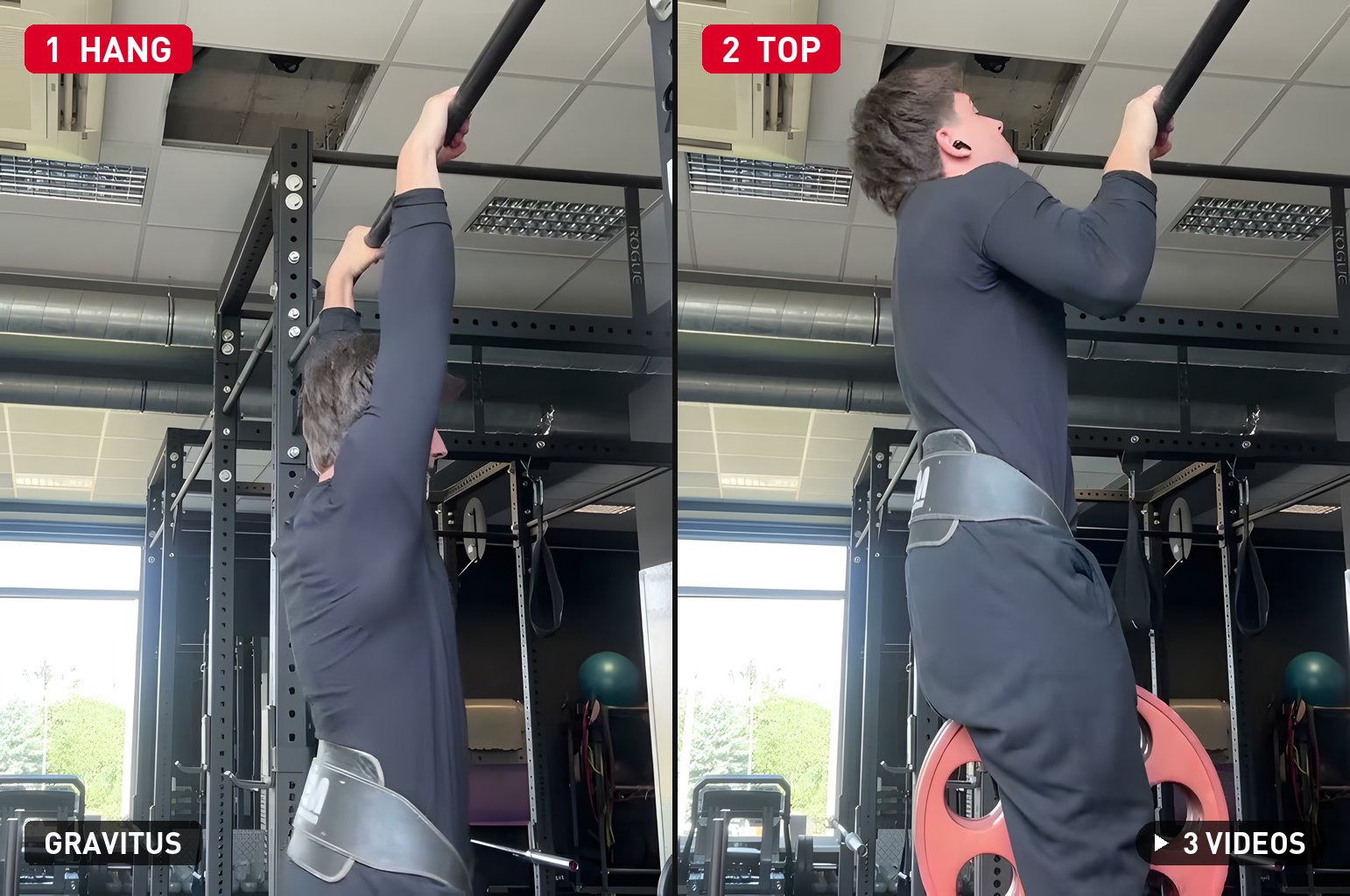
- 1Hang. Dip belt on with the plate hanging from the chain, arms straight, legs still.
- 2Top. Drive your elbows down until your chin clears the bar, then lower over 2 to 3 seconds.
Watch 3 video demonstrations
Find more video demonstrations in the Gravitus app
How to do a weighted pull-up
- Buckle the dip belt low on your hips, thread the chain through a plate and clip it back to the belt so the plate hangs at your thighs.
- Stand on a box under the bar, grab it palms away with your hands a little wider than your shoulders, then step off and let the plate settle before the first rep.
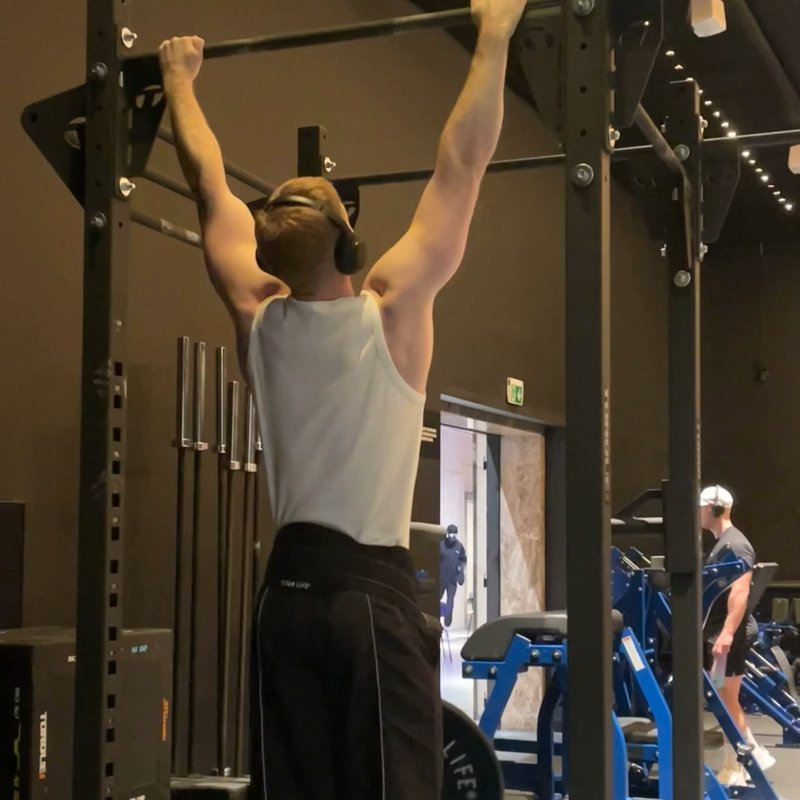
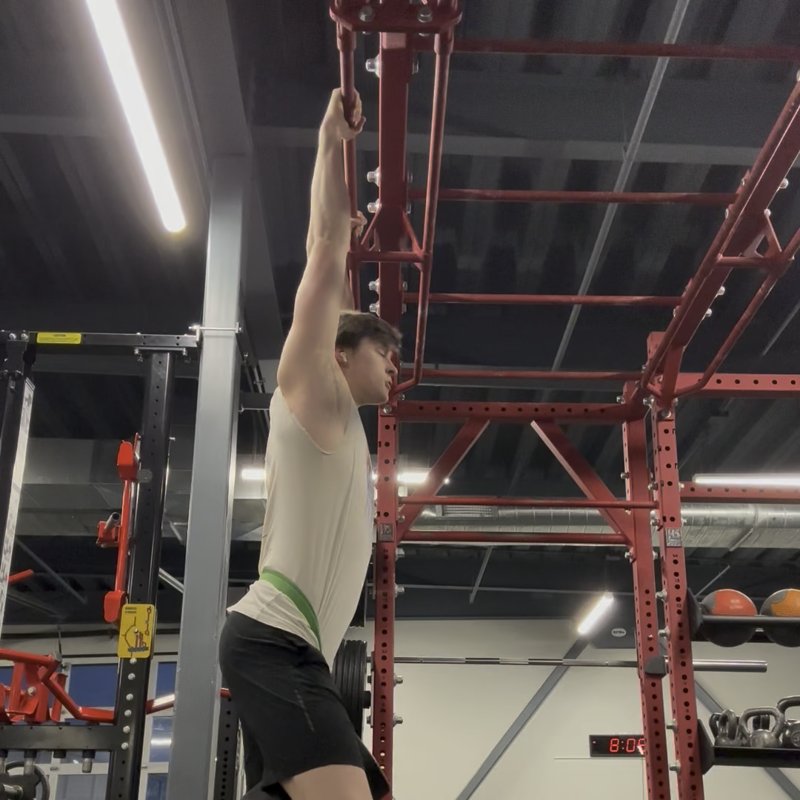
- Hang with straight arms. Squeeze your glutes and keep your legs still so the plate does not swing.
- Pull your shoulders down, away from your ears, then drive your elbows down to your sides until your chin clears the bar.
- Lower over 2 to 3 seconds to straight arms. Step back onto the box to unload instead of dropping with the plate.
Dip belt vs weighted vest vs dumbbell
| Attribute | Dip belt | Weighted vest | Dumbbell between the feet |
|---|---|---|---|
| Where the load sits | Hangs from your hips on a chain | Strapped to your chest and back | Clamped between your feet or ankles |
| How heavy it goes | As many plates as the chain holds | Capped by the vest | Capped by how hard you can squeeze |
| Changing the weight | Swap a plate in seconds | Move blocks in and out of pockets | Pick up a different dumbbell |
| Best for | Heavy sets, small jumps, drop sets | Higher reps, or a circuit with push-ups and dips | Light loads, when there is no belt |
Use a dip belt. We found no study comparing the three, but the belt leaves your legs free, loads in 2.5 lb steps and holds far more than a vest. A clamped dumbbell turns your hips into the weak link and can slip, so keep it for light sets. A vest is fine until it runs out of weight.
How much weight do lifters add?
Among 3,000+ men who log weighted pull-ups on Gravitus with a bodyweight on file, the heaviest set had a median of 5 reps with 22% of bodyweight added. For a 180 lb (82 kg) man, that is 40 lb (18 kg). The strongest quarter added 32% or more, and the top 10% added 46% (Gravitus data, September 2026). Too few women have a bodyweight on file for a reliable figure.
Log only the weight on the belt, not your bodyweight plus the belt. That is what 95% of men on Gravitus do, and it keeps your log comparable when your bodyweight changes. We do not show a weight calculator for this lift, because a one-rep-max formula applied to added weight alone gives the wrong answer (see below).
When to add weight, and how much
Add weight when you can do 12 strict reps with your bodyweight, from straight arms to chin over the bar. Lifters who log weighted pull-ups on Gravitus had a median best bodyweight set of 12 reps for men and 10 for women (7,000+ men and 240+ women, September 2026). If you are at 8, keep adding reps first.
Start with 5 to 10 lb (2.5 to 5 kg) and aim for 3 sets of 6 to 8. Small jumps matter more than they look. For a 180 lb (82 kg) lifter, a 10 lb plate adds about 5% to the load on the bar, since the bar lifts your bodyweight and the plate together.
When every set reaches the top of your rep range, add 2.5 to 5 lb (1.25 to 2.5 kg) and drop back to the bottom of the range.
Weighted pull-up myths the numbers do not support
"Plug your weighted set into a 1RM calculator." Only if you count your bodyweight. The bar lifts your body and the plate together. Take a 180 lb (82 kg) lifter who does 5 reps with 45 lb (20 kg) added. Counting all 225 lb, the Brzycki formula (Brzycki 1993) predicts a single with 75 lb (32.5 kg) added and 10 reps with 10 lb (5 kg) added. Enter 45 lb alone and it predicts 50 lb (22.5 kg) for a single and 40 lb (17.5 kg) for 10 reps, four times the real 10-rep load. Counting bodyweight holds up: at 80% of their max with bodyweight included, college men did 8.1 pull-ups (Johnson 2009), where the formula predicts 8.
"A 45 lb plate for 5 reps is advanced." Among Gravitus men, 45% of best sets used 45 lb (20 kg) or more, and the median best set was 5 reps with 22% of bodyweight added. A plate for 5 is about average for a lifter who trains the lift.
"You need heavy weight to grow your back." Sets taken close to failure build muscle across a wide range of loads (Schoenfeld 2021). Weight earns its place by keeping pull-ups in a rep range you can do strictly, not by making the lats grow differently.
Muscles worked
Weighted pull-up vs pull-up vs lat pulldown
| Attribute | Weighted pull-up | Pull-up | Lat pulldown |
|---|---|---|---|
| Load | Bodyweight plus the belt | Your bodyweight | Any weight on the stack |
| Smallest jump | 2.5 lb (1.25 kg) plate | One rep | One plate on the stack |
| Best for | Strength once bodyweight reps pass 12 | Building up to 12 strict reps | Beginners, and extra back volume |
Train the pull-up itself if a pull-up is your goal. In college men, a pulldown max was 93% of bodyweight while a pull-up max was 116% of bodyweight, and the two correlated strongly in men but not in women (Johnson 2009).
Sets, reps and progression
Stop each set 1 to 2 reps short of failure, with every rep from straight arms to chin over the bar. Rest 2 to 3 minutes and train weighted pull-ups 2 times a week, first in the session while your grip is fresh.
Sets of 3 to 5 with more weight suit a strength goal. For muscle, anything from 5 to 10 works when you finish close to failure (Schoenfeld 2021). Add bodyweight sets after the weighted work for extra volume.
Common mistakes
-
Adding weight too earlyGet to 12 strict bodyweight reps first. Weight on top of half reps just makes worse half reps.
-
Letting the plate swingHang still before the first rep and squeeze your glutes. A swinging plate turns the rep into a kip.
-
Stopping short at the bottomStraighten your arms every rep. Heavier plates tempt you into top-half reps.
-
Reaching with your chinCraning your neck makes the rep look complete. Pull until your chin clears the bar with your neck long.
-
Jumping 10 lb at a timeUse 2.5 and 5 lb plates. A 10 lb jump adds about 5% to the load for a 180 lb (82 kg) lifter.
-
Logging bodyweight plus the plateLog only the added weight, so your history stays comparable when your bodyweight changes.
Weighted pull-up variations
Questions people ask
How many pull ups before adding weight?
12 strict reps from straight arms to chin over the bar. Lifters who log weighted pull-ups on Gravitus had a median best bodyweight set of 12 reps for men and 10 for women (September 2026).
How much weight should I add to pull-ups?
Start with 5 to 10 lb (2.5 to 5 kg) and add 2.5 to 5 lb (1.25 to 2.5 kg) when every set reaches the top of your rep range. Log only the weight on the belt.
What is a good weight for weighted pull-ups?
Among 3,000+ Gravitus men with a bodyweight on file, the median best set was 5 reps with 22% of bodyweight added, 40 lb (18 kg) for a 180 lb man. The top 10% added 46% of bodyweight (September 2026).
Is holding a dumbbell between your feet good for weighted pull-ups?
For light sets, yes. It gets harder to hold as the dumbbell gets heavier, so your legs give out before your back does. Switch to a dip belt once you pass 20 lb (10 kg).
Are weighted pull-ups better than lat pulldowns?
For pull-up strength, yes. Pulldown strength predicted pull-up strength in men but not in women (Johnson 2009). The pulldown is easier for extra back volume, so most lifters do well with both.
Can I do weighted pull-ups every day?
Not heavy ones. Train weighted pull-ups 2 times a week and fill other days with bodyweight sets or rows, since heavy sets tire your grip and elbows.
When during my workout should I do weighted pull-ups?
First, or right after your main lower-body lift, while your grip is fresh. Bodyweight pull-ups and rows go after.
Log every set and see your percentile on every lift, weighted pull-up included.
Get Gravitus