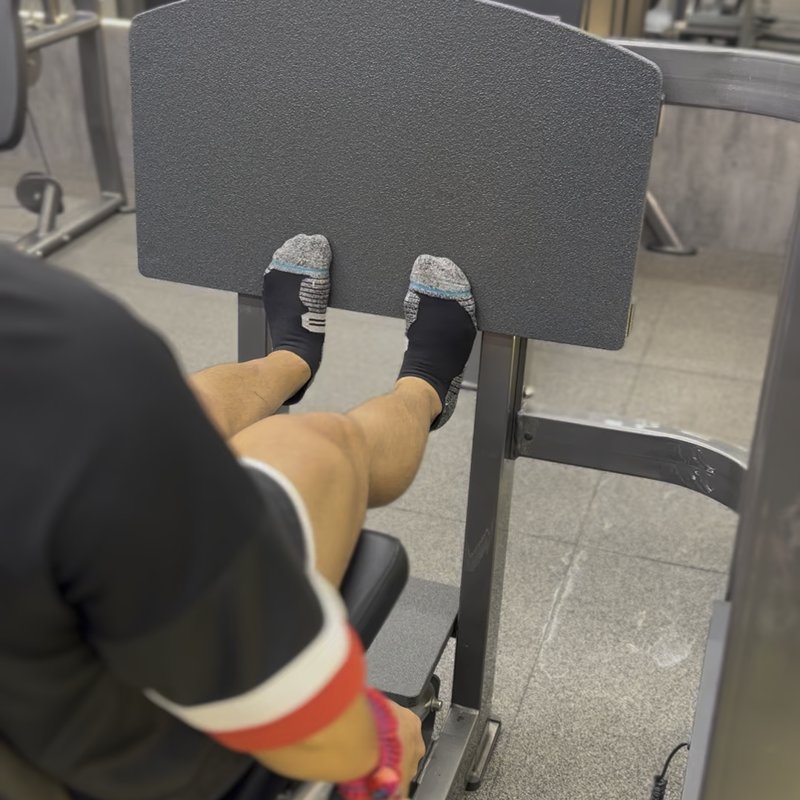
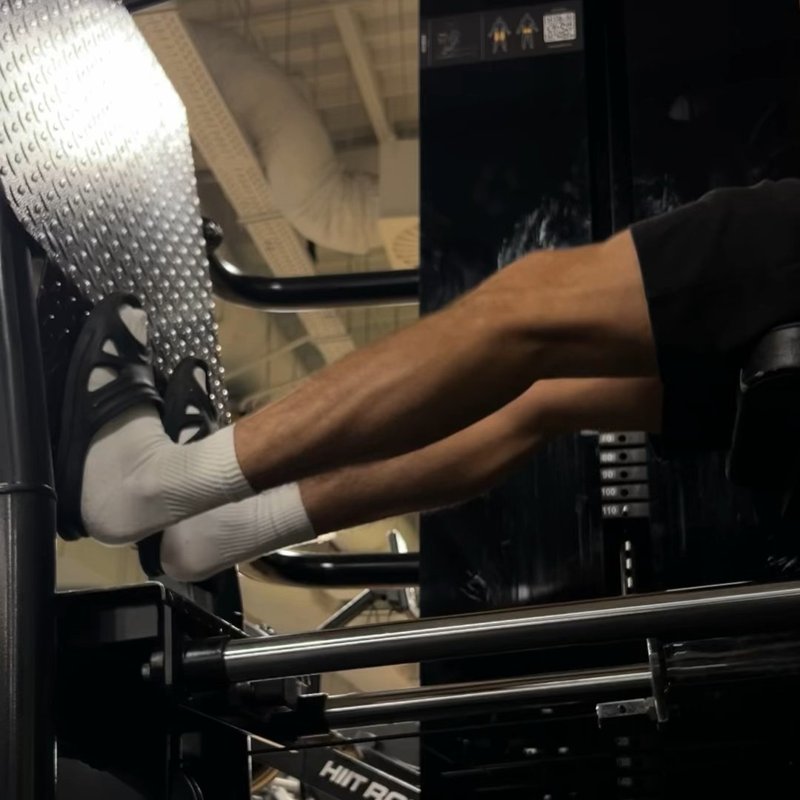
How to Do Standing Calf Raises
A standing calf raise is a calf exercise done on your feet with your knees straight. Put the balls of your feet on a step or machine platform, lower your heels as far as they go, then rise onto your toes. It trains the gastrocnemius and soleus. Most lifters do 3 to 4 sets of 10 to 15 reps.
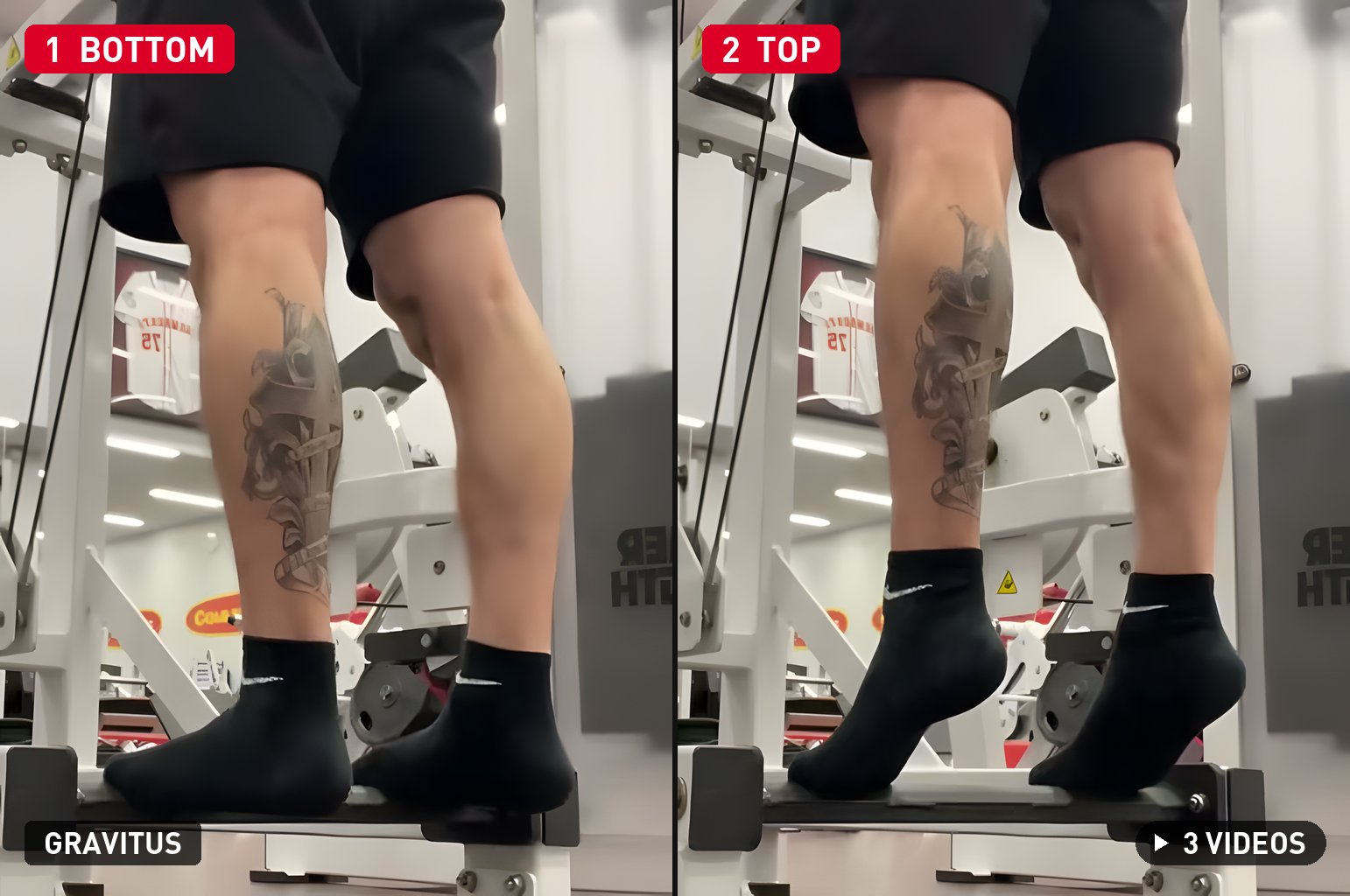
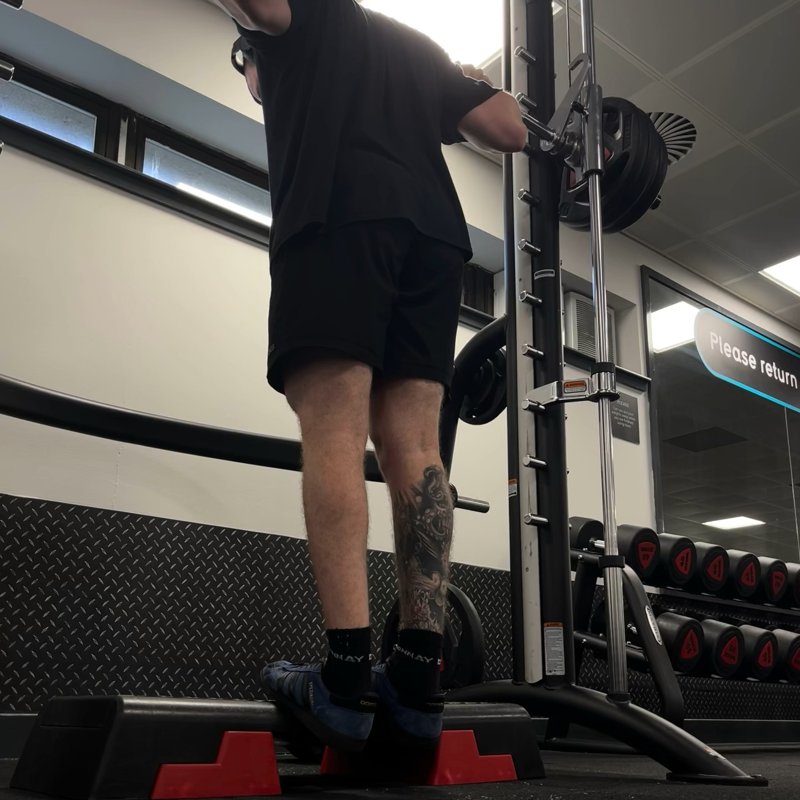
- 1Bottom. Balls of your feet on the edge of the platform, knees straight. Lower your heels as far as they go and pause for a second.
- 2Top. Push through the balls of your feet and rise as high as you can, then lower over 2 seconds.
Watch 2 video demonstrations
How to do a standing calf raise
- Set the shoulder pads so you have to stand up straight to lift them. On a Smith machine or a step, the foot position is the same.
- Put the balls of your feet on the edge of the platform, hip-width apart, toes pointing forward.
- Stand tall with your knees straight but not locked hard. They stay straight for the whole set.
- Lower your heels slowly as far as they go, until your calves are fully stretched, and pause for a second at the bottom.
- Push through the balls of your feet and rise as high as you can. Lower over 2 seconds into the next rep without bouncing.
How deep should you go?
Go all the way down. The bottom half of the rep, from heels low to a flat foot, is where your calves are stretched, and it builds the most muscle. The weight is not what changes: your body and the load press down through the ball of your foot, so the resistance at your ankle changes by only about 10% from bottom to top. The curves are modelled for heels 25 degrees below and above flat.
Over 8 weeks, calf raises through only the bottom half grew the inner calf 15.2%, against 6.7% for full reps and 3.4% for the top half (Kassiano 2023). Do full reps, and when you cannot finish another one, keep going with bottom-half partials. That grew the inner calf 9.6%, against 6.7% for stopping at failure (Larsen 2025).
How much weight should you use for standing calf raises?
On Gravitus, the median man lifts 165 lb (75 kg) for 10 reps on the standing calf raise, and the median woman 90 lb (40 kg).
- Most lift
- 100 to 235 lb
- Top 10% lift
- 310 lb or more
- Starting out
- under 100 lb
- Most lift
- 45 to 130 lb
- Top 10% lift
- 190 lb or more
- Starting out
- under 45 lb
- Most lift
- 45 to 105 kg
- Top 10% lift
- 140 kg or more
- Starting out
- under 45 kg
- Most lift
- 20 to 60 kg
- Top 10% lift
- 85 kg or more
- Starting out
- under 20 kg
Muscles worked
Standing vs seated calf raise vs leg press calf raise
| Attribute | Standing | Seated | Leg press | |
|---|---|---|---|---|
| Knees | Straight | Bent 90 degrees | Straight | |
| Works most | Gastrocnemius, soleus | Soleus | Gastrocnemius, soleus | |
| 12-week growth, whole calf | 5.6% | 2.1% | Not tested | |
| Best for | Calf size | Soleus work | sitting down | Heavy loads with your back supported |
Standing, if you pick one. Training one leg each way for 12 weeks, the standing leg grew its gastrocnemius 9 to 12% and the seated leg less than 2%. The soleus grew about the same either way, 2.1% vs 2.9% (Kinoshita 2023). A leg press calf raise also keeps your knees straight, so it trains the same muscles as standing.
Calf raise claims the research does not back
Many calf guides repeat the same advice. Four common claims are wrong or unsupported:
- Seated raises are how you grow the soleus. Seated raises do take the gastrocnemius out, but over 12 weeks the soleus grew about as much from standing raises as from seated ones, 2.1% vs 2.9% (Kinoshita 2023).
- Squeeze and hold at the top. The top half of the rep built the least muscle, 3.4% vs 15.2% for the bottom half (Kassiano 2023). Spend your pause at the bottom.
- Foot angle is only for comfort. It changes which head grows. Toes turned out grew the inner head more, 8.4% vs 3.8%, and toes turned in grew the outer head more, 9.1% vs 5.5% (Nunes 2020).
- Calves only grow with very high reps. They grew with sets of 10 at 70% of max (Kinoshita 2023) and with sets of 15 to 20 (Kassiano 2023). Sets taken close to failure build muscle across a wide range of reps (Schoenfeld 2021).
Sets, reps and progression
Train calves 2 to 3 times a week. Twice a week was enough to grow them in 12 weeks with 5 sets of 10 (Kinoshita 2023). Stop each set 0 to 2 reps short of failure, or add bottom-half partials once you reach it.
Add reps first. When every set reaches 15 full-depth reps, add 10 lb (5 kg) and go back to 10. If the new weight makes your reps shorter, it is too heavy.
Common mistakes
-
Bouncing out of the bottomYour Achilles tendon stretches and springs back, lifting part of the weight for you. Pause for a second with your heels low.
-
Stopping short of the stretchThe bottom half builds the most muscle. Lower until your heels stop moving.
-
Bending the kneesThe rep turns into a squat and the gastrocnemius does less. Keep your knees straight and lighten the weight if they bend.
-
Rolling onto the little toePush through the big toe as well so your ankle rises straight up.
-
Too much weight, tiny repsA heavy stack moved an inch only trains the top of the rep, the part that grows least. Use a weight you can take through full range.
Standing calf raise variations
Questions people ask
What muscles do standing calf raises work?
The gastrocnemius most, with the soleus underneath it. Small muscles around the ankle and your core hold you steady.
What is the difference between seated and standing calf raises?
Your knees. Standing, they are straight, which stretches the gastrocnemius so it does most of the work. Seated, they are bent 90 degrees, which leaves mainly the soleus. Standing raises grew the whole calf more over 12 weeks, 5.6% vs 2.1% (Kinoshita 2023).
Do standing calf raises work soleus?
Yes. The soleus works with the knee straight or bent, and it grew about as much from standing raises as from seated ones (Kinoshita 2023).
Why does bending the knee shift emphasis from gastrocnemius to soleus?
The gastrocnemius crosses the knee and the soleus does not. Bending the knee shortens the gastrocnemius so it can pull less hard, and the soleus takes over.
How many reps for calf raises?
10 to 15 per set, 3 to 4 sets, stopping 0 to 2 reps short of failure. Calves grew with sets of 10 and with sets of 15 to 20, so pick a range you can do at full depth.
How long does it take to grow calves?
In studies, 8 to 12 weeks of 2 to 3 calf sessions a week grew the gastrocnemius 6 to 15% with full or bottom-half reps (Kassiano 2023, Kinoshita 2023).
How much weight should I standing calf raise?
For 10 reps, the median on Gravitus is 165 lb (75 kg) for men and 90 lb (40 kg) for women. The strongest quarter lifts 235 lb (105 kg) and 130 lb (60 kg) or more.
Log every set and see your percentile on every lift, standing calf raise included.
Get Gravitus