How to Do Seated Calf Raises
A seated calf raise is a machine calf exercise done sitting with your knees bent 90 degrees under a pad. With the balls of your feet on the platform, lower your heels as far as they go, then rise onto your toes. It mainly trains the soleus. Most lifters do 3 to 4 sets of 10 to 20 reps.
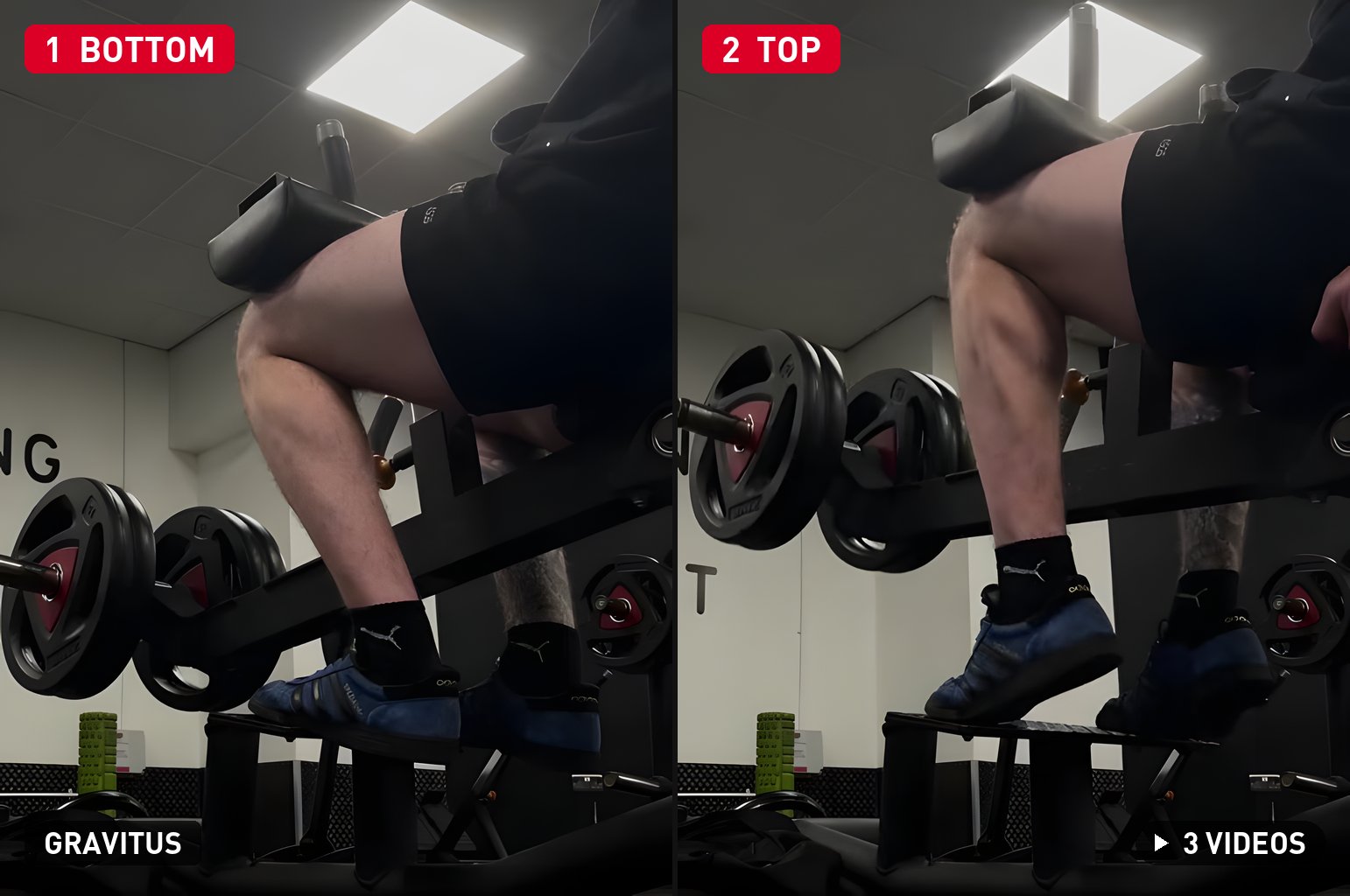
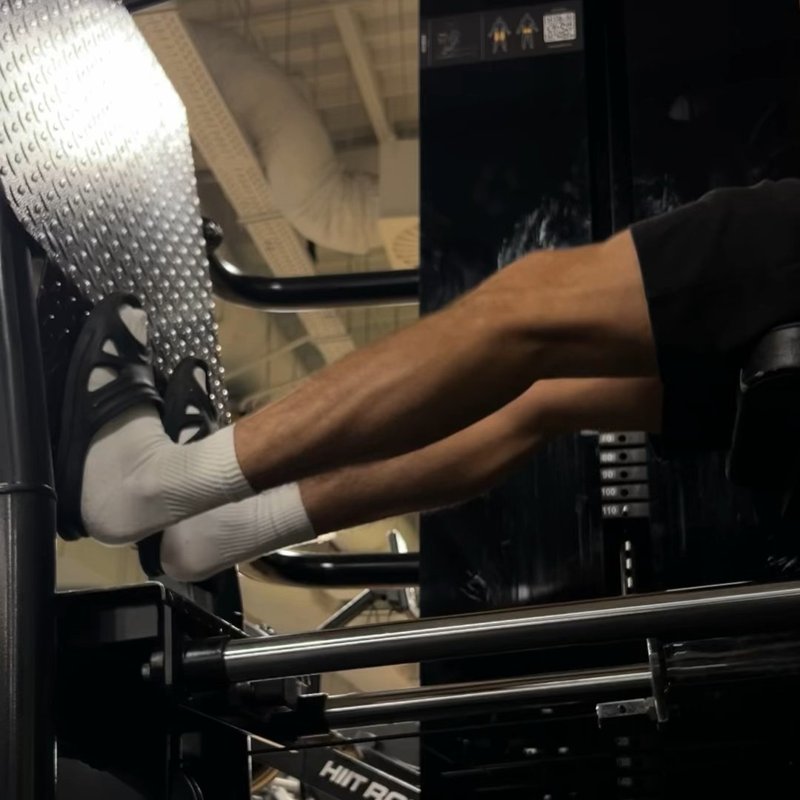
- 1Bottom. Pad snug on your lower thighs, balls of your feet on the edge of the platform. Lower your heels as far as they go and pause for a second.
- 2Top. Push through the balls of your feet and rise as high as you can, then lower over 2 seconds. Only your ankles move.
Watch 1 video demonstration
How to do a seated calf raise
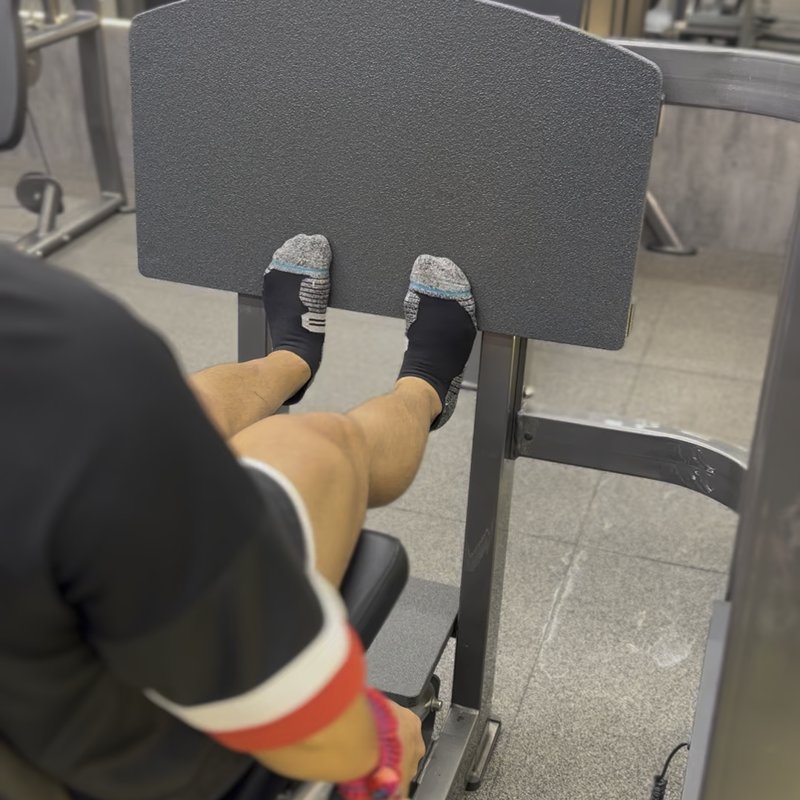
- Sit down and set the knee pad so it rests snug on your lower thighs, just above your knees, with your knees bent about 90 degrees.
- Put the balls of your feet on the edge of the platform, hip-width apart, toes forward, heels hanging off.
- Rise onto your toes to lift the pad off the safety stop, then push the stop lever forward to release it.
- Lower your heels slowly as far as they go, until your calves are fully stretched, and pause for a second at the bottom.
- Push through the balls of your feet and rise as high as you can. Lower over 2 seconds into the next rep. After the last rep, rise once more and pull the lever back before you stand up.
How to set up the seated calf raise machine
Your heels dropping below the platform is what gives the rep its depth. In the 12-week trial, reps ran from 20 degrees below flat to 30 degrees above it (Kinoshita 2023). In straight-knee calf raises, the stretched half of the rep built the most muscle (Kassiano 2023). That has not been tested with the knee bent, so go all the way down and pause there.
How much weight should you use for seated calf raises?
On Gravitus, the median man lifts 110 lb (50 kg) for 10 reps on the seated calf raise, and the median woman 65 lb (30 kg).
- Most lift
- 80 to 150 lb
- Top 10% lift
- 200 lb or more
- Starting out
- under 80 lb
- Most lift
- 45 to 100 lb
- Top 10% lift
- 145 lb or more
- Starting out
- under 45 lb
- Most lift
- 37.5 to 67.5 kg
- Top 10% lift
- 90 kg or more
- Starting out
- under 37.5 kg
- Most lift
- 20 to 45 kg
- Top 10% lift
- 65 kg or more
- Starting out
- under 20 kg
Why you use less weight than on a standing calf raise
Expect to load less on the seated machine. On Gravitus, men log about a third less weight on the seated calf raise than on the standing one. Three things add up:
- Your body rests on the seat. Standing, you lift your body and the stack on every rep. Seated, you lift only the pad and the plates on your thighs.
- The gastrocnemius drops out. It crosses the knee, so bending the knee to 90 degrees shortens it and it can pull far less. With the knee bent 90 degrees, calf strength was 31% lower than with the leg straight, and gastrocnemius activity 35% lower (Kovács 2024).
- The soleus does not make up the gap. Its activity rose by 15 to 28% in the first half of slow reps with the knee bent, not enough to replace the gastrocnemius (Kovács 2024).
Do not carry your standing number across. Pick a weight you can lower all the way for 15 reps with a pause at the bottom, and add plates from there.
Muscles worked
Benefits of seated calf raises
- Calf work with no load on your back. The weight sits on your thighs, not your shoulders or spine.
- Soleus work without the gastrocnemius. It adds calf sets when straight-knee raises are uncomfortable or your standing machine is taken.
- Simple to learn and load. Only your ankles move, and the safety stop catches the weight between sets.
- Calf work you can do sitting anywhere. Unweighted seated heel raises done slowly and nonstop for hours, called soleus pushups, cut the rise in blood sugar after a glucose drink by 52% (Hamilton 2022). That is a different activity from a loaded set of 15, and it was not tested with weight.
What they do not do is grow the soleus more than standing raises. Over 12 weeks the soleus grew 2.9% on the seated leg and 2.1% on the standing leg, a difference the study could not tell apart from chance (Kinoshita 2023).
Seated vs standing calf raise vs calf press
| Attribute | Seated | Standing | Calf press |
|---|---|---|---|
| Knees | Bent 90 degrees | Straight | Straight |
| Works most | Soleus | Gastrocnemius, soleus | Gastrocnemius, soleus |
| 12-week growth, soleus | 2.9% | 2.1% | Not tested |
| 12-week growth, whole calf | 2.1% | 5.6% | Not tested |
| Best for | Extra soleus sets | Calf size | Deep stretch, back supported |
Standing, if you pick one. Training one leg each way for 12 weeks, the standing leg grew its gastrocnemius 9 to 12% and the seated leg less than 2%, while the soleus grew about the same either way (Kinoshita 2023). Do seated raises on top of a straight-knee calf exercise, not instead of one.
Seated calf raise claims the research does not back
Most seated calf raise guides repeat the same advice. Four common claims are wrong or untested:
- You need seated raises to grow the soleus. Seated raises do take the gastrocnemius out, but over 12 weeks the soleus grew about as much from standing raises, 2.1% vs 2.9% (Kinoshita 2023).
- The soleus is slow-twitch, so it needs 20 to 30 reps. The soleus is mostly slow-twitch fibers, but it grew with seated sets of 10 at 70% of max (Kinoshita 2023), and sets taken close to failure build muscle across a wide range of reps (Schoenfeld 2021).
- Squeeze and hold at the top. In straight-knee raises the top half of the rep built the least muscle, 3.4% vs 15.2% for the bottom half (Kassiano 2023). Spend your pause at the bottom.
- Turn your toes out or in to hit different parts. Toe angle changed which gastrocnemius head grew in a straight-knee study (Nunes 2020). With the knee bent the gastrocnemius does little, and no study has tested toe angle on this machine, so point your toes where it feels best.
Sets, reps and progression
Train calves 2 to 3 times a week and stop each set 0 to 2 reps short of failure. The seated leg in the 12-week trial did 5 sets of 10 twice a week (Kinoshita 2023). If you also do standing raises or calf presses, 2 to 3 seated sets after them is enough.
Add reps first. When every set reaches 20 full-depth reps, add 10 lb (5 kg) and go back to 12. If the new weight makes your reps shorter, it is too heavy.
Common mistakes
-
Pad on the kneecapsIt presses on the kneecap and shifts as you rise. Set it on your lower thighs, just above the knee.
-
Bouncing out of the bottomYour Achilles tendon stretches and springs back, lifting part of the weight for you. Pause for a second with your heels low.
-
Heels hitting the platformYour feet are too far forward, so the rep stops before the stretch. Only the balls of your feet go on the edge.
-
Lifting with your thighsLeaning back or driving the pad up with your hips turns it into a half rep. Only your ankles move; lighten the weight if more than that does.
-
Loading your standing weightThe gastrocnemius cannot help with the knee bent, so a standing load turns every rep into a short one. Start lighter and use full range.
Seated calf raise variations
Questions people ask
What muscles do seated calf raises work?
The soleus most, the flat muscle under the gastrocnemius. The gastrocnemius helps a little, and small muscles around the ankle keep it from rolling in or out.
What are the benefits of seated calf raises?
Calf work with no load on your back, extra soleus sets when straight-knee raises are uncomfortable, and a lift that is simple to learn. They do not grow the soleus more than standing raises (Kinoshita 2023).
What is the difference between seated and standing calf raises?
Your knees. Seated, they are bent 90 degrees, which shortens the gastrocnemius and leaves mainly the soleus. Standing, they are straight, so both muscles work. Standing raises grew the whole calf more over 12 weeks, 5.6% vs 2.1% (Kinoshita 2023).
Do seated calf raises work the gastrocnemius?
A little. With the knee bent 90 degrees its activity was 35% lower than with the leg straight (Kovács 2024), and over 12 weeks of seated raises it grew less than 2% (Kinoshita 2023).
Are seated calf raises effective?
For the soleus, yes, but standing raises grew the soleus about as much and the gastrocnemius far more (Kinoshita 2023). Use seated raises as extra calf work alongside a straight-knee exercise.
How much weight should I seated calf raise?
For 10 reps, the median on Gravitus is 110 lb (50 kg) for men and 65 lb (30 kg) for women. The strongest quarter lifts 150 lb (67.5 kg) and 100 lb (45 kg) or more.
Log every set and see your percentile on every lift, seated calf raise included.
Get GravitusRelated exercises
- Kinoshita et al. 2023. Front Physiol 14:1272106.
- Kovács et al. 2024. Biol Open 13(12):bio061810.
- Hamilton, Hamilton and Zderic 2022. iScience 25(9):104869.
- Kassiano et al. 2023. J Strength Cond Res 37(9):1746-1753.
- Nunes et al. 2020. J Strength Cond Res 34(8):2347-2351.
- Schoenfeld et al. 2021. Sports 9(2):32.