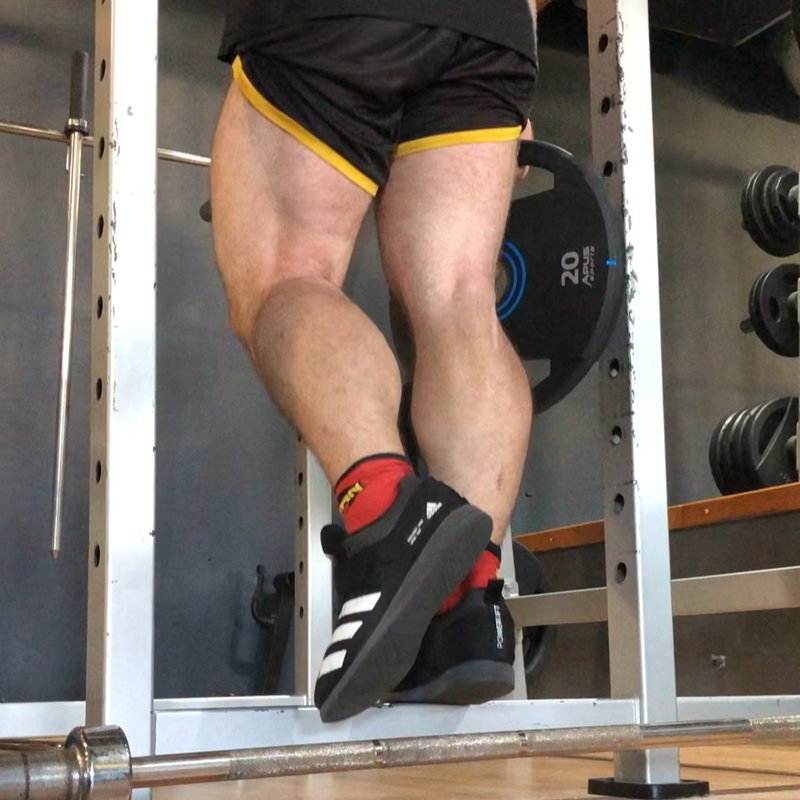
How to Do a Calf Press on the Leg Press
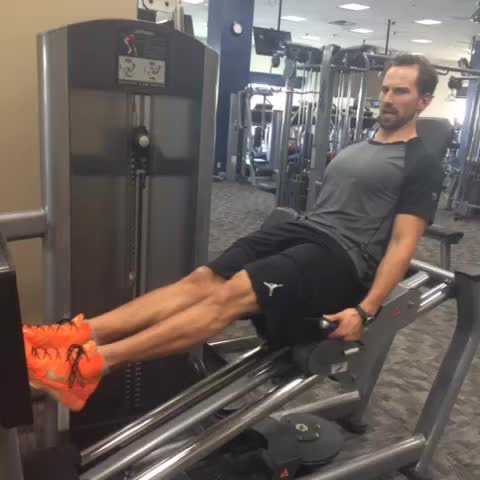
A calf press on the leg press, or leg press calf raise, trains your calves with your knees straight. Put the balls of your feet on the bottom edge of the platform, drop your heels, then point your toes to push the sled away. It works the gastrocnemius and soleus. Do 3 to 4 sets of 10 to 20 reps.
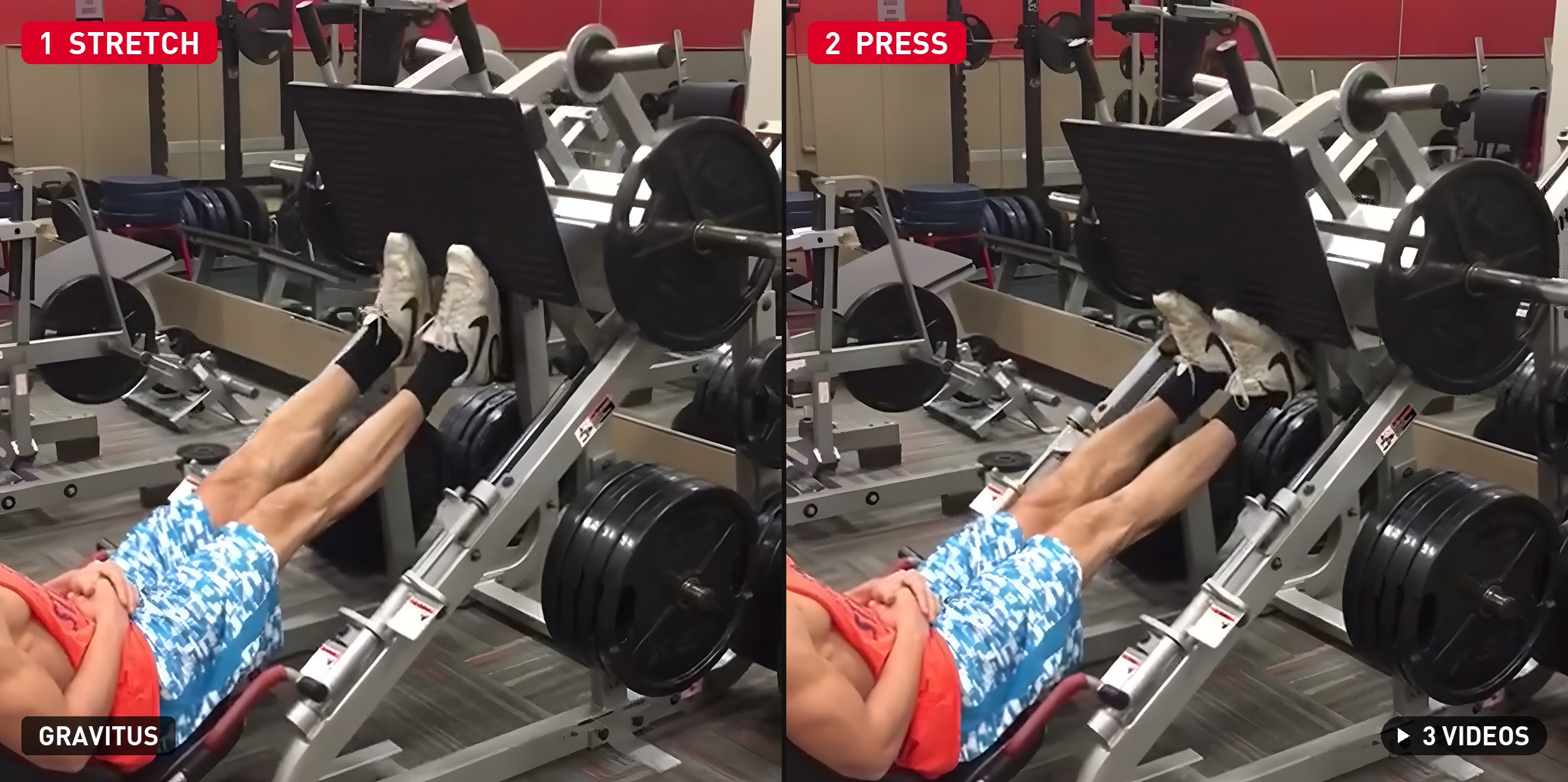
- 1Stretch. Legs straight, balls of your feet on the bottom edge of the platform. Let your heels drop until your calves are fully stretched, and pause.
- 2Press. Push the sled away by pointing your toes as far as they go. Your knees stay straight and only your ankles move.
Watch 3 video demonstrations
Find more video demonstrations in the Gravitus app
How to do a calf press on the leg press
- Set the safety stops one notch below where the sled sits when your legs are straight and your heels are fully dropped. The next section shows how to find it.
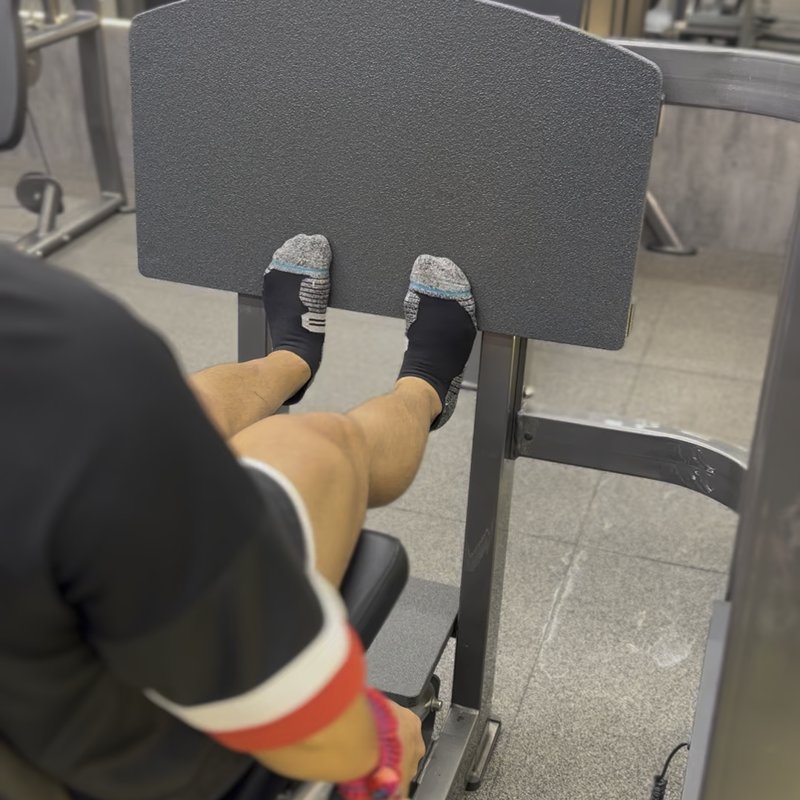
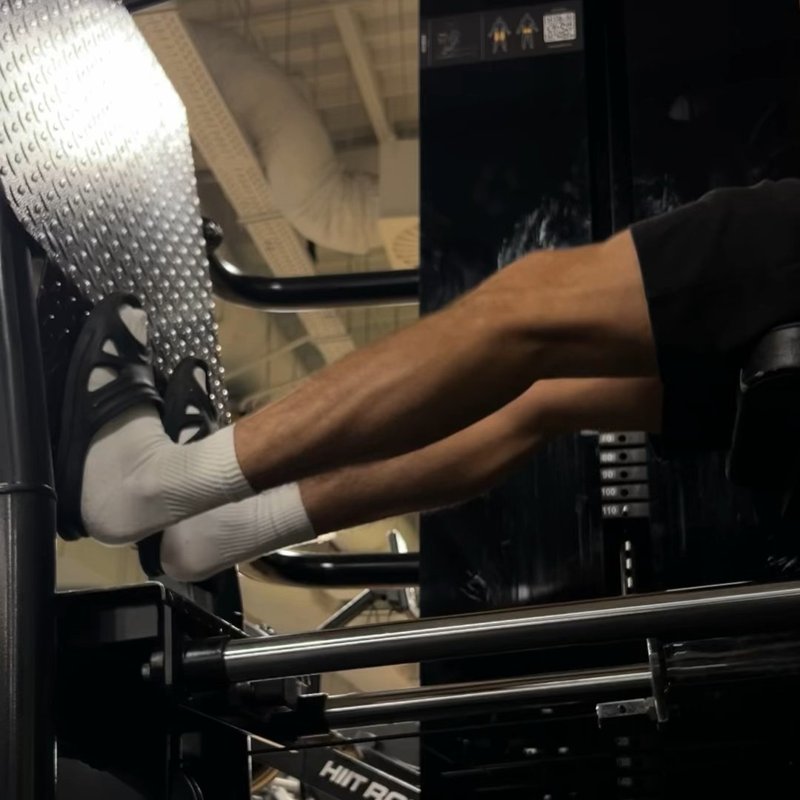
- Sit with your back and hips flat on the pad. Put the balls of your feet on the bottom edge of the platform, hip-width apart, toes forward, heels hanging off.
- Press the sled up until your legs are straight, then turn the rack handles out. Your knees stay straight but not locked hard for the whole set.
- Let your heels drop until your calves are fully stretched and pause for a second. Then push through the balls of your feet until your toes point as far as they go.
- After the last rep, turn the handles back in to rack the sled. Move your feet only once it is racked.
How to set up the leg press for calves
The stretched half of the rep builds the most calf muscle (Kassiano 2023), so the setup is about reaching a full stretch safely: the safety stops on a 45 degree sled, the seat on a seated leg press. Toe angle picks which head grows more, toes out for the inner calf and toes in for the outer (Nunes 2020). Both trials trained on a seated leg press, and the calf press guide covers that setup.
Are leg press calf raises safe?
Yes, with the safety stops set. The risk is specific to the 45 degree sled: only the balls of your feet hold the platform and your knees are straight, so if a foot slips off the edge, the sled comes down the rails toward you. Set stops catch it a few inches lower.
Find the notch before you load plates. Sit in, put your feet on the bottom edge, unrack the empty sled and let your heels drop as far as they go. Rack it and set the stops one notch below where the sled was at that stretch.
Keep your feet where they are while the sled is unracked. Moving them down the platform under load is when they slip, so place them first and rack before you change them. Single-leg sets carry the same rule, with the stops set.
On some sleds the stops only set in the lower part of the rails, far below your calf press. Use a seated leg press or a calf press machine instead: if a foot slips there, the plates drop onto the stack.
How much weight should you calf press on the leg press?
On Gravitus, the median man lifts 265 lb (120 kg) for 10 reps on the calf press on the leg press, and the median woman 160 lb (72.5 kg).
- Most lift
- 180 to 360 lb
- Top 10% lift
- 455 lb or more
- Starting out
- under 180 lb
- Most lift
- 105 to 235 lb
- Top 10% lift
- 330 lb or more
- Starting out
- under 105 lb
- Most lift
- 82.5 to 162.5 kg
- Top 10% lift
- 207.5 kg or more
- Starting out
- under 82.5 kg
- Most lift
- 47.5 to 105 kg
- Top 10% lift
- 150 kg or more
- Starting out
- under 47.5 kg
Muscles worked
45 degree leg press vs seated leg press vs standing calf raise
| Attribute | 45 degree leg press | Seated leg press | Standing calf raise |
|---|---|---|---|
| Loaded with | Plates on a sled | Weight stack | Pads on your shoulders |
| First rep starts | Legs straight, sled unracked | At the stretch, plates resting | Standing tall, at the top |
| Stretch set by | How far your heels drop | Seat position | How far your heels drop |
| If a foot slips | The sled drops to the stops | The plates drop onto the stack | You step down |
| Best for | Heaviest loads | Quick setup, least risk | Calf work without a leg press |
Your knees are straight on all three, so they train the same muscles. Use the 45 degree sled when its stops can be set just below your stretch. If they cannot, use a seated leg press: it is the machine the calf trials were run on (Kassiano 2023, Nunes 2020).
Leg press calf raise advice that is wrong
Four claims that show up in popular guides are wrong or unsupported. The first and last were on this page until September 2026.
- Release the safety stops before you start. Release the rack handles. The adjustable stops stay set, one notch below your stretch, for the whole set.
- Toes in for the inner calf. It is the other way round. Toes out grew the inner head more and toes in grew the outer head more (Nunes 2020).
- Standing raises beat the leg press for calf growth. The trial behind that claim compared standing raises with seated ones, where the knees bend 90 degrees (Kinoshita 2023). On the leg press your knees are straight, as they are standing.
- Keep your heels on the platform. Your heels hang off the bottom edge. With the whole foot on the plate they cannot drop, and you lose the stretch.
Sets, reps and progression
Train calves 2 to 3 times a week and stop each set 0 to 2 reps short of failure. The research on rep ranges and stretched partials is in our standing calf raise and calf press guides.
Add reps first. When every set reaches 20 full reps, add 10 lb (5 kg) to each side and go back to 12. Change plates only with the sled racked, and load both sides evenly.
Common mistakes
-
Safety stops at the bottomIf a foot slips, the sled travels most of the rails before anything catches it. Set the stops one notch below your stretch.
-
Moving your feet under loadSliding your feet down the platform with the sled unracked is when they slip. Place them first, and rack before you change them.
-
Balancing on your toesToe tips on the edge slip off. Put the balls of your feet on the plate so your forefoot is under it.
-
Knees bending and straighteningThe rep turns into a leg press and the sled moves more than your ankles. Lighten it until only your ankles move.
-
Bouncing out of the stretchYour Achilles tendon springs back and lifts part of the sled. Pause for a second with your heels low.
Leg press calf raise variations
Questions people ask
Are leg press calf raises good?
Yes. Your knees are straight, so they train the gastrocnemius and soleus like a standing calf raise, with your back on a pad and no load on your spine. The trials that tested calf range of motion and foot angle ran on a leg press (Kassiano 2023, Nunes 2020).
Are leg press calf raises safe?
Yes, with the safety stops set one notch below your deepest stretch. The risk is a foot slipping off the edge of a 45 degree sled, and the stops catch the sled before it reaches you. Place your feet before you unrack and rack before you move them.
Are leg press calf raises the same as standing calf raises?
The ankle movement and the muscles are the same, because your knees are straight in both. On the leg press you push a sled with your back supported. Standing, your body is part of the load and your core holds you upright.
Do leg presses work calves?
They do work them. In trained men, a regular 45 degree leg press drew about the same calf muscle activity as a standing calf raise, each at a 10-rep max (Gentil 2020). That study measured activity in one set, not growth, so if you want bigger calves, add calf presses.
How should I place my feet during leg press calf raises?
Balls of your feet on the bottom edge of the platform, hip-width apart, heels hanging off. Toes forward trains both heads of the gastrocnemius. Toes out grows the inner head more and toes in the outer head (Nunes 2020).
How to do calf raises on seated leg press?
Set the seat so that with the plates resting, your legs are straight and your calves fully stretched. Put the balls of your feet on the bottom edge and push the plate away with your ankles. Every rep starts from the stretch, and there is no sled to unrack.
How much weight should I use for calf press on leg press?
For 10 reps, the median on Gravitus is 265 lb (120 kg) for men and 160 lb (72.5 kg) for women. The strongest quarter lifts 360 lb (162.5 kg) and 235 lb (105 kg) or more.
Log every set and see your percentile on every lift, calf press on the leg press included.
Get Gravitus