How to Do Seated Hip Adduction
Seated hip adduction is a machine exercise for the inner thighs. Sit with your back on the pad and the pads inside your knees, start with your legs apart, squeeze your knees together, then let them open slowly. It trains the adductor longus, brevis and magnus. Most lifters do 3 to 4 sets of 10 to 15 reps.
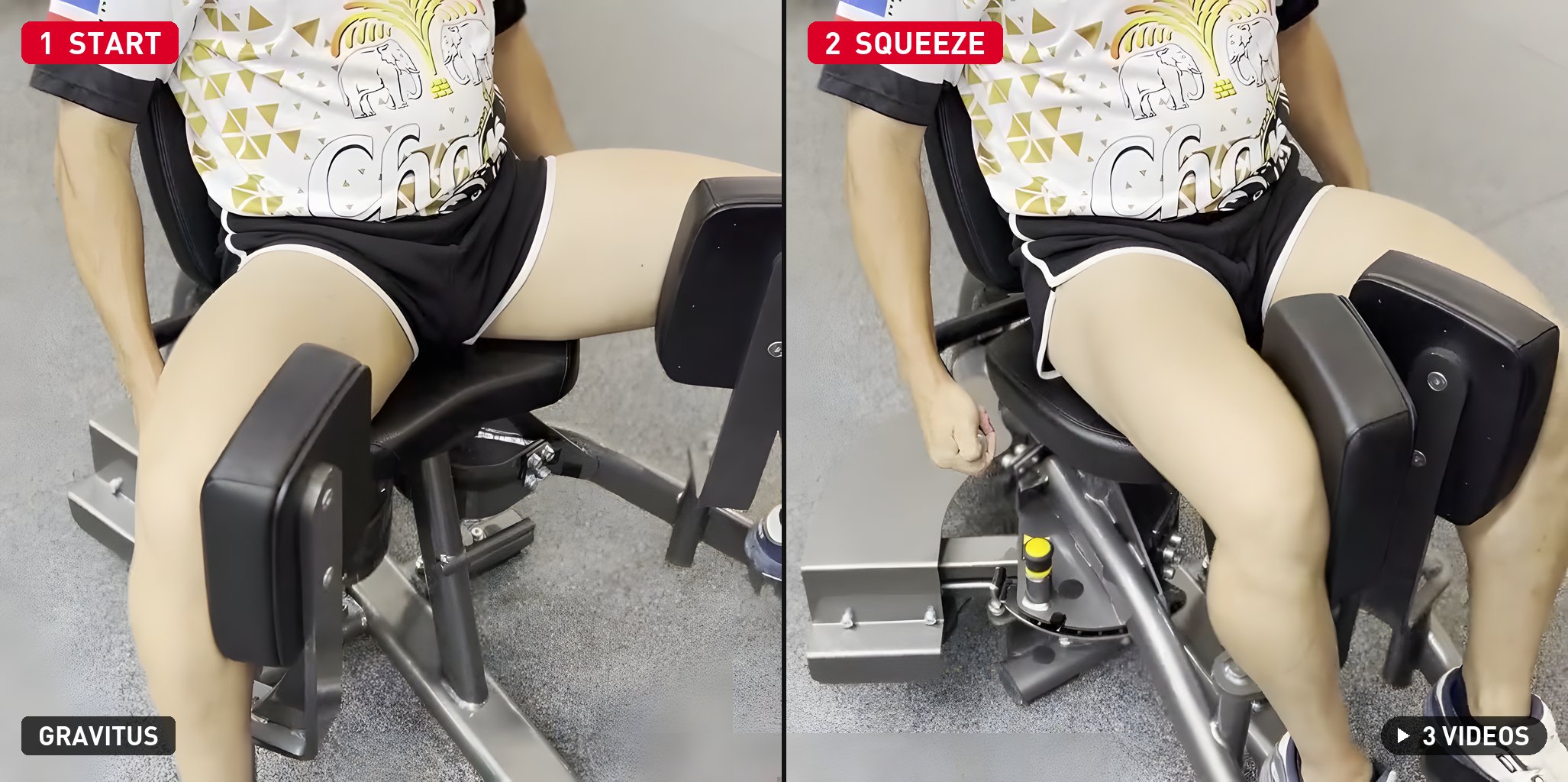
- 1Start. Legs open to a light stretch in your inner thighs, the pads on the inside of your knees and your back on the pad.
- 2Squeeze. Bring your knees together until the pads meet, pause for a second, then let your legs open slowly.
Watch 3 video demonstrations
Find more video demonstrations in the Gravitus app
How to use the hip adduction machine
- Set the start lever so your legs open to a light stretch in your inner thighs, and pick the weight with the pin.
- Sit all the way back so your hips sit over the pivots, the points the leg arms swing around. Put your feet on the foot bars and the pads on the inside of your knees.
- Sit upright with your back on the pad and hold the handles.
- Squeeze your knees together until the pads meet or almost meet. Pause for a second.
- Let your legs open over 2 to 3 seconds back to the stretch, stopping just before the plates touch.
How wide to start, and how to sit
Start width sets how much of the strong part of the rep you get. The adductors push harder with the legs apart: side-lying adduction force was higher at 10 and 20 degrees of hip abduction than with the legs together (Welsh 2020), and on a device built like the gym machine, force peaked near the widest point of the rep at every hip angle tested (Marušič 2025). The same study found the seated position costs some force. With the hips bent 90 degrees, peak force was about 18% lower than with the hips straight, while adductor longus activity did not change (Marušič 2025). Sitting upright is fine. Leaning forward bends your hips past 90 degrees, which no study has tested.
What the adductors do, and why squats matter too
The machine trains hip adduction, pulling the thighs together. That is the main job of the adductor longus, adductor brevis and gracilis, but not of the biggest adductor. Most of the adductor magnus is built to extend the hip: in 15 young adults, its size and leverage gave it more than twice the capacity for hip extension as for adduction (Takahashi 2025). In a modelling study of eight exercises, deadlifts, sumo deadlifts, squats and step-ups put the top-tier forces on the rear adductor magnus, and the long-lever Copenhagen exercise ranked top tier for every adductor (Collings 2026). The machine was not tested.
Growth studies point the same way. Ten weeks of full squats grew the adductors 6.2%, against 2.7% for half squats (Kubo 2019), and nine weeks of back squats grew the adductors more than hip thrusts did (Plotkin 2023). We found no training study that measured adductor growth from the adduction machine itself.
Use the machine for direct work on the adductor longus and brevis, and keep a deep squat, lunge or deadlift in your week for the adductor magnus.
How much weight should you use on the hip adduction machine?
On Gravitus, the median man lifts 145 lb (65 kg) for 10 reps on the seated hip adduction, and the median woman 90 lb (42.5 kg).
- Most lift
- 105 to 190 lb
- Top 10% lift
- 260 lb or more
- Starting out
- under 105 lb
- Most lift
- 70 to 130 lb
- Top 10% lift
- 170 lb or more
- Starting out
- under 70 lb
- Most lift
- 47.5 to 87.5 kg
- Top 10% lift
- 117.5 kg or more
- Starting out
- under 47.5 kg
- Most lift
- 32.5 to 60 kg
- Top 10% lift
- 77.5 kg or more
- Starting out
- under 32.5 kg
Muscles worked
Adduction machine vs deep squat vs Copenhagen plank
| Attribute | Adduction machine | Deep squat | Copenhagen plank |
|---|---|---|---|
| Adductors hit hardest | Longus, brevis | Rear adductor magnus | All of them |
| Loaded with | Weight stack | Barbell | Bodyweight |
| Progress by | Moving the pin | Adding plates | Longer lever, more reps |
| Best for | Direct inner-thigh work | Adductor size, with quads and glutes | Groin injury prevention |
Use the machine for direct adductor work and deep squats for adductor magnus size. If you sprint or change direction in your sport, add the Copenhagen plank: a program built on it cut the risk of groin problems by 41% in 652 semi-professional footballers (Harøy 2019).
Sets, reps and progression
Stop each set 1 to 2 reps short of failure. Sets taken close to failure build muscle across a wide range of reps (Schoenfeld 2021), so pick a range where you can still start every rep from the full stretch.
Add reps first. When every set reaches 15, move the pin down one plate and go back to 10. Keep the start setting the same, or the new number means nothing. Train it 1 to 2 times a week, after your squats or lunges.
Common mistakes
-
Lining your knees up with the pivotsThe pivots sit under your hips, not your knees. Sit all the way back so the leg arms swing around your hip joints.
-
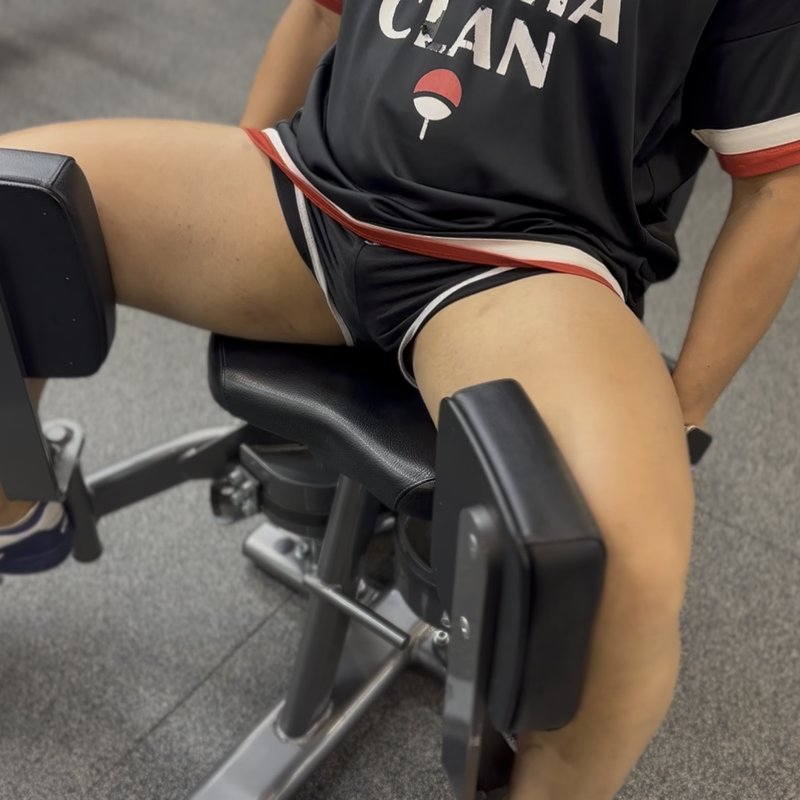
Starting too narrowA start with your knees close skips the wide part of the rep, where the adductors are strongest. Open the lever to a light stretch.
-
Starting too wideA sharp pull in the groin at the start means the lever is too far out. Move it in one notch.
-
Hips sliding or lifting off the seatThe weight is too heavy. Go lighter until your hips stay put for the whole set.
-
Letting the pads fly openLet your legs open over 2 to 3 seconds and stop just before the stack touches.
Seated hip adduction variations
Questions people ask
What does hip adduction do?
It pulls your thighs toward each other. The machine trains the adductor longus, brevis and the front of the adductor magnus against a weight stack. The same muscles steady your pelvis when you walk, run and change direction.
How wide should hip adduction be?
Wide enough to feel a light stretch in your inner thighs at the start, without a pull in the groin. The adductors push harder with the legs apart (Welsh 2020), so a narrow start cuts off the strongest part of the rep.
Is hip adduction good for men?
Yes. Men and women have the same adductors, and strong adductors help in squats, sprinting and changing direction. Most Gravitus lifters who log this machine are men.
Does hip adduction work pelvic floor?
Not in a way that trains it. In 20 healthy women, squeezing the thighs together during a pelvic floor contraction did not make that contraction stronger or last longer (Amorim 2017). Train the pelvic floor directly.
Is the hip adduction machine better than squats for adductors?
Not for size. The largest adductor, the magnus, is mostly a hip extensor (Takahashi 2025), and full squats grew the adductors 6.2% in 10 weeks (Kubo 2019). The machine adds direct work for the adductor longus and brevis. Use both.
How to do hip adduction without machine?
Use a Copenhagen plank, a ball squeeze between your knees, side-lying adduction or a standing cable adduction. The Copenhagen plank is the hardest, and a program built on it cut groin problems in footballers (Harøy 2019).
How much weight should I use on the hip adduction machine?
For 10 reps, the median on Gravitus is 145 lb (65 kg) for men and 90 lb (42.5 kg) for women. The strongest quarter lifts 190 lb (87.5 kg) and 130 lb (60 kg) or more.
Log every set and see your percentile on every lift, seated hip adduction included.
Get GravitusRelated exercises
- Welsh et al. 2020. Int J Sports Phys Ther 15(1):22-33.
- Marušič et al. 2025. PLoS One 20(11):e0336699.
- Takahashi et al. 2025. J Appl Physiol 138(4):1088-1099.
- Collings et al. 2026. Med Sci Sports Exerc 58(8):1751-1763.
- Kubo et al. 2019. Eur J Appl Physiol 119(9):1933-1942.
- Plotkin et al. 2023. Front Physiol 14:1279170.
- Harøy et al. 2019. Br J Sports Med 53(3):150-157.
- Amorim et al. 2017. PLoS One 12(5):e0177575.
- Schoenfeld et al. 2021. Sports 9(2):32.