How to Do a Sumo Deadlift
A sumo deadlift is a barbell deadlift with your feet wide, your toes turned out and your hands on the bar inside your knees. Push your knees out, keep the bar against your legs and stand up. It trains the glutes, quads, adductors and hamstrings. Most lifters do 3 sets of 3 to 6 reps.
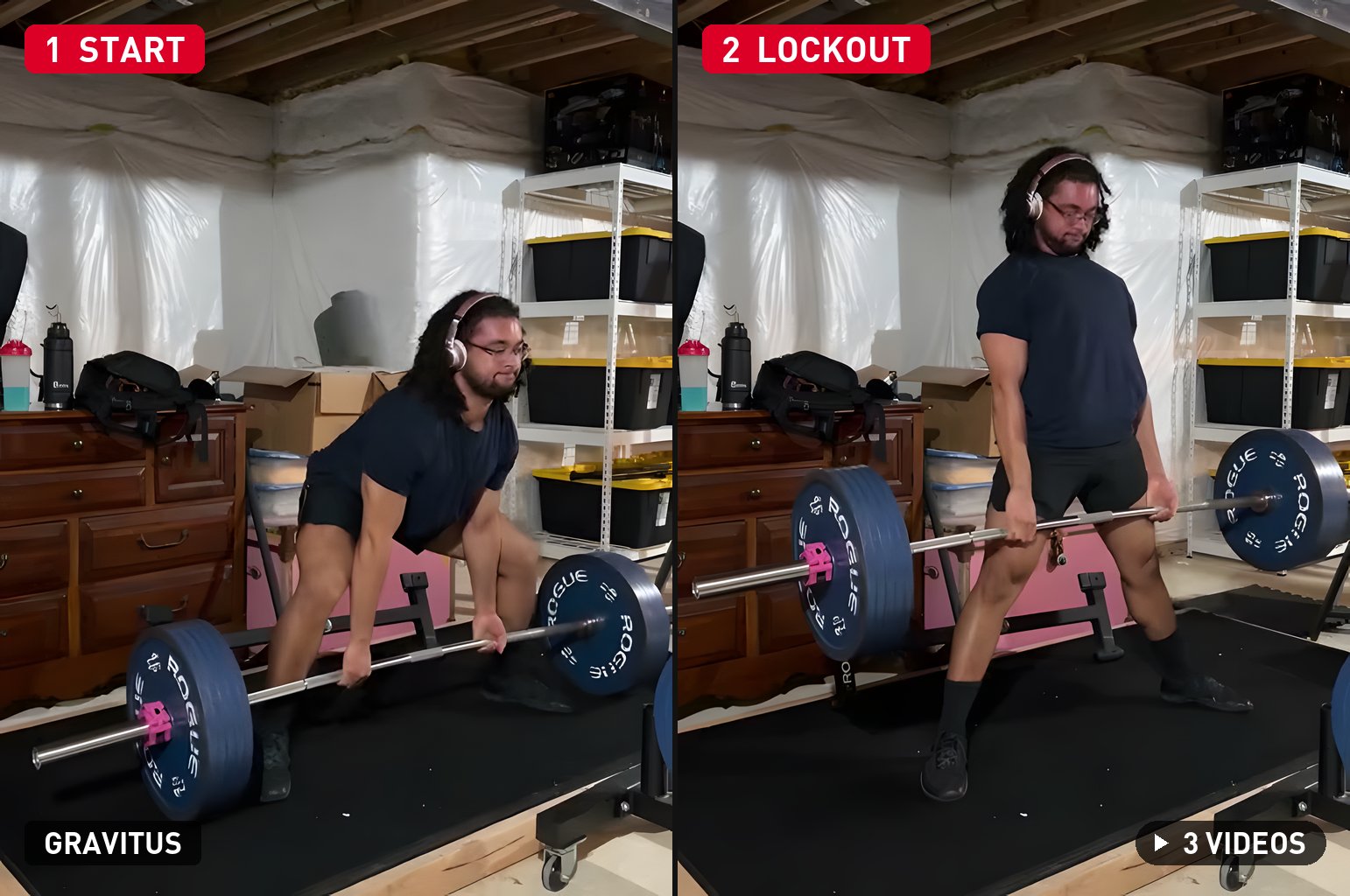
- 1Start. Feet wide and toes turned out, hands inside your knees, shins close to vertical and the bar over your midfoot.
- 2Lockout. Push the floor apart and stand up with the bar against your legs until your hips and knees are straight.
Watch 3 video demonstrations
Find more video demonstrations in the Gravitus app
How to do a sumo deadlift
Bracing, the grip and the bar path work as in the conventional deadlift. What changes in sumo is where your feet, hands and hips go.
- Stand with the bar over your midfoot, feet about twice as wide as for a conventional deadlift and toes turned out 30 to 45 degrees.
- Bend down and grip the bar about shoulder width, arms hanging straight down inside your knees.
- Push your knees out over your toes, lower your hips until your shins are close to vertical and lift your chest. Your shoulders sit over the bar or just in front of it.
- Brace your abs and pull on the bar with straight arms until you feel the weight, without lifting it yet.
- Push the floor apart with your feet and stand up, keeping the bar against your legs. Your hips and shoulders rise together.
- Stand tall with your hips and knees straight, then lower the bar the same way, hips back and knees out.
How wide should your sumo stance be?
Wide enough that your shins are close to vertical when you grip the bar, and no wider than lets your knees stay over your toes. At a national powerlifting championship, sumo lifters stood with their feet 70 cm (28 in) apart against 32 cm (13 in) for conventional lifters, turned their toes out 42 degrees against 14, and gripped the bar 8 cm (3 in) narrower (Escamilla 2000). Start there and adjust a few centimetres at a time.
How much weight should you sumo deadlift?
On Gravitus, the median man lifts 245 lb (112.5 kg) for 10 reps on the sumo deadlift, and the median woman 125 lb (57.5 kg).
- Most lift
- 200 to 305 lb
- Top 10% lift
- 350 lb or more
- Starting out
- under 200 lb
- Most lift
- 95 to 155 lb
- Top 10% lift
- 190 lb or more
- Starting out
- under 95 lb
- Most lift
- 90 to 137.5 kg
- Top 10% lift
- 160 kg or more
- Starting out
- under 90 kg
- Most lift
- 42.5 to 70 kg
- Top 10% lift
- 85 kg or more
- Starting out
- under 42.5 kg
Can you lift more sumo or conventional?
Most lifters pull more conventional. Among lifters who log both styles on Gravitus, the median sumo max is 94% of their conventional max: 94% for men and 95% for women (September 2026). Only 36% pull more sumo.
Lifters are strongest in the style they train most. Those who log at least twice as many sumo sets as conventional sets pull a median 17% more sumo. Those who mostly pull conventional pull 13% less sumo, and those who train both about equally are within 3%. The data cannot tell whether they picked the style that suits them or got stronger at the one they practised. In deadlift beginners tested in both styles, maxes did not differ (Cholewa 2019).
These figures compare each lifter's best logged set on each lift, converted to a one-rep max with the Brzycki formula.
Muscles worked
Sumo vs conventional vs Romanian deadlift
| Attribute | Sumo | Conventional | Romanian deadlift |
|---|---|---|---|
| Stance | Wide, toes out | Hip width | Hip width |
| Hands | Inside your knees | Outside your knees | Outside your thighs |
| Each rep starts | From the floor | From the floor | Standing, bar at your thighs |
| Works most | Glutes, quads, adductors | Glutes, hamstrings, back | Hamstrings, glutes |
| Weight vs your deadlift | 94% | 100% | 80% |
Sumo moves the bar less: bar travel and mechanical work were 25 to 40% greater in conventional pullers (Escamilla 2000). It loads the lower back about 10% less (Cholewicki 1991) and works the quads harder (Escamilla 2002). Conventional works the hamstrings more (Hanen 2025). For more, see sumo vs conventional deadlift and the Romanian deadlift guide.
Sumo deadlift claims the research does not back
Four common sumo claims are wrong or unsupported:
- You can lift more sumo. Most lifters cannot. The median Gravitus lifter pulls 94% as much sumo as conventional, and only lifters who train mostly sumo pull more with it.
- Sumo is the inner-thigh deadlift. The adductor magnus works hard in both styles. A 2026 modelling study put sumo and conventional deadlifts in the same top tier for adductor magnus force (Collings 2026).
- Short arms mean you should pull sumo. In 47 deadlift beginners tested in both styles, arm length did not predict which style was stronger. Only a longer torso gave sumo a slight edge (Cholewa 2019).
- Sumo works your calves. In sumo pullers the ankle was loaded by the shin muscles, not the calves (Escamilla 2000), and calf activity was higher in conventional (Escamilla 2002).
Sets, reps and progression
5 and 3 are the most logged sumo deadlift rep counts on Gravitus. Stop each set 1 to 3 reps short of failure, before your back rounds or your hips shoot up first. Pull sumo once or twice a week, as your main deadlift or as a second deadlift day.
When every set reaches the top of your range, add 5 to 10 lb (2.5 to 5 kg) and drop back to 3 reps. For muscle rather than a bigger max, sets of 6 to 10 work too.
Common mistakes
-
Setting your hips too lowThe bar will not move until your hips rise, so they shoot up first. Set them just low enough that your shins are close to vertical.
-
Letting your knees cave inPush them out over your toes for the whole rep. If they cave at every width, narrow your stance.
-
Yanking the bar off the floorPull the slack out with straight arms until you feel the weight, then push the floor away.
-
Letting the bar drift forwardPull your shoulders back and down and keep the bar against your shins and thighs.
-
Leaning back at lockoutStand tall with your hips and knees straight. Leaning back loads your lower back and adds nothing.
Sumo deadlift variations
Questions people ask
What does sumo deadlift target?
The glutes and quads, with the adductor magnus and hamstrings helping extend the hip. Your spinal erectors hold your back flat and your lats, upper back and forearms hold the bar. Compared with conventional, sumo works the quads harder and the hamstrings less (Escamilla 2002, Hanen 2025).
Is sumo deadlift easier?
The bar moves less, but most lifters do not lift more with it. Bar travel and work were 25 to 40% greater in conventional pullers (Escamilla 2000), yet the median Gravitus lifter pulls 94% as much sumo as conventional. The start off the floor is usually the hardest part of a sumo pull.
How wide should my sumo deadlift stance be?
About twice as wide as your conventional stance, with your toes turned out 30 to 45 degrees. Competition sumo lifters stood 70 cm (28 in) wide on average (Escamilla 2000). Adjust until your shins are close to vertical at the start and your knees stay over your toes.
Do sumo deadlifts work hamstrings?
Yes, but less than conventional deadlifts. In 30 experienced lifters, biceps femoris activity was higher in the conventional deadlift, while the vastus lateralis was more active in sumo off the floor (Hanen 2025). For the most hamstring work, add Romanian deadlifts.
Is sumo deadlift safer than conventional?
It loads the lower back a little less. In national-level powerlifters, sumo cut the L4/L5 moment by 10% and the shear force by 8% compared with conventional (Cholewicki 1991). Neither style is unsafe with a flat back and a weight you control.
How much weight should I sumo deadlift?
For 10 reps, the median on Gravitus is 245 lb (112.5 kg) for men and 125 lb (57.5 kg) for women. The strongest quarter lifts 305 lb (137.5 kg) and 155 lb (70 kg) or more.
Log every set and see your percentile on every lift, sumo deadlift included.
Get GravitusRelated exercises
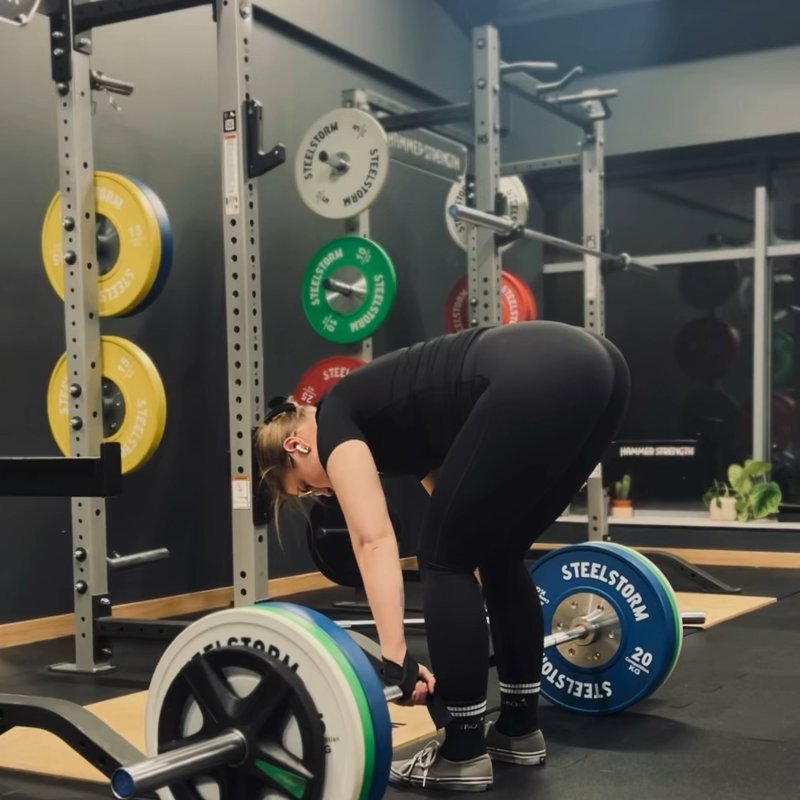 DeadliftErector spinae, glutes, hamstrings, quadriceps
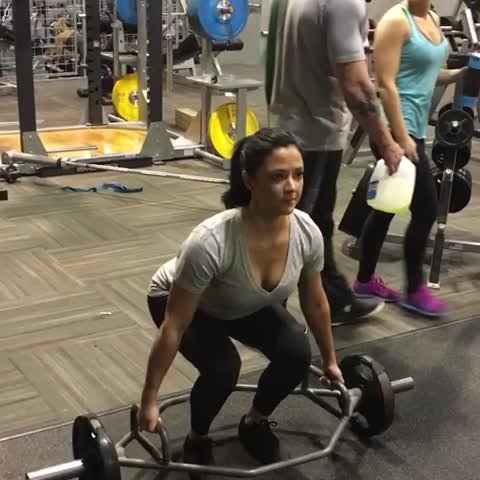 Trap Bar DeadliftErector spinae, glutes, hamstrings, quadriceps
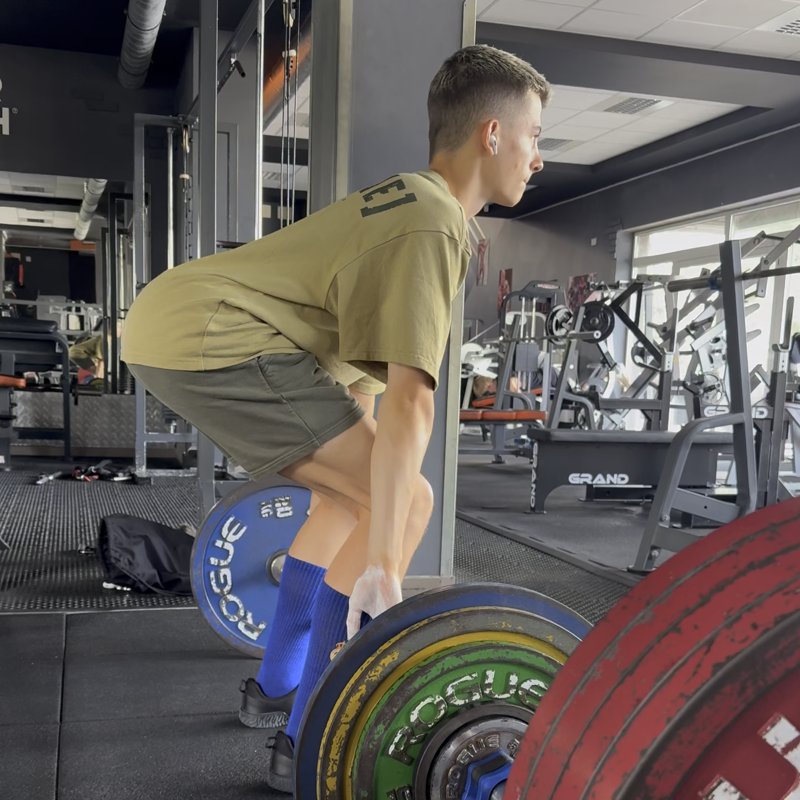 Conventional DeadliftErector spinae, glutes, hamstrings, quadriceps
 Martwy CiągErector spinae, glutes, hamstrings, quadriceps
 Paused DeadliftErector spinae, glutes, hamstrings, quadriceps
 Deficit DeadliftErector spinae, glutes, hamstrings, quadriceps
- Escamilla et al. 2000. Med Sci Sports Exerc 32(7):1265-1275.
- Escamilla et al. 2002. Med Sci Sports Exerc 34(4):682-688.
- Cholewicki, McGill and Norman 1991. Med Sci Sports Exerc 23(10):1179-1186.
- Cholewa et al. 2019. J Sports Sci Med 18(3):448-453.
- Hanen et al. 2025. Front Bioeng Biotechnol 13:1597209.
- Gundersen et al. 2025. J Strength Cond Res 39(3):281-288.
- Collings et al. 2026. Med Sci Sports Exerc 58(8):1751-1763.