How to Do a Push Press
A push press is an overhead press started by your legs. With the bar on your front delts, dip a few inches at the knees, then drive up hard and press to straight arms. It trains the front delts and triceps, helped by the quads and glutes. Most lifters do 3 to 5 sets of 3 to 6 reps.
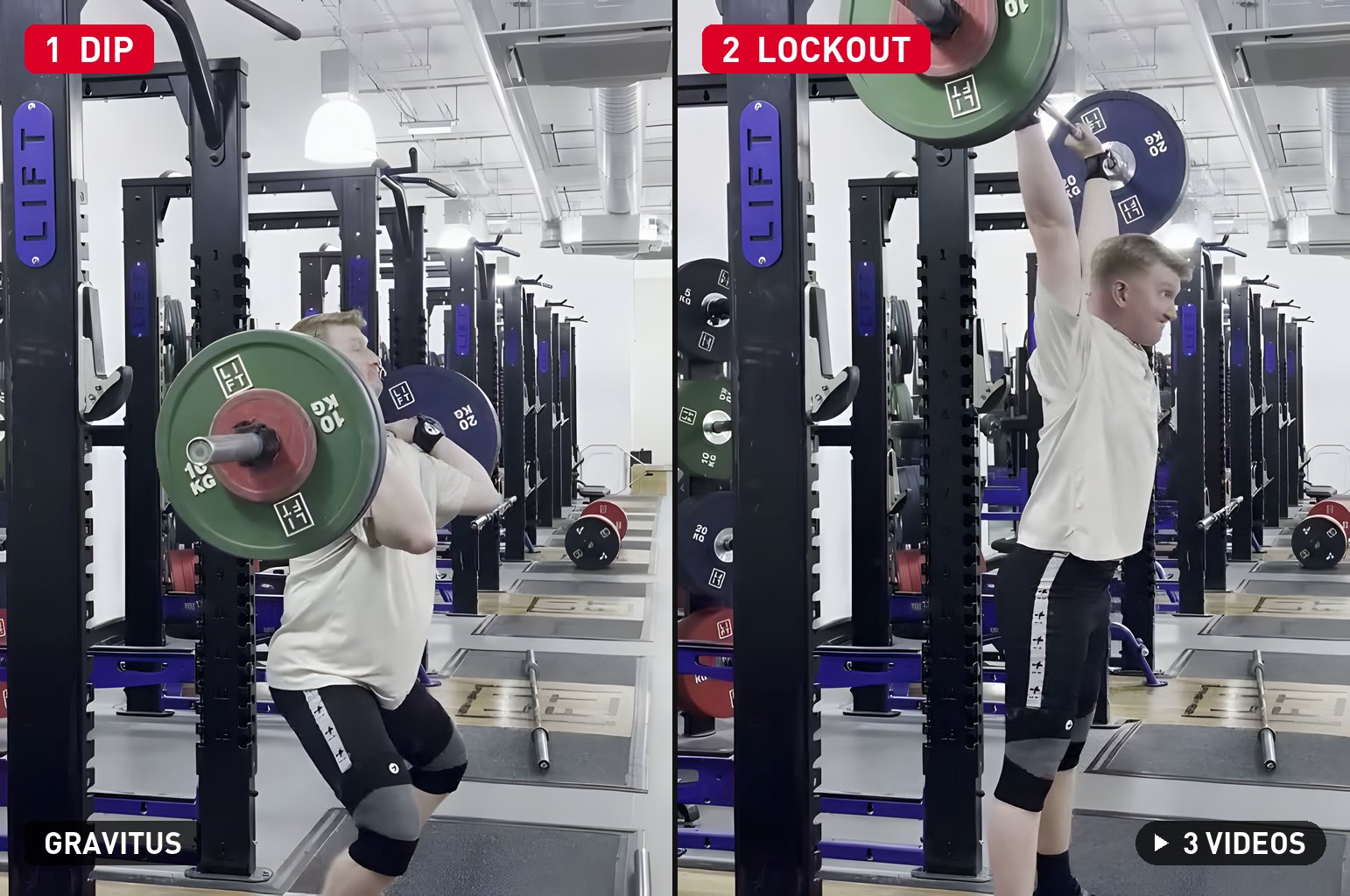
- 1Dip. Bar on your front delts, torso upright. Bend only your knees a few inches, straight down, and reverse without a pause.
- 2Lockout. Drive up hard with your legs and press as the bar leaves your shoulders. Finish with straight arms and the bar over your shoulders and mid-foot.
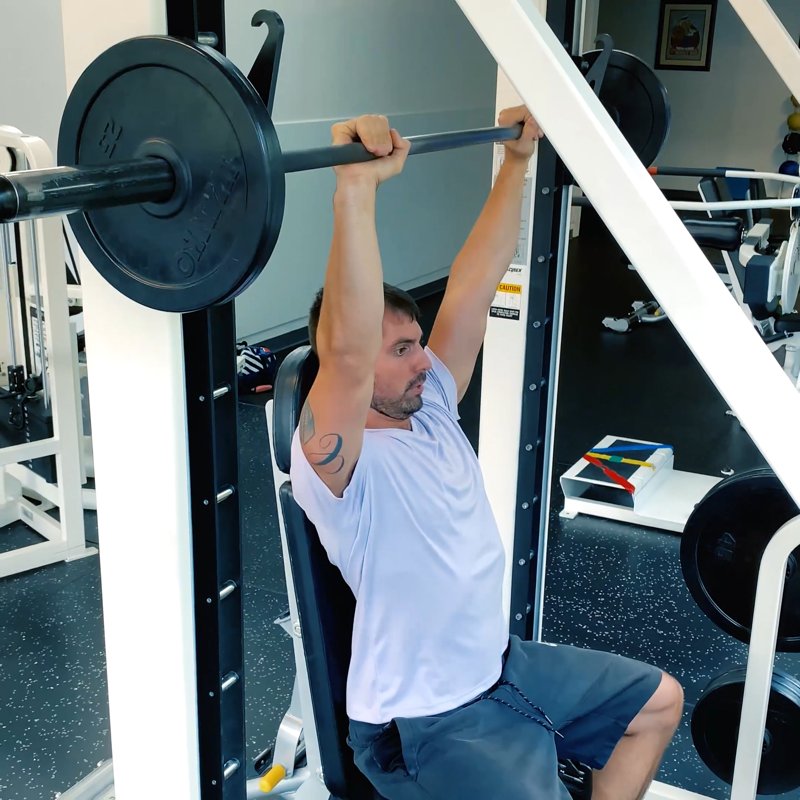
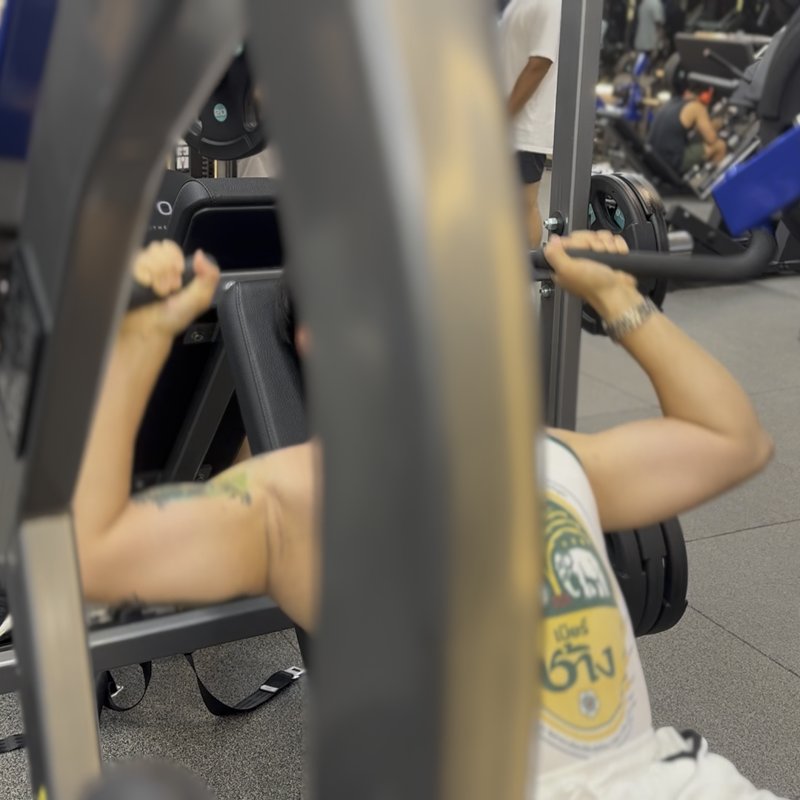
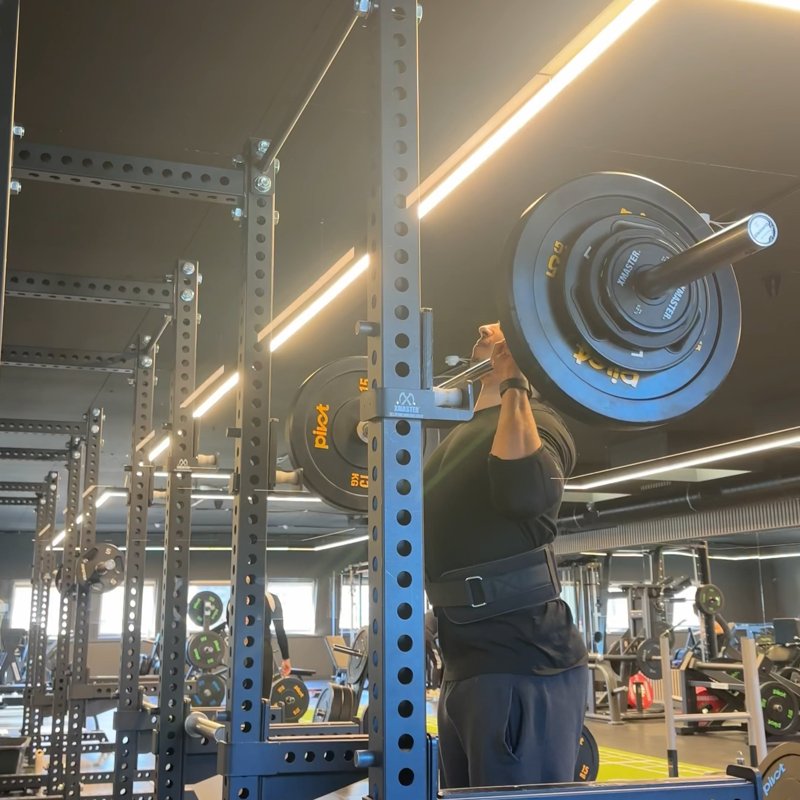
Watch 3 video demonstrations
Find more video demonstrations in the Gravitus app
How to do a push press
- Set the bar in a rack at upper-chest height. Grip it just outside your shoulders with a full grip, the bar low in your palms.
- Unrack it onto your front delts, against your throat, with your elbows slightly in front of the bar. Step back and stand with your heels about hip width apart.
- Take a big breath and brace your abs. Dip by bending only your knees, a few inches straight down, with your torso upright and your heels flat.
- Without pausing at the bottom, drive up hard through your whole foot until your knees and hips are straight. The bar leaves your shoulders from the leg drive.
- As the bar rises, pull your head back to let it pass your face, then press to straight arms and push your head forward under it. The bar finishes over your shoulders and mid-foot.
- Lower the bar to your shoulders under control and bend your knees slightly as it lands, so your legs take the impact. Reset your breath before the next rep.
How deep to dip, and how fast
Dip a short distance and turn around fast. Weightlifting coaches teach a dip of about 10% of your height, which is 6 to 7 inches (15 to 18 cm) for most adults: a quarter squat or less. A deeper dip is slower to reverse and lets your chest tip forward, so the bar drives out in front of you instead of straight up. In studies of the jerk, which starts with the same dip and drive, the top-ranked lifters dipped shallower and stopped the dip in less time than the rest (Soriano 2019).
Bend at the knees, not the hips. Your knees travel forward over your toes while your torso stays vertical, like sliding down a wall with your back against it. Your heels stay flat until your legs are straight; they may come up a little at the very end of the drive. The bar should feel light as it leaves your shoulders. Your arms take over only to finish what the legs started.
Reverse the dip the moment you reach the bottom. Pausing there loses the rebound that makes the drive fast, and turns the lift into a strict press with bent knees.
Push press vs overhead press: how the weights compare
Most guides say you can push press 20 to 30% more than you strict press. Gravitus logs show a much smaller gap. We compared the best estimated max of 1,800+ men and 260 women who log both the push press and the overhead press (Sep 2026). The median man's push press was only 103% of his strict press, and the middle half ran from 90 to 116%. The median woman's was 107%. Counting only sets of 5 reps or fewer, the median man's rose to 106%.
About 1 man in 5 pushed 120% or more, and 4 in 10 logged a push press lighter than their strict press. Part of the gap may be how lifters train it: many push press for speed with lighter loads or after their strict pressing. But a push press under your strict press means the dip and drive are not adding anything yet. Practise the dip with a light bar until it feels fast, then build up. The top quarter of men push press 116% or more of their strict press: 155 lb (70 kg) on a 135 lb (60 kg) press.
How much weight should you push press?
On Gravitus, the median man lifts 110 lb (50 kg) for 10 reps on the push press, and the median woman 55 lb (25 kg).
- Most lift
- 90 to 130 lb
- Top 10% lift
- 155 lb or more
- Starting out
- under 90 lb
- Most lift
- 45 to 70 lb
- Top 10% lift
- 85 lb or more
- Starting out
- under 45 lb
- Most lift
- 40 to 60 kg
- Top 10% lift
- 70 kg or more
- Starting out
- under 40 kg
- Most lift
- 19 to 32.5 kg
- Top 10% lift
- 37.5 kg or more
- Starting out
- under 19 kg
Push press muscles worked
Push press claims that do not hold up
- You can push press 30% more than you strict press. That figure appears all over the web without a source. The median Gravitus lifter logs 3 to 7% more (see above). About 1 man in 5 reaches 20% or more, so treat 30% as a ceiling, not a starting expectation.
- The push press is a cheat press. The legs do real work. With 10 to 90% of their max, trained men produced as much peak power in the push press as in a loaded jump squat, with the most power at 75% of their push press max (Lake 2014).
- The push press makes you faster. Not on its own evidence. Six weeks of push press training at the load that maximised power did little for young soccer players' sprint or jump, while jump squats improved both (Loturco 2016). Push press power was only moderately linked to sprint speed (Loturco 2017).
- Deeper dip, more drive. A deep dip is slow to reverse and tips you forward. Keep it short and fast (Soriano 2019).
- The push press and the push jerk are the same lift. In a push jerk you dip a second time to catch the bar on straight arms. Trained men lifted about 10% more that way (Soriano 2022).
Push press vs overhead press vs push jerk
| Attribute | Push press | Overhead press | Push jerk |
|---|---|---|---|
| Legs | Dip and drive, then press | Locked, no dip | Dip, drive, dip again to catch |
| Weight | 3 to 7% more than strict (Gravitus median) | Baseline | About 10% more than a push press |
| Skill | Moderate | Low | High |
| Arms finish the bar | True | Yes, from the bottom | No, you drop under it |
| Best for | Heavy top-half pressing, leg power | Strict pressing strength | Weightlifting, the most load overhead |
Keep the strict press as your main shoulder lift and push press on a second pressing day, or before lighter strict work. No study has compared the two for muscle growth. In trained lifters the push press max was about 1.0 times bodyweight for men and 0.8 for women, with push and split jerks heavier (Soriano 2022).
Sets, reps and progression
Push press first in the workout, while you are fresh, for 3 to 5 sets of 3 to 6 reps. That matches how Gravitus lifters use it: two-thirds of logged push press sets are 3 to 6 reps. Stop 1 to 3 reps short of failure. When the bar slows, the dip gets sloppy and the press drifts forward. Heavy loads build strength best, while muscle grows across a wide range of loads (Schoenfeld 2021), so save high reps for the strict press and dumbbells.
For power, use 2 to 3 fast reps at 65 to 75% of your push press max, where peak and mean power were highest (Lake 2014). For strength, add 5 lb (2.5 kg) when every set reaches 6 reps and drop back to 3. Press inside a rack with the safety arms just below your shoulders when the bar is heavy.
Common mistakes
-
Chest tipping forward in the dipThe bar drives out in front of you. Bend only your knees and keep your torso vertical, as if your back slides down a wall.
-
Dipping too deep or too slowThe drive loses speed and turns into a squat. Dip a few inches and reverse without a pause.
-
Pressing before the legs finishYour arms start the bar and the leg drive is wasted. Straighten your knees and hips first, then press.
-
Pressing around your faceThe bar drifts forward and gets heavier. Pull your head back, press close to your chin and nose, and push your head through at the top.
-
Leaning back to finishYour lower back arches under the heaviest part of the lift. Squeeze your glutes, keep your ribs down and lighten the bar.
-
Stiff legs as the bar comes downYour shoulders and spine take the impact. Bend your knees slightly as the bar lands on your shoulders.
Push press variations
Questions people ask
What muscles does the push press work?
The front delts and triceps press the bar, with help from the side delts. The quads and glutes start the bar in the dip and drive, and your core, traps and calves keep you upright and finish the drive.
Is the push press better than the overhead press?
Not better, different. The overhead press trains your shoulders and triceps through the whole press; the push press lets your legs start the bar, so you can press heavier through the top half and train leg power (Lake 2014). Most lifters do best with the strict press as the main lift and the push press as a second pressing lift.
How much more can you push press than strict press?
Less than most guides claim. In Gravitus logs, the median man's push press was 103% of his strict press and the median woman's 107% (Sep 2026). About 1 man in 5 reached 120%. The 30% figure often quoted fits skilled lifters, not most.
How deep should the dip be in a push press?
Short. About 10% of your height, or 6 to 7 inches (15 to 18 cm) for most adults, bending only at the knees with your torso upright. Reverse it the moment you reach the bottom.
Push press vs push jerk?
Both start with the same dip and drive. In a push press you press the bar to lockout; in a push jerk you dip again and catch it on straight arms. Trained men lifted about 10% more in the push jerk (Soriano 2022), but it takes more timing to learn.
Does the push press build muscle?
Yes, in the front delts and triceps, though no study has measured it directly. Your legs move the bar through the bottom of the press, so the shoulders work less there than in a strict press. Use strict and dumbbell presses for most shoulder volume and the push press for heavy top-half work.
How much weight should I push press?
For 10 reps, the median on Gravitus is 110 lb (50 kg) for men and 55 lb (25 kg) for women. The strongest quarter lifts 130 lb (60 kg) and 70 lb (32.5 kg) or more.
Log every set and see your percentile on every lift, push press included.
Get GravitusRelated exercises
- Soriano, Suchomel and Comfort 2019. Sports Med 49(6):867-885.
- Soriano et al. 2022. J Strength Cond Res 36(7):1930-1935.
- Lake, Mundy and Comfort 2014. J Strength Cond Res 28(9):2552-2559.
- Loturco et al. 2016. PLoS One 11(4):e0153958.
- Loturco et al. 2017. Int J Sports Med 38(8):604-612.
- Schoenfeld et al. 2021. Sports 9(2):32.