How to Overhead Press
The overhead press is a standing barbell press from your collarbones to straight arms. Grip just outside your shoulders, pull your head back to let the bar pass your face, then push your head under it. It trains the front delts and triceps. Most lifters do 3 to 5 sets of 5 to 10 reps.
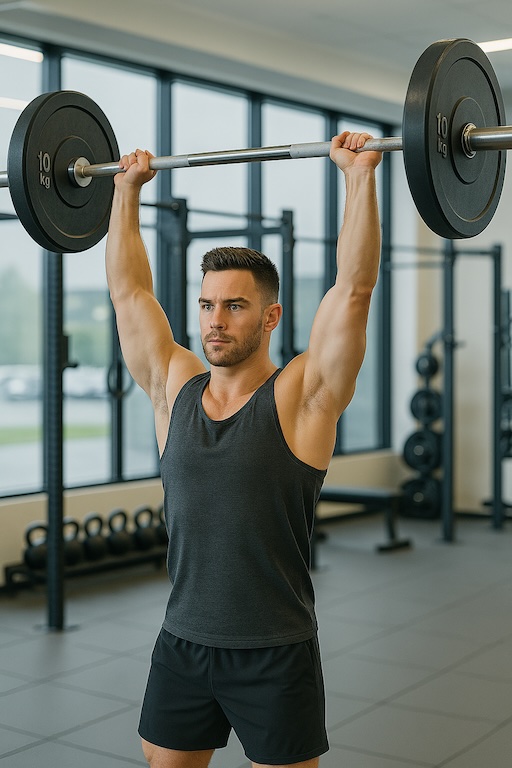
- 1Start. Bar on your front delts at collarbone height, hands just outside your shoulders, forearms vertical and knees straight.
- 2Top. Head back as the bar passes your face, then forward under it. Lock your elbows with the bar over your shoulders and mid-foot.
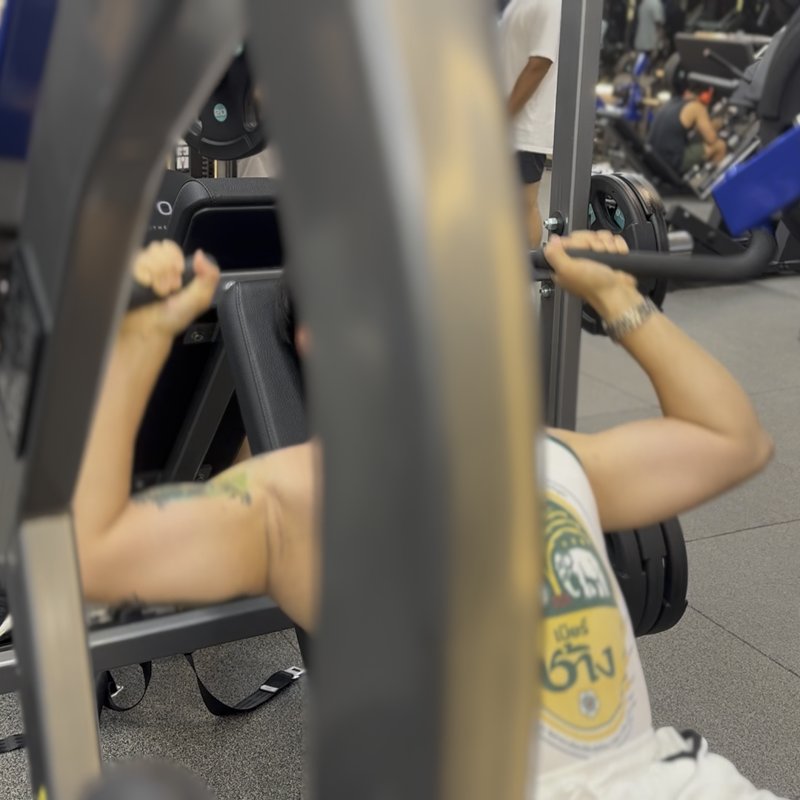
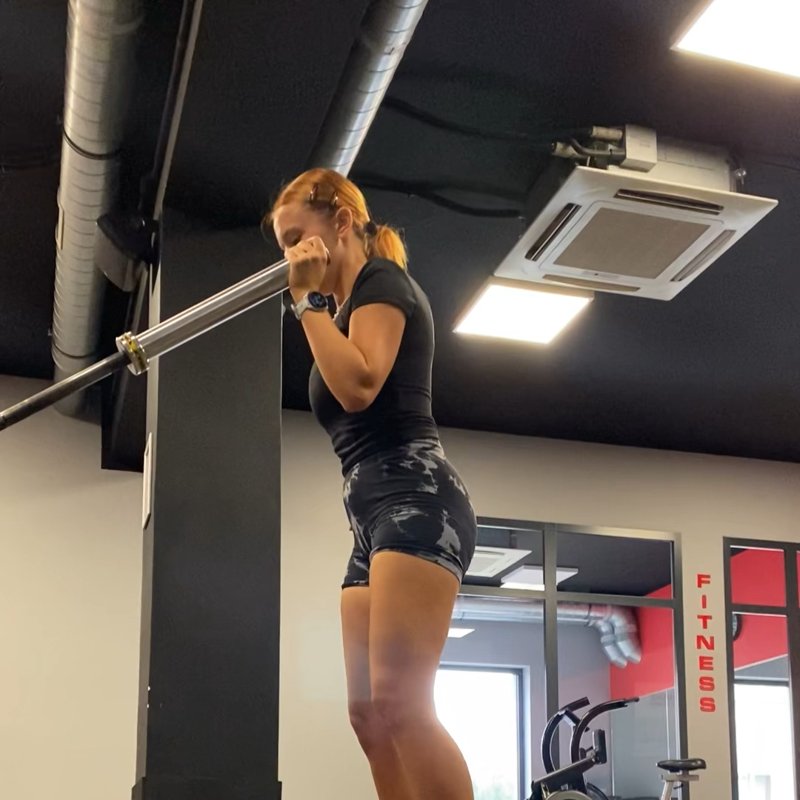
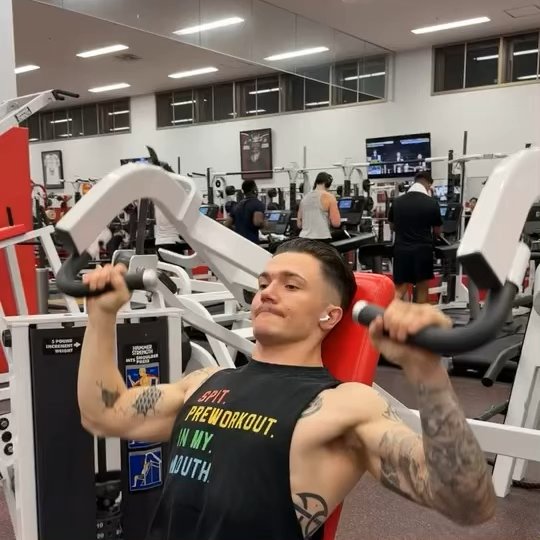
Watch 3 video demonstrations
Find more video demonstrations in the Gravitus app
How to overhead press
- Set the bar in a rack at upper-chest height. Grip it just outside your shoulders with your thumbs around the bar and the bar low in your palms, over your forearms.
- Unrack it onto your front delts at collarbone height and take two steps back. Stand with your feet about hip width apart and your knees straight.
- Set your elbows slightly in front of the bar, so your forearms are vertical. Squeeze your glutes, take a big breath and brace your abs.
- Press the bar straight up, pulling your head back just far enough for the bar to pass your chin and nose.
- Once the bar passes your forehead, push your head forward under it and lock your elbows, with the bar over your shoulders and mid-foot. Let your shoulder blades rise and rotate with your arms.
- Lower over 2 seconds to your collarbones, moving your head back again as the bar passes your face, and press the next rep.
Bar path: your head moves, the bar goes straight up
The bar starts in front of your shoulders and finishes over them, so it has to move back as it rises. You make that happen by moving your head and torso under the bar, not by pushing the bar around your face. Seen from the side, the bar should travel close to straight up over your mid-foot. If it swings out in front of your face, your head did not move back far enough, and the bar gets much heavier the further it drifts forward.
Grip width: just outside your shoulders
In a seated barbell press, resistance-trained men lifted more weight with a narrower grip and moved through more shoulder and elbow range. Wider grips took load off the elbows and put more on the shoulders; narrower grips did the opposite (Gundersen 2026). Start just outside your shoulders, and move in a little if your shoulders complain or your forearms angle out.
Standing or seated?
Stand for the barbell press. Sitting against a backrest takes your legs and lower back out of the lift, but it does not let most lifters press more with a barbell. In Gravitus logs, the median man's standing overhead press was 99% of his seated barbell press (1,700+ men who log both, Sep 2026). In the lab, only pressing dumbbells standing lowered the 1-rep max (Saeterbakken 2013).
Standing works more muscle at the same relative load. Seated barbell presses drew 25% less rear delt activity than standing ones, with trends toward less side delt and triceps activity (Saeterbakken 2013). Your abs work too: a press on the floor at 75% of max trained them at least as hard as a lighter press on a BOSU ball (Willardson 2009), so you do not need an unstable surface to train your core.
Stand with your knees straight and your glutes squeezed. If your lower back keeps arching, press seated against a backrest or sit on the floor for a Z press.
What Gravitus lifters overhead press for 10 reps
On Gravitus, the median man lifts 90 lb (42.5 kg) for 10 reps on the overhead press, and the median woman 45 lb (20 kg).
- Most lift
- 75 to 110 lb
- Top 10% lift
- 125 lb or more
- Starting out
- under 75 lb
- Most lift
- 32.5 to 55 lb
- Top 10% lift
- 65 lb or more
- Starting out
- under 32.5 lb
- Most lift
- 32.5 to 50 kg
- Top 10% lift
- 57.5 kg or more
- Starting out
- under 32.5 kg
- Most lift
- 15 to 25 kg
- Top 10% lift
- 30 kg or more
- Starting out
- under 15 kg
Overhead press vs bench press: how the weights compare
The median man presses 57% of his bench press, and the median woman 64%. We compared the best estimated max of 19,000+ men and 3,000+ women who log both lifts in Gravitus (Sep 2026). A 225 lb (102.5 kg) bench predicts a press of about 125 lb (57.5 kg). A press under half your bench puts you in the bottom quarter of men.
Against other lifts, the median man's press is 71% of his incline bench, and each dumbbell in a dumbbell shoulder press is about 55% of his barbell press. To see how your max compares with lifters your bodyweight, sex and age, use the overhead press standards or the average overhead press page.
Overhead press muscles worked
Should you shrug at the top, or keep your shoulders down?
Neither on purpose. Let your shoulders rise as you lock out. During the military press, the shoulder blades rotate up and tilt back and the collarbones rise and pull back as the arms go overhead (Ichihashi 2014, Ludewig 2009). That movement makes room for the arm, so pinning your shoulders down and back like on a bench press works against it. A forced shrug is not needed either; reach tall at the top and the shoulder blades do the rest. What to avoid is shrugging before the press starts, with your shoulders up by your ears at the bottom.
Four other claims that do not hold up:
- It trains all three delts. The rear delts do little in a front press. Pressing behind the neck drew far more rear delt activity than pressing in front (Coratella 2022). Add reverse flyes or face pulls.
- The pec minor helps you press. It pulls the shoulder blade forward and down, the opposite of what the shoulder blade does as your arms go overhead.
- Seated lets you press more. Not with a barbell. In Gravitus logs, standing and seated barbell presses are about the same weight.
- Stopping short of lockout keeps tension on the delts. In a seated military press, pressing to straight arms drew more delt, trap and triceps activity than stopping with the elbows bent (Paoli 2010).
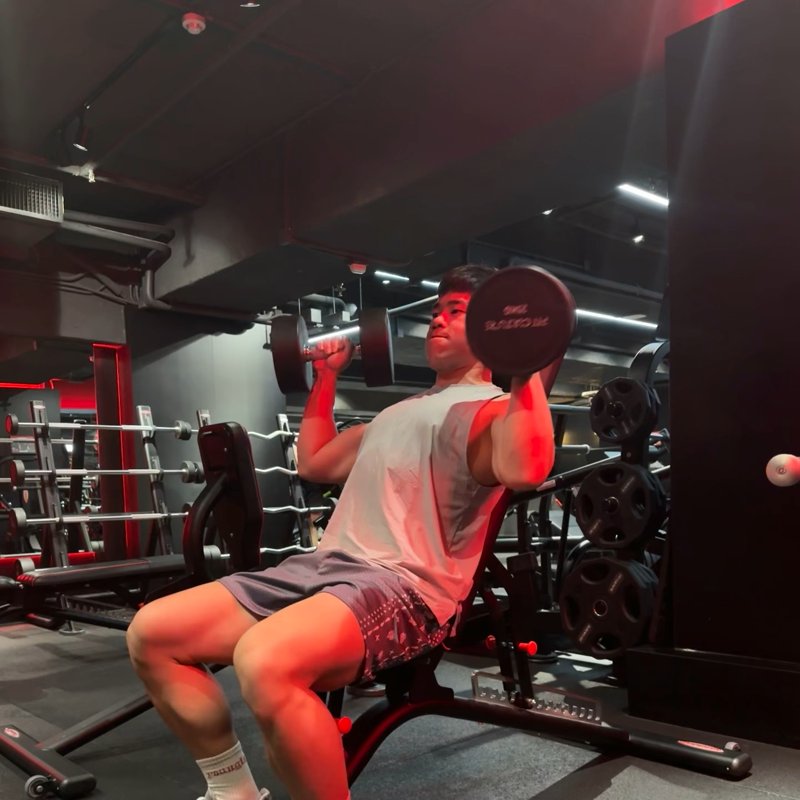
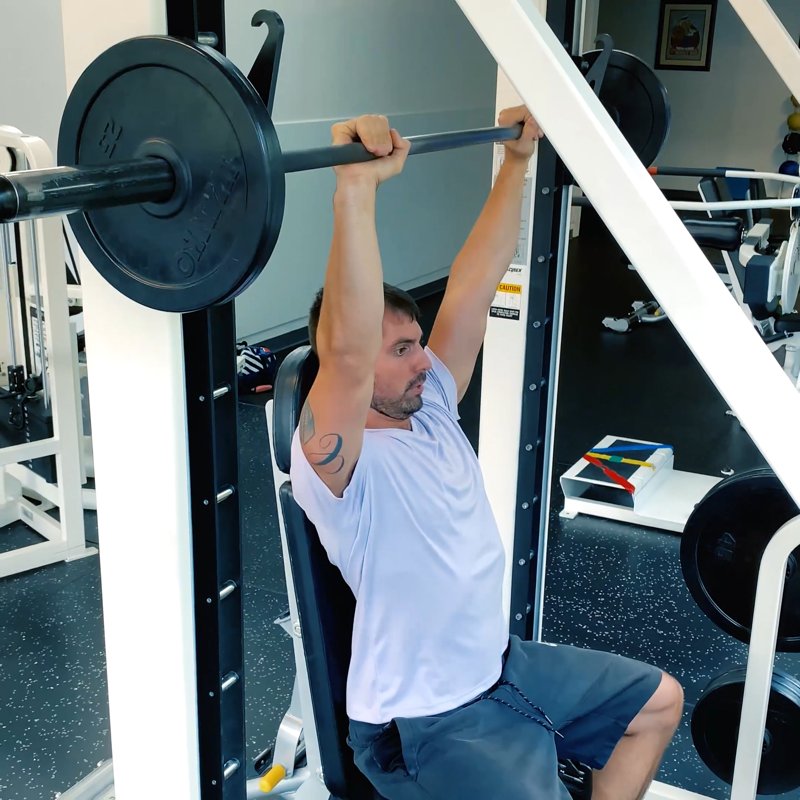
Overhead press vs dumbbell shoulder press vs Smith machine
| Attribute | Barbell overhead press | Dumbbell shoulder press | Smith machine shoulder press |
|---|---|---|---|
| Path | Straight up, your head moves | You choose it | Straight up the rails |
| Balance needed | Some, one free bar | Most, each arm alone | Little, one bar on rails |
| Weight jumps | 2.5 lb (1.25 kg) or less | 5 lb (2.5 kg) per hand | 2.5 lb (1.25 kg) or less |
| Spotter | Safety pins near failure | Helpful when heavy | Not needed, with safety stops |
| Best for | Free-weight pressing strength | Range of motion, one arm at a time | Hard sets alone |
A tie for growth: free weights and machines build muscle equally, but strength carries over best to the equipment you train on (Haugen 2023). Keep the barbell press if you want a bigger barbell press, and add dumbbells if one side is weaker.
Sets, reps and progression
Press once or twice a week, early in a shoulder, push or upper-body workout. Stop each set 1 to 2 reps short of failure. Sets taken close to failure build muscle across a wide range of reps (Schoenfeld 2021), so heavy 5s and lighter 10s both work. Press inside a rack with the safety pins a few inches below your collarbones, so you can bend your knees and set a missed rep down.
The press moves up slowly. A 5 lb (2.5 kg) jump on a 95 lb (42.5 kg) press adds 5%. Add reps first: when every set reaches the top of your range, add 2.5 to 5 lb (1.25 to 2.5 kg) and drop back to the bottom. Fractional plates help once the jumps stall. Pair the press with lateral raises for the side delts and a rear delt exercise.
Common mistakes
-
Leaning backThe press turns into a steep incline press and your lower back bends. Squeeze your glutes, brace, and move your head, not your torso, out of the bar's way.
-
Bending your kneesA dip and drive turns it into a push press. Lock your knees before the first rep and keep them locked.
-
Pressing around your faceThe bar drifts forward and gets heavier. Pull your head back, press close to your chin and nose, and push your head through at the top.
-
Elbows behind the barThe bar starts moving forward off your shoulders. Set your elbows slightly in front of the bar, forearms vertical.
-
Wrists bent backThe bar sits in your fingers and strains the wrist. Set it low in your palm, over your forearm.
-
Shrugging before you pressYour traps start the rep and your neck tightens. Start with your shoulders relaxed and let them rise only as the bar goes up.
Overhead press variations
Questions people ask
What muscles does the overhead press work?
The front delts most, with the triceps, side delts and upper chest helping. Your core and glutes hold your torso still, and the rear delts do little.
What grip width should I use for the overhead press?
Just outside your shoulders, where your forearms are vertical at the bottom, seen from the front and the side. In a seated barbell press, narrower grips let men lift more, and wider grips shifted load from the elbows to the shoulders (Gundersen 2026).
Should I shrug at the top of the overhead press?
Let your shoulders rise, but you do not need a big shrug. Your shoulder blades rotate up and your collarbones rise as your arms go overhead (Ichihashi 2014). Reach tall at lockout, and do not shrug before the press starts.
Standing vs seated overhead press?
Standing for most barbell pressing. In Gravitus logs, men press about the same weight standing and seated, and in the lab seated barbell presses drew 25% less rear delt activity (Saeterbakken 2013). Press seated if you want your legs and lower back out of the lift.
Overhead press vs bench press?
Do both if you can. The bench press works the chest most and moves more weight; the overhead press works the front delts and triceps standing. In Gravitus logs, the median man presses 57% of his bench and the median woman 64%.
Is the behind the neck press bad for your shoulders?
Not for everyone, but it needs more shoulder mobility than a front press. It drew more side and rear delt activity and less upper chest (Coratella 2022, Padovan 2026). If it hurts, or you have to push your head far forward to clear the bar, press in front.
Why does my lower back hurt when I overhead press?
Usually because you lean back to press, which bends your lower back under the bar. Squeeze your glutes, brace your abs, keep your ribs down, and move your head, not your torso, out of the bar's way. If you still lean back, take weight off.
Is overhead press bad for your wrists?
Not with the bar low in your palm, over your forearm. Wrist pain usually means the bar sits in your fingers and your wrists bend back. Grip closer to the heel of your hand and keep your forearms vertical; wrist wraps help on heavy sets.
How much weight should I overhead press?
For 10 reps, the median on Gravitus is 90 lb (42.5 kg) for men and 45 lb (20 kg) for women. The strongest quarter lifts 110 lb (50 kg) and 55 lb (25 kg) or more.
Log every set and see your percentile on every lift, overhead press included.
Get GravitusRelated exercises
- Gundersen et al. 2026. Sports Biomech 25(6):841-854.
- Saeterbakken and Fimland 2013. J Strength Cond Res 27(7):1824-1831.
- Ichihashi et al. 2014. J Shoulder Elbow Surg 23(5):649-657.
- Ludewig et al. 2009. J Bone Joint Surg Am 91(2):378-389.
- Coratella et al. 2022. Front Physiol 13:825880.
- Padovan et al. 2026. J Hum Kinet 103:81-96.
- Paoli, Marcolin and Petrone 2010. J Strength Cond Res 24(6):1578-1583.
- Willardson, Fontana and Bressel 2009. Int J Sports Physiol Perform 4(1):97-109.
- Haugen et al. 2023. BMC Sports Sci Med Rehabil 15:103.
- Schoenfeld et al. 2021. Sports 9(2):32.