How to Do Preacher Curls (Scott Curls)
A preacher curl, or Scott curl, is a biceps curl done with the backs of your upper arms on an angled pad, so you cannot swing the weight. On a standard 45-degree pad it is hardest near the bottom, where the biceps is stretched. It trains the biceps and brachialis. Most lifters do 3 sets of 8 to 15 reps.
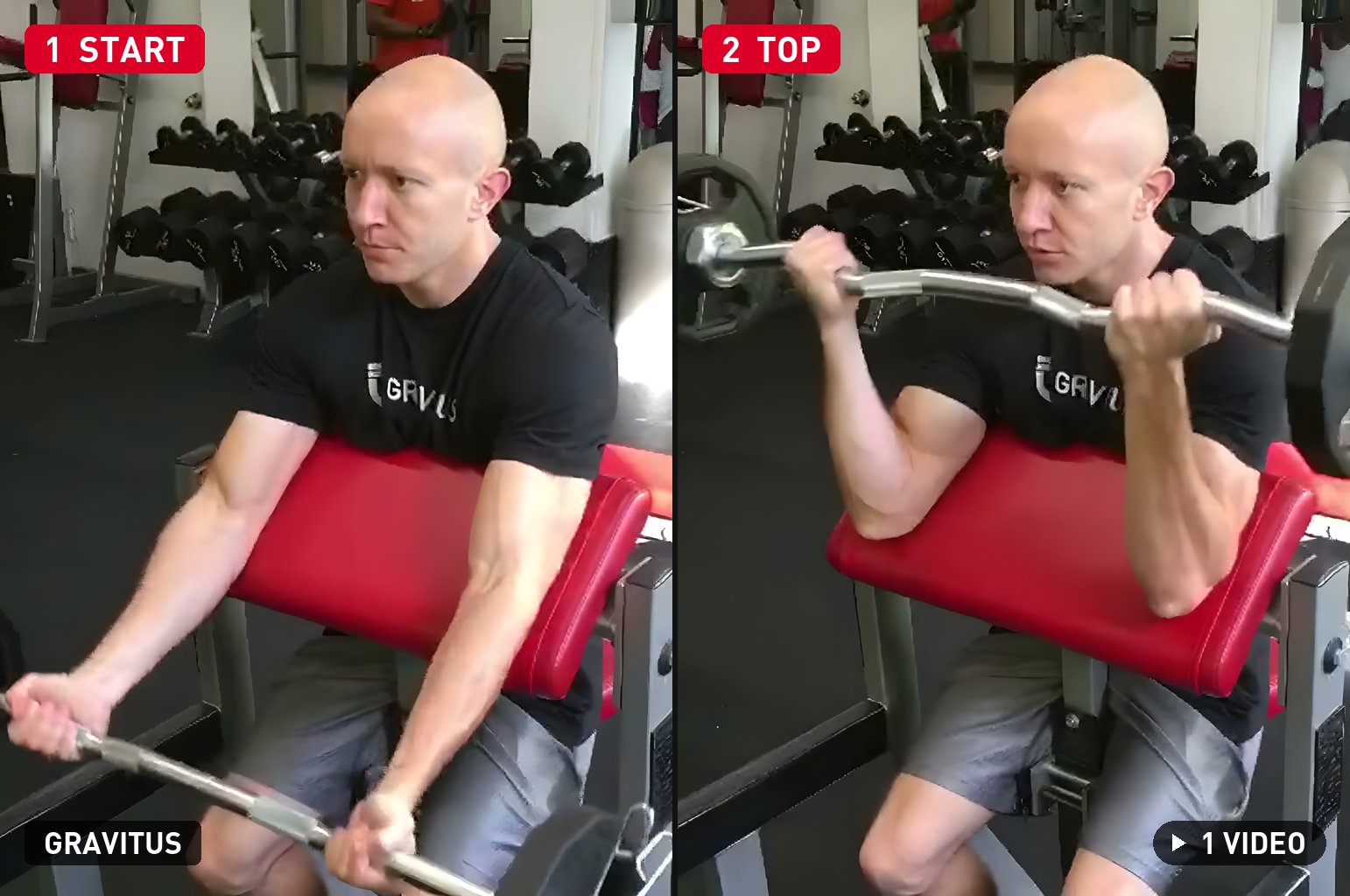
- 1Start. Armpits on the top edge of the pad, the backs of your upper arms flat on it, underhand grip, arms straight.
- 2Top. Curl by bending only at the elbows until your forearms are close to vertical, then lower until your arms are straight.
Watch 1 video demonstration
How to do a preacher curl
- Set the seat so your armpits sit on the top edge of the pad and the backs of your upper arms lie flat on it, chest against the pad.
- Take an EZ bar or barbell with an underhand grip at about shoulder width. On an EZ bar, use the angled grips.
- Curl the bar toward your shoulders by bending only at the elbows. Stop when your forearms are close to vertical; past that the load is gone.
- Lower over 2 to 3 seconds until your arms are straight. Do not bounce out of the bottom.
- Keep your upper arms and chest on the pad for the whole set. If your elbows lift, the weight is too heavy.
Where the preacher curl is hardest
A bar pulls straight down, so a curl is hardest when your forearm is level with the floor. On a preacher bench your upper arm already slopes forward, so your forearm reaches level early in the rep. The flatter the pad, the closer to arms-straight the hardest point sits, and the sooner the top of the rep goes light.
Use the 45-degree side and lower to straight arms every rep, because the bottom half carries most of the load. In an 8-week trial, training only that half grew the biceps more near the elbow and raised the full curl max 43%, against 19% for the top half (Pedrosa 2023).
How much weight should you preacher curl?
On Gravitus, the median man lifts 60 lb (27.5 kg) for 10 reps on the preacher curl, and the median woman 30 lb (14 kg).
- Most lift
- 45 to 75 lb
- Top 10% lift
- 90 lb or more
- Starting out
- under 45 lb
- Most lift
- 25 to 40 lb
- Top 10% lift
- 50 lb or more
- Starting out
- under 25 lb
- Most lift
- 20 to 32.5 kg
- Top 10% lift
- 40 kg or more
- Starting out
- under 20 kg
- Most lift
- 11 to 18 kg
- Top 10% lift
- 22.5 kg or more
- Starting out
- under 11 kg
What the research says
Four growth trials have tested the preacher curl. Over 8 weeks, preacher curls grew the elbow flexors more near the elbow and incline curls more near the shoulder (Kassiano 2025). In a 9-week trial, the preacher group's arms grew near the elbow and the incline group's did not grow measurably, though the gap between groups was not significant (Zabaleta-Korta 2023). Over 10 weeks, barbell and cable preacher curls grew the biceps 8% and 7% (Nunes 2020), and one-arm cable preacher and Bayesian curls 6% to 7% and 9%, a gap too small to call (Attarieh 2025).
Five common claims the research does not back:
- It builds the biceps peak. The extra growth from preacher curls showed up near the elbow (Kassiano 2025), and so did the extra growth from their bottom half (Pedrosa 2023).
- It targets the short head. With your arm in front, the long head is shorter at the shoulder, so guides say the short head works harder. When two 10-week trials changed only the shoulder angle and matched the resistance, the biceps grew about the same (Attarieh 2025, Larsen 2026).
- Stop short of straight arms. The bottom is where a preacher curl carries its load, and the arms that grew most trained down to a straight elbow (Pedrosa 2023). Lower slowly and do not bounce.
- Cable preacher curls keep constant tension. In the cable version tested, the load peaked with the elbows bent, the reverse of a barbell. Both grew the biceps about the same (Nunes 2020).
- Lengthened partials beat full reps. Bottom-half reps beat top-half reps (Pedrosa 2023), but in an 8-week program that included two curls, lengthened partials and full reps grew trained lifters' elbow flexors the same (Wolf 2025).
Muscles worked
Which preacher curl to use
On free weights, the pad angle sets the resistance curve. On a cable or machine, the pulley or cam does.
Preacher vs incline dumbbell vs Bayesian curl
| Attribute | Preacher curl | Incline dumbbell curl | Bayesian cable curl |
|---|---|---|---|
| Upper arm | In front of your body | Behind your body | Behind your body |
| Hardest point | A third of the way up, bottom loaded | Halfway, nothing at the bottom | Near the bottom, set by your stance |
| Extra growth | Near the elbow | Near the shoulder | None found, level with a cable preacher curl |
| Cheating | Hard, the pad holds your arms | Hard, the bench holds your back | Easy to swing |
None wins outright. Over 8 weeks the preacher curl grew the elbow flexors more near the elbow and the incline curl more near the shoulder (Kassiano 2025), and the Bayesian curl matched a cable preacher curl (Attarieh 2025). If you do two curls, pair the preacher with one that puts your arm behind you.
Sets, reps and progression
Stop each set 0 to 2 reps short of failure. Sets taken close to failure build muscle across a wide range of reps (Schoenfeld 2021), so pick a range you can keep strict on the pad.
Add reps first. When every set reaches the top of your range, add 5 lb (2.5 kg) to the bar and drop back to the bottom of the range.
Common mistakes
-
Seat at the wrong heightIf the pad digs into your armpits or sits well below them, your shoulders creep into the lift. Set the seat so your armpits rest on the top edge and your upper arms lie flat.
-
Stopping short at the bottomThe bottom half carries most of the load and grew the biceps most (Pedrosa 2023). Lower until your arms are straight.
-
Bouncing out of the bottomThe stretched position is where the bar is heaviest. Lower over 2 to 3 seconds and start each rep from a stop.
-
Curling past verticalOnce your forearms pass vertical the bar rests on your joints and the biceps get a break. Stop just short.
-
Lifting your elbows or chest off the padYour shoulders start to help and the curl turns into a swing. Go lighter until your arms stay down.
Preacher curl variations
Questions people ask
What is a descending preacher curl?
A preacher curl whose resistance is highest near the bottom, with your arm straight, and falls as you curl up. A dumbbell preacher curl on a sloped Scott bench is one; researchers class it as a descending profile (Zabaleta-Korta 2023). On a machine the cam sets the profile, and a cable preacher curl usually runs the other way (Nunes 2020).
Why is it called a preacher curl?
The sloped pad looks like a preacher's pulpit or lectern. It is also called the Scott curl after Larry Scott, the first Mr. Olympia in 1965, who made it famous training at Vince Gironda's gym.
What muscles do preacher curls work?
The biceps, both heads, and the brachialis, with the brachioradialis helping. In growth trials, preacher curls grew the elbow flexors most near the elbow (Kassiano 2025).
Is preacher curl push or pull?
Pull. You bend your elbow to pull the weight toward you, so it belongs with pull or arm work.
Should I do preacher curls first or last?
Either works for muscle growth. A meta-analysis found exercise order did not change hypertrophy, but strength rose most in whichever exercise came first (Nunes 2021). Put the preacher curl first if getting stronger on it is your goal.
Should you fully extend your arms on preacher curls?
Yes, under control. The bottom of a preacher curl carries the most load, and training that half grew the biceps near the elbow more than training the top half (Pedrosa 2023). Lower slowly to straight arms and do not bounce.
How much weight should I preacher curl?
For 10 reps, the median on Gravitus is 60 lb (27.5 kg) for men and 30 lb (14 kg) for women. The strongest quarter lifts 75 lb (32.5 kg) and 40 lb (18 kg) or more.
Log every set and see your percentile on every lift, preacher curl included.
Get GravitusRelated exercises
- Pedrosa et al. 2023. Sports 11(2):39.
- Kassiano et al. 2025. Int J Sports Med 46(5):334-343.
- Zabaleta-Korta et al. 2023. J Hum Kinet 87:259-270.
- Nunes et al. 2020. Int J Environ Res Public Health 17(16):5859.
- Attarieh, Nunes et al. 2025. Eur J Sport Sci 25(4):e12279.
- Larsen et al. 2026. Front Physiol 17:1750722.
- Wolf et al. 2025. PeerJ 13:e18904.
- Nunes et al. 2021. Eur J Sport Sci 21(2):149-157.
- Schoenfeld et al. 2021. Sports 9(2):32.