Bayesian Cable Curl: The Ultimate Guide
A Bayesian cable curl is a one-arm biceps curl done facing away from a cable, with your upper arm slightly behind your body. Set up well, the cable is hardest near the bottom of the rep, where the biceps are stretched. It trains the biceps and brachialis. Most lifters do 3 sets of 8 to 15 reps per arm.
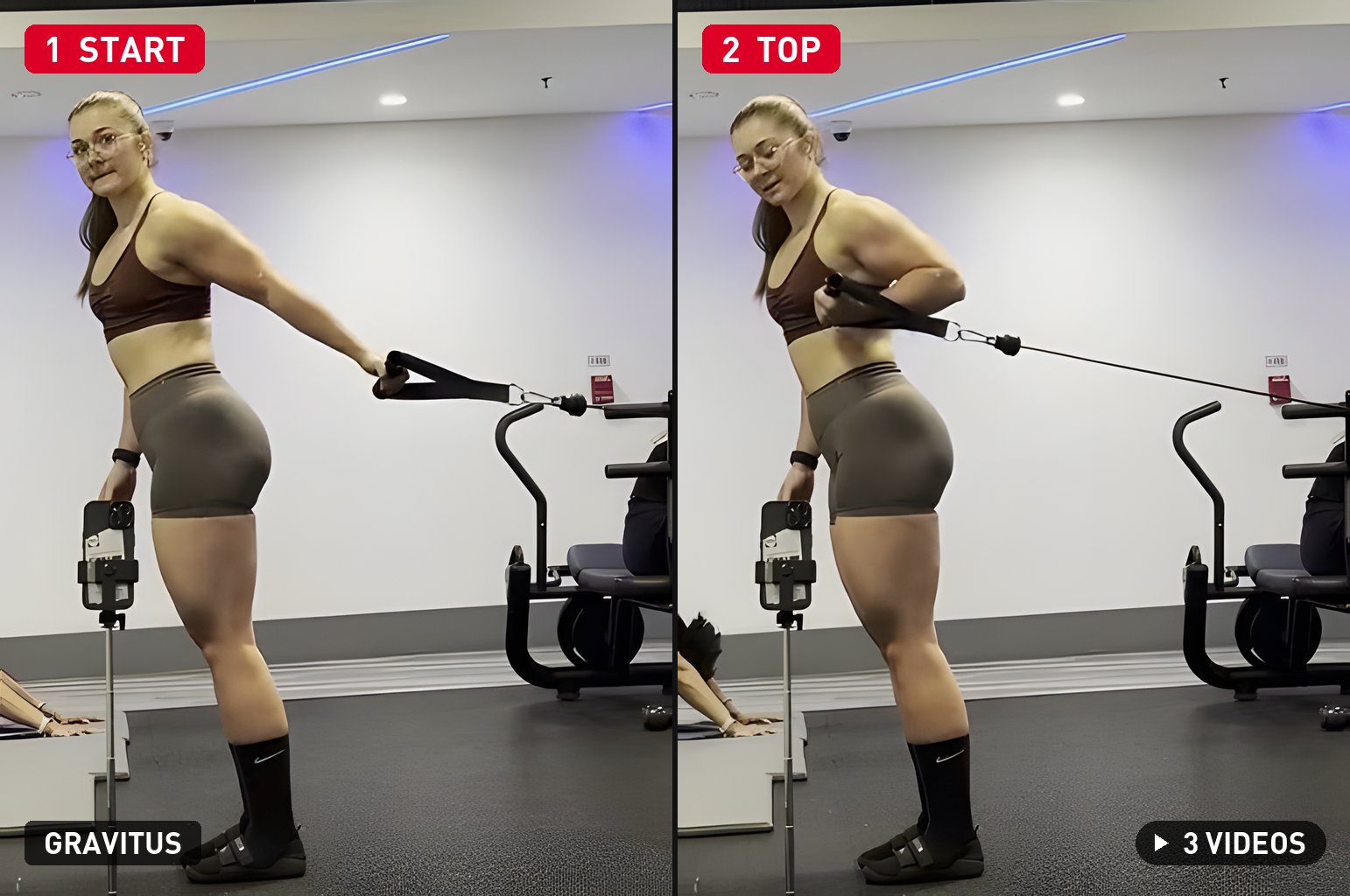
- 1Start. Back to the stack, D handle in one hand. Step forward until the cable draws your arm slightly behind your body, palm facing forward.
- 2Top. Curl the handle toward your chest by bending only at the elbow, then lower until your arm is straight.
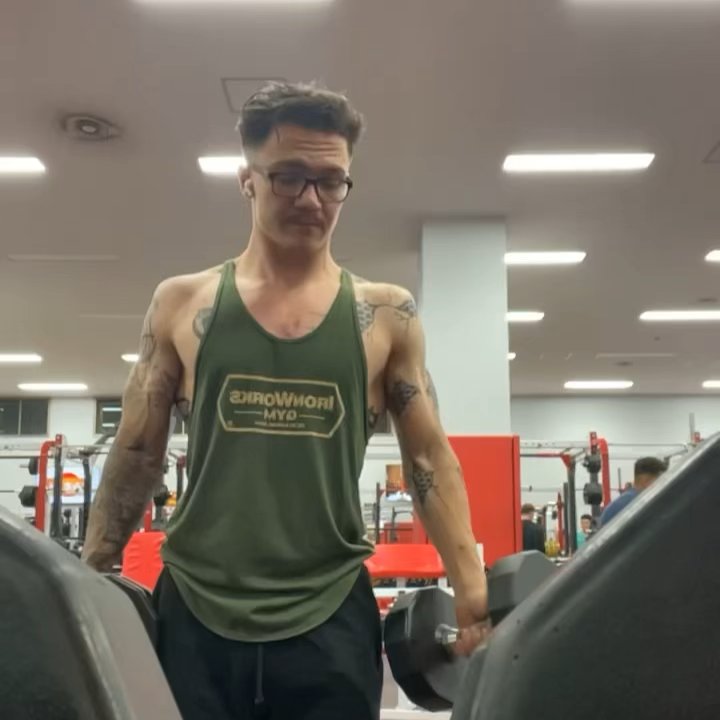
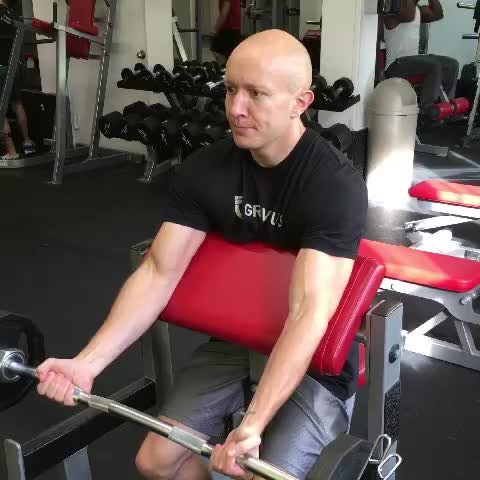
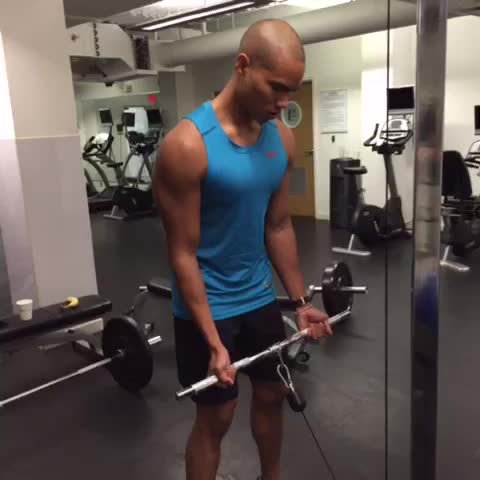
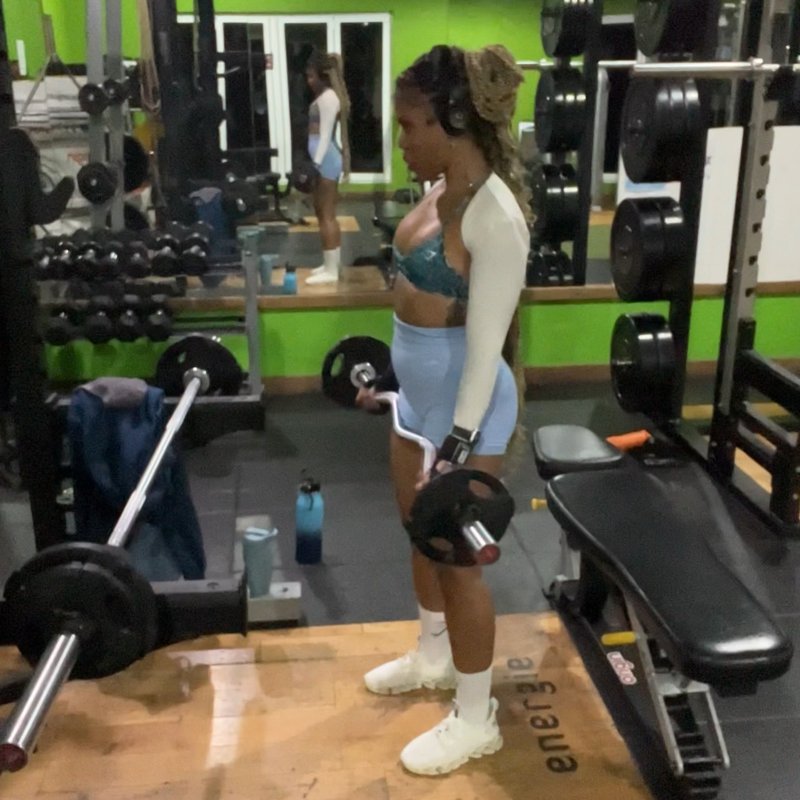
Watch 3 video demonstrations
How to do a Bayesian cable curl
- Clip a D handle to a pulley at hip height, or on the lowest notch. Take it in one hand and turn your back to the stack.
- Walk forward until the cable draws your arm slightly behind your body and the weight lifts off the stack. From a low pulley, keep going until the cable runs close to level.
- Stagger your feet, brace your abs and turn your palm to face forward. Your elbow sits just behind your torso and stays there.
- Curl the handle toward your shoulder by bending only at the elbow.
- Lower over 2 to 3 seconds until your arm is fully straight and you feel the stretch in your biceps.
Where you stand changes the Bayesian curl
A cable pulls with the same force all rep, but not with the same leverage on your elbow. The curl is hardest when your forearm is at a right angle to the cable, so the closer the cable runs to level, the closer to arms-straight the hardest point sits. The curves are modelled for an arm held 20 degrees behind the body, with the shoulder 2 ft (0.6 m) or 5 ft (1.6 m) in front of a low pulley, or 3 ft (1 m) in front of a hip-height one.
Set the pulley at hip height, or step well forward from a low one. Training the curl with the arms nearly straight grew the biceps more than training the top half (Sato 2021, Kassiano 2023). Pulling your arm further back does not add load at the bottom: with a low pulley it moves the hardest point up the rep.
How much weight should you Bayesian curl?
On Gravitus, the median man lifts 35 lb (16 kg) for 10 reps on the bayesian cable curl.
- Most lift
- 27.5 to 55 lb
- Top 10% lift
- 75 lb or more
- Starting out
- under 27.5 lb
- Most lift
- 12 to 25 kg
- Top 10% lift
- 35 kg or more
- Starting out
- under 12 kg
What the research says
Two 10-week trials have tested the arm-behind-the-body position directly. One-arm Bayesian cable curls grew the biceps 9% and preacher cable curls 6% to 7%, a gap too small to call (Attarieh 2025). In the second trial, cable curls with the shoulder fully extended or at neutral grew the elbow flexors by the same 6% to 9% when the resistance was matched (Larsen 2026). What the Bayesian curl adds is load at the bottom of the rep, where training grows the biceps most (Sato 2021).
Four common claims the research does not back:
- It builds the long head more. The long head crosses the shoulder, so it is longer with your arm behind you. But in both trials the biceps grew the same at every site measured, whatever the shoulder angle.
- Cables give constant tension. The pull on the cable stays the same, but its leverage on your elbow does not. With a hip-height pulley the top of the rep carries almost no load, as the chart above shows.
- It works the biceps harder than a regular curl. At 80% of each lift's max, the dumbbell curl drew more biceps activity than the Bayesian curl (Parpa 2025). Activity is not growth, and the growth trials put the Bayesian level with other curls.
- The name means it is evidence-based. It is named after Bayesian Bodybuilding, the coaching company of Menno Henselmans, who popularized it.
Muscles worked
Ways to set it up
The same rule applies to every version: keep the cable close to level with your arm straight, and your elbow still.
Bayesian vs incline dumbbell vs preacher curl
| Attribute | Bayesian cable curl | Incline dumbbell curl | Preacher curl |
|---|---|---|---|
| Upper arm | Behind your body | Behind your body | In front of your body |
| Hardest point | Near the bottom, set by your stance | Halfway, nothing at the bottom | Lower half |
| Growth research | 9% in 10 weeks | No trial against the Bayesian | 6% to 7% in the same trial (cable) |
A tie for growth. Bayesian and preacher cable curls built the biceps and brachialis about equally over 10 weeks (Attarieh 2025). The incline dumbbell curl puts your arm in the same place but is light at the bottom, where the Bayesian curl is hardest. Pick the one that suits your gym and your elbows, or rotate them.
Sets, reps and progression
Stop each set 0 to 2 reps short of failure. Muscle grows across a wide range of loads when sets go close to failure (Schoenfeld 2021), so pick a range you can keep strict. Start with your weaker arm and match its reps with the other.
Stack jumps of 5 to 10 lb are big for one arm. Add reps first: when every set reaches the top of your range, move up one plate and drop back to the bottom of the range.
Common mistakes
-
Standing on top of a low pulleyThe cable runs along your forearm at the bottom and the stretch carries no load. Step well forward, or raise the pulley to hip height.
-
Elbow drifting forwardIt turns into a regular cable curl and the front delts help. Keep your elbow just behind your side.
-
Stopping short at the bottomThe stretched part is the point of the exercise. Straighten your arm fully every rep.
-
Pulling the arm far backWith a low pulley the hardest point moves up the rep, and the front of the shoulder takes the strain. Slightly behind your body is enough.
-
Swinging the torsoYour hips lift the weight, not your biceps. Stagger your feet, brace and go lighter.
Bayesian curl alternatives
Questions people ask
What does Bayesian curl target?
The biceps, both heads, and the brachialis, with the brachioradialis helping. What sets it apart is load on the biceps with the arm straight and stretched.
How to set up Bayesian cable curls?
Put a D handle on a pulley at hip height or the lowest notch. Face away, hold the handle and step forward until the cable draws your arm slightly behind your body. From a low pulley, step far enough that the cable runs close to level.
Is the Bayesian curl better than the incline dumbbell curl?
No trial has compared them. Both put your arm behind your body, but the incline dumbbell curl is light at the bottom and hardest halfway, while a well set-up Bayesian curl is hardest near the bottom. If you have a cable, the Bayesian loads the stretch better.
Do Bayesian curls work the long head?
Yes, along with the short head, but no study shows they favor it. In two 10-week trials, curling with the arm behind the body grew the biceps no more than curling with it in front or at your side (Attarieh 2025, Larsen 2026).
How much weight should I use for Bayesian cable curls?
For 10 reps, the median on Gravitus is 35 lb (16 kg) for men. The strongest quarter lifts 55 lb (25 kg) or more.
Log every set and see your percentile on every lift, bayesian cable curl included.
Get Gravitus