How to Do a Lat Pulldown
A lat pulldown is a seated cable exercise. Grab the bar overhand, a little wider than your shoulders, lean back slightly and pull it to your upper chest by driving your elbows down. It trains the lats most, with the biceps and mid back helping. Most lifters do 3 to 4 sets of 8 to 12 reps.

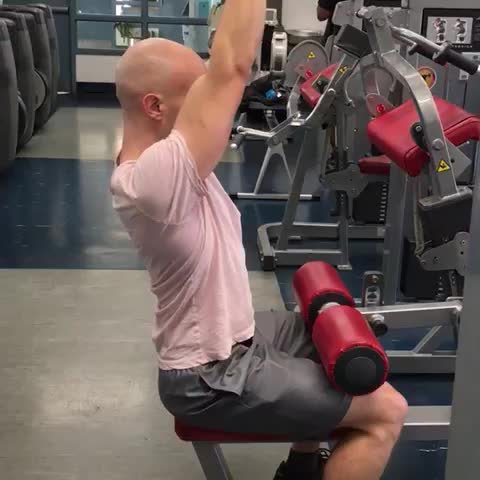
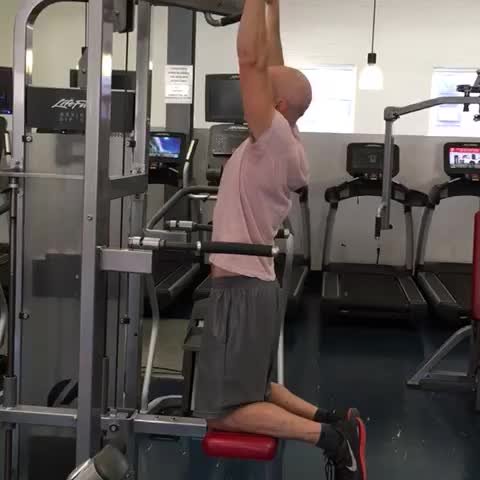
- 1Start. Thighs locked under the pad, overhand grip just outside your shoulders. Arms fully straight so the lats stretch.
- 2Pull. Drive your elbows down to your sides and pull the bar to your upper chest, in front of your face.
Watch 3 video demonstrations
Find more video demonstrations in the Gravitus app
How to do a lat pulldown with proper form
- Clip a long lat bar to the high pulley. Set the thigh pad so it locks your legs down with your feet flat.
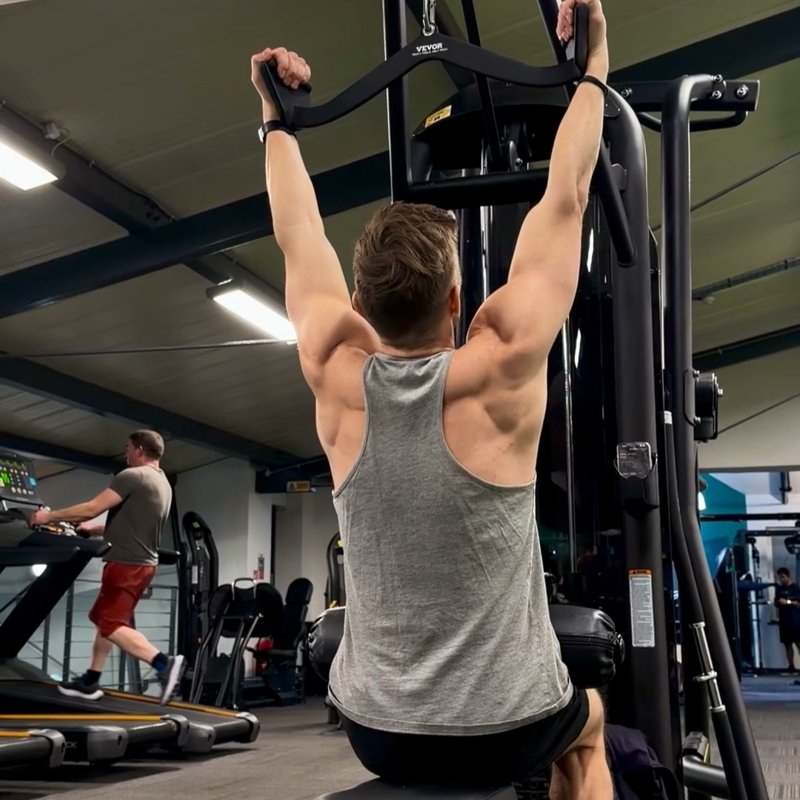
- Grab the bar overhand with your hands just outside your shoulders, about 1.5 times shoulder width. Sit down with your arms straight overhead.
- Lean back from your hips just far enough that the bar can pass your face. Pull your shoulders down, away from your ears.
- Drive your elbows down to your sides until the bar touches your upper chest. Keep the same lean the whole rep.
- Let the bar rise over 2 to 3 seconds until your arms are straight and your lats stretch, without letting the plates touch.
To the chest or behind the neck, and how far to lean
| Attribute | To the chest | To the chest, 30 degree lean | Behind the neck | |
|---|---|---|---|---|
| Lat activity | The most | or tied | Same as sitting upright (Buonsenso 2025) | Lower while pulling in two studies, the same in one |
| Other muscles | Biceps, rear delts, mid back | More rear delt work (Buonsenso 2025) | Rear delts and biceps: more in one study, less in two | |
| Weight for 8 reps | The heaviest | Not measured | About 15% less (Padovan 2024) | |
| Shoulders | A normal overhead reach | A normal overhead reach | Arms out wide and turned back, head pushed forward |
Pull to your upper chest. Lean back only as far as you need for the bar to clear your face, anywhere up to about 30 degrees, and hold that angle for the whole set. In 14 trained men, the front pulldown moved 70 kg (155 lb) for 8 reps and behind the neck about 60 kg (130 lb) (Padovan 2024). While pulling down, lat activity was higher in front in two studies (Signorile 2002, Padovan 2024) and the same in the third (Sperandei 2009).
How much weight should you lat pulldown?
On Gravitus, the median man lifts 140 lb (62.5 kg) for 10 reps on the lat pulldown, and the median woman 75 lb (35 kg).
- Most lift
- 110 to 165 lb
- Top 10% lift
- 200 lb or more
- Starting out
- under 110 lb
- Most lift
- 60 to 90 lb
- Top 10% lift
- 110 lb or more
- Starting out
- under 60 lb
- Most lift
- 50 to 75 kg
- Top 10% lift
- 90 kg or more
- Starting out
- under 50 kg
- Most lift
- 27.5 to 40 kg
- Top 10% lift
- 50 kg or more
- Starting out
- under 27.5 kg
Muscles worked
Lat pulldown myths the research does not support
"A wide grip builds a wider back." With an overhand grip at 1, 1.5 and 2 times shoulder width, lat activity was similar, and the widest grip moved about 4% less weight for 6 reps (Andersen 2014). No study has compared grip widths for lat growth. Our close-grip lat pulldown guide covers what a narrow grip changes.
"Underhand, close or neutral grips hit the lower lats." No pulldown study has measured upper vs lower lat activity by grip. Across seven grips in 40 trained men, lat activity did not differ at all (Buonsenso 2025). See the neutral grip lat pulldown guide for the full grip comparison.
"Any lean back turns it into a row." A 30 degree lean gave the same lat activity as sitting upright and added rear delt work (Buonsenso 2025). The problem is rocking, where your torso swings back on each rep to move the weight. Pick a lean and hold it.
"You need to pull down your bodyweight before you can do a pull-up." College men's one-rep pulldown was 93% of their bodyweight, while their one-rep pull-up was 116% of it (Johnson 2009). Pulldown numbers run lower than pull-up numbers, so the pull-up can come first.
Lat pulldown vs pull-up vs seated cable row
| Attribute | Lat pulldown | Pull-up | Seated cable row |
|---|---|---|---|
| Pull | Overhead, down to your chest | Your body up to the bar | In front, back to your stomach |
| Load | Any weight on the stack | Your bodyweight, plus or minus | Any weight on the stack |
| Works most | Lats, with the biceps and mid back | Lats, with the biceps, mid back and core | Lats, mid traps, rhomboids and rear delts |
| Best for | Loading the lats in small steps | Pulling your own bodyweight | Mid back and horizontal pulling |
Use the pulldown as your loadable vertical pull and a row for horizontal pulling. If a pull-up is your goal, practise pull-ups too. Pulldown strength tracked pull-up strength in men but not in women (Johnson 2009).
Sets, reps and progression
Use the lat pulldown as your main vertical pull or after pull-ups. Stop each set 0 to 2 reps short of failure. Muscle grows across a wide range of reps when sets are hard (Schoenfeld 2021), so pick a range you can keep strict.
Add reps first. When every set reaches 12 with the same lean, move the pin down one plate and drop back to 8.
Common mistakes
-
Rocking the torsoSwinging back on each rep lets momentum move the weight. Set your lean before the first rep and hold it, or go lighter.
-
Pulling behind the neckIt moved about 15% less weight (Padovan 2024) and gave the same or less lat activity while pulling. Pull to your upper chest.
-
Shrugging at the topPull your shoulders down before your elbows bend, and keep them down.
-
Pulling with your handsThink about driving your elbows to your sides. In beginners, a lat-focused cue raised lat activity in the pulldown (Snyder 2009).
-
Stopping short at the topStraighten your arms every rep. In trained lifters, partial reps in the stretched half of the range matched full reps for arm growth and single-arm pulldown strength over 8 weeks (Wolf 2025), so the top is the part to keep.
-
Dropping the weightLet the bar rise over 2 to 3 seconds without letting the plates touch.
Lat pulldown variations
Questions people ask
What is a lat pulldown?
A seated cable exercise where you pull a long bar from overhead down to your upper chest. It trains the lats, the large muscles on the sides of your back, and works like a pull-up where you choose the weight.
What muscles does lat pulldown work?
The lats most, with the teres major. The biceps, brachialis, rhomboids, mid and lower traps, rear delts and lower chest help, and the core and forearms hold you in place.
Does lat pulldown work chest?
A little. The lower chest helps pull the arms down from overhead, but the lats and biceps were more active than the chest in the pulldown (Doma 2013). It is a back exercise.
Does lat pulldown work shoulders?
The rear delts help pull the arms down and back, and they worked harder with a 30 degree lean (Buonsenso 2025). The lats do most of the work.
Do lat pulldowns help you do pull ups?
Yes, they train the same muscles, but they do not replace pull-up practice. In college lifters, pulldown strength predicted pull-up strength in men but not in women (Johnson 2009). Do pulldowns alongside assisted pull-ups or negatives.
How to do a behind the neck lat pulldown?
Sit under the bar, grab it wide and overhand, tip your head forward and pull the bar down behind it to the base of your neck. We do not recommend it. It moved about 15% less weight (Padovan 2024), and while pulling down it gave the same or less lat activity than pulling to your chest (Signorile 2002, Sperandei 2009).
How much weight should I lat pulldown?
For 10 reps, the median on Gravitus is 140 lb (62.5 kg) for men and 75 lb (35 kg) for women. The strongest quarter lifts 165 lb (75 kg) and 90 lb (40 kg) or more.
Log every set and see your percentile on every lift, lat pulldown included.
Get GravitusRelated exercises


- Padovan et al. 2024. J Hum Kinet 91(Spec Issue):47-60.
- Buonsenso et al. 2025. J Funct Morphol Kinesiol 10(3):345.
- Signorile, Zink and Szwed 2002. J Strength Cond Res 16(4):539-546.
- Sperandei et al. 2009. J Strength Cond Res 23(7):2033-2038.
- Andersen et al. 2014. J Strength Cond Res 28(4):1135-1142.
- Johnson et al. 2009. J Strength Cond Res 23(3):1022-1028.
- Doma, Deakin and Ness 2013. Sports Biomech 12(3):302-313.
- Wolf et al. 2025. PeerJ 13:e18904.
- Snyder and Leech 2009. J Strength Cond Res 23(8):2204-2209.
- Schoenfeld et al. 2021. Sports 9(2):32.