How to Use the Incline Chest Press Machine
An incline chest press machine is a seated press that pushes up and away at an angle. Set the seat so the handles start at your upper chest, just below your collarbones, and press until your arms are straight. It trains the upper chest, front delts and triceps. Most lifters do 3 to 4 sets of 8 to 12 reps.
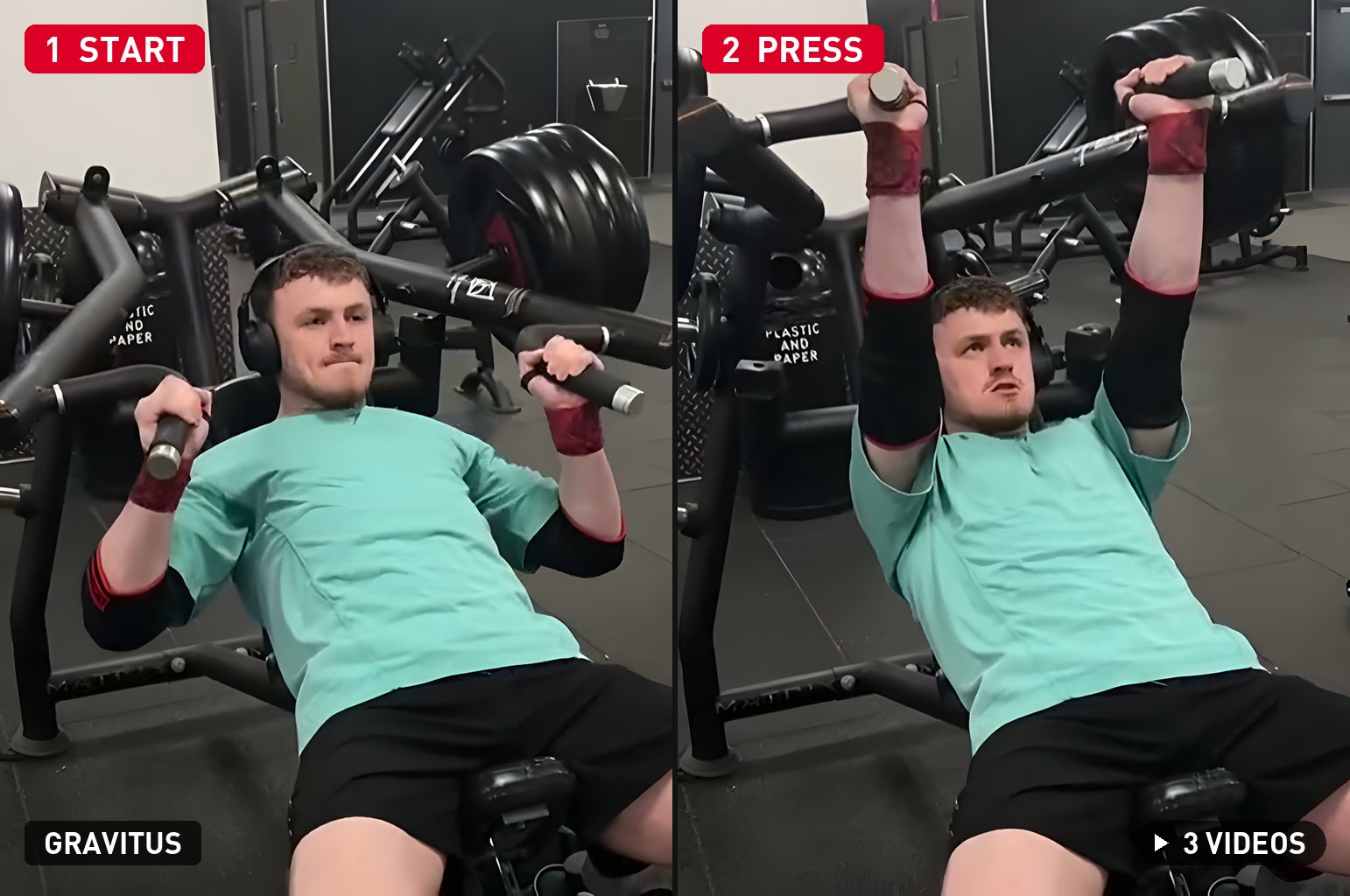
- 1Start. Seat set so the handles start beside your upper chest, just below the collarbones. Back and shoulder blades against the pad.
- 2Press. Press up and away along the machine's path until your arms are straight but not locked, then lower over 2 to 3 seconds.
Watch 3 video demonstrations
How to use the incline chest press machine
- Sit with your back on the pad and set the seat so the handles line up with your upper chest, just below your collarbones. If the back pad adjusts, set it between 30 and 45 degrees.
- On a plate-loaded machine, put the same plates on both arms. If there is a start lever or foot bar, use it so the handles begin just in front of your chest with a stretch you can control.
- Plant your feet, pull your shoulder blades back and down into the pad, and grip the handles with your wrists straight. Your elbows sit 45 to 60 degrees out from your sides.
- Press up and away along the machine's path until your arms are straight but not locked. Breathe out as you press and keep your head, shoulders and glutes on the pads.
- Lower over 2 to 3 seconds until your hands are back beside your upper chest, without letting the plates touch.
Seat height sets the incline
An incline machine's path is fixed, but your body is not. The handles finish in the same spot every rep, so moving the seat moves your shoulders against them. Lower the seat and your arms point further overhead at lockout, which is a steeper press. Raise it and they point closer to straight out from your chest, which is a flatter one. No study has tested seat height on an incline machine, so the ranges come from bench studies. Upper chest activity peaked at a 30 degree incline and front delt activity at 60 degrees, while the middle and lower chest worked hardest flat (Rodríguez-Ridao 2020). Another study found the upper chest peak at 44 degrees (Trebs 2010). In competitive bodybuilders, a 45 degree incline bench drew the most upper chest activity of four presses and a flat chest press machine the least (Coratella 2020). Start with the handles just below your collarbones and write the seat notch in your log, so every session uses the same incline.
Stack, plate-loaded, iso-lateral or converging
The handle path is what you feel. On a lever machine the handles swing in an arc around a pivot, usually above and behind you, so they rise as they move away. On a track machine they move in a straight line. Neither keeps the load the same through the rep. A plate-loaded lever is heaviest where the arm holding the plates points level with the floor and lighter as it tips away from that point. A stack machine sets its curve with the shape of its cam. That is also why incline machine numbers do not compare between gyms: the pin or plate number is not the load at your hands, and the same number can feel much heavier on one brand than on another.
How much weight should you use on the incline chest press machine?
On Gravitus, the median man lifts 120 lb (55 kg) for 10 reps on the incline chest press machine, and the median woman 45 lb (20 kg).
- Most lift
- 80 to 160 lb
- Top 10% lift
- 200 lb or more
- Starting out
- under 80 lb
- Most lift
- 30 to 60 lb
- Top 10% lift
- 85 lb or more
- Starting out
- under 30 lb
- Most lift
- 35 to 72.5 kg
- Top 10% lift
- 90 kg or more
- Starting out
- under 35 kg
- Most lift
- 14 to 27.5 kg
- Top 10% lift
- 37.5 kg or more
- Starting out
- under 14 kg
Incline chest press machine muscles worked
Incline machine claims that do not hold up
- "Line the handles up with your mid-chest." That is the setup for a flat chest press machine. On an incline machine, handles at mid-chest mean the seat is high and the incline flattens out. Set them just below your collarbones instead.
- "Machines keep constant tension." No machine does. A plate-loaded lever gets heavier and lighter as it tilts, and a stack machine's cam decides where the rep is hardest. You feel it most where the machine's leverage peaks, not evenly through the rep.
- "Converging handles work the inner chest." No study has tested converging machines, and no study shows an inner chest you can train on its own. The converging path moves your hands together; it does not change which part of the chest works. The incline does that.
- "The steeper, the more upper chest." Upper chest activity peaked at 30 degrees in one study and 44 degrees in another, and at 60 degrees the front delts were the most active muscle (Rodríguez-Ridao 2020, Trebs 2010). If you feel it mostly in your shoulders, raise the seat a notch.
- "Machines build less muscle than free weights." A review of 13 studies found no difference in muscle growth between machine and free-weight training (Haugen 2023).
Incline chest press machine vs incline dumbbell press vs incline bench press
| Attribute | Incline machine | Incline dumbbell press | Incline bench press |
|---|---|---|---|
| Incline set by | Seat height, back pad | Bench notch | Bench notch |
| Balance needed | Least | Most, each arm alone | More, one bar |
| Spotter | Not needed | Helpful when heavy | Needed near failure, or safety pins |
| Best for | Sets close to failure, drop sets | One arm at a time, free wrists | Heaviest loads, small jumps |
A tie for muscle growth. Over 8 weeks, trained men who did their presses on machines or with free weights gained muscle, chest included, and strength within 2% of each other (Hernández-Belmonte 2023). Strength carries over best to the lift you train (Haugen 2023), so pick the incline press you can keep adding weight to.
Sets, reps and progression
Do incline machine presses once or twice a week, first in a chest or push workout or after a free-weight press. Stop each set 0 to 2 reps short of failure. Sets taken close to failure build muscle across a wide range of reps (Schoenfeld 2021), and a machine lets you get there safely without a spotter.
Add reps first. When every set reaches 12 clean reps, move up one pin or one small plate per arm and drop back to 8. Keep the seat notch the same, or the new number means nothing.
Common mistakes
-
Seat too lowThe handles sit at your collarbones or above and your shoulders do the work. Raise the seat until they start just below your collarbones.
-
Seat too highThe handles sit at mid-chest and the incline flattens out. Lower the seat a notch.
-
Elbows flared straight outThe front of the shoulder takes the strain. Keep your elbows 45 to 60 degrees from your sides, or use the neutral handles if the machine has them.
-
Shoulders rolling off the padYour shoulders push forward at the end of each rep. Keep your shoulder blades on the pad and stop just short of locking out.
-
Cutting the rep shortLet the handles come back until your hands are beside your upper chest every rep.
-
Hips lifting off the seatIt flattens the incline you set. Keep your glutes on the seat and your feet flat.
Incline chest press machine variations
Questions people ask
What does incline machine press target?
The upper (clavicular) head of the chest most, with the front delts and triceps helping. The rotator cuff and serratus anterior keep your shoulders steady against the pad.
Is incline chest press machine a compound exercise?
Yes. It moves both the shoulder and the elbow, so the chest, front delts and triceps all work.
Does incline chest press work shoulders?
Yes, the front delts. They help at every angle and do more as the press gets steeper. Their activity peaked at 60 degrees in a bench study (Rodríguez-Ridao 2020), so if you feel it mostly in your shoulders, raise the seat a notch.
How to adjust incline press machine?
Set the seat so the handles line up with your upper chest, just below your collarbones. A lower seat makes the press steeper and a higher one flatter. If the back pad moves, set it between 30 and 45 degrees, and write both notches in your log.
Does converging chest press work upper chest?
Only when it presses on an incline. Converging handles change the path of your hands, not the angle of the press. A flat chest press machine drew the least upper chest activity of four presses tested (Coratella 2020).
Is the incline chest press machine better than the incline dumbbell press?
Not for growth. A review of 13 studies found no difference in muscle growth between machines and free weights (Haugen 2023). The machine is easier to take close to failure alone. Dumbbells let each arm work on its own and your wrists turn.
Is a plate-loaded incline press harder than a selectorized stack incline press?
Neither is harder by design. The plate or pin number is not the load at your hands, because lever angles, the weight of the arms and stack cams all change it. Compare yourself only to your own log on the same machine.
How much weight should I use on the incline chest press machine?
For 10 reps, the median on Gravitus is 120 lb (55 kg) for men and 45 lb (20 kg) for women. The strongest quarter lifts 160 lb (72.5 kg) and 60 lb (27.5 kg) or more.
Log every set and see your percentile on every lift, incline chest press machine included.
Get GravitusRelated exercises
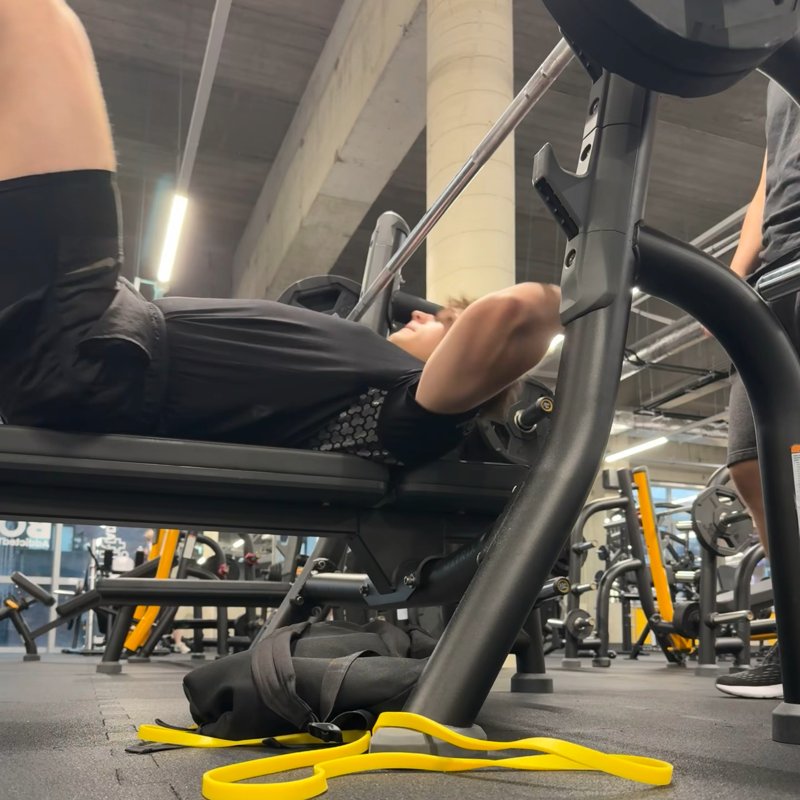 Bench PressAnterior deltoids, pectoralis major
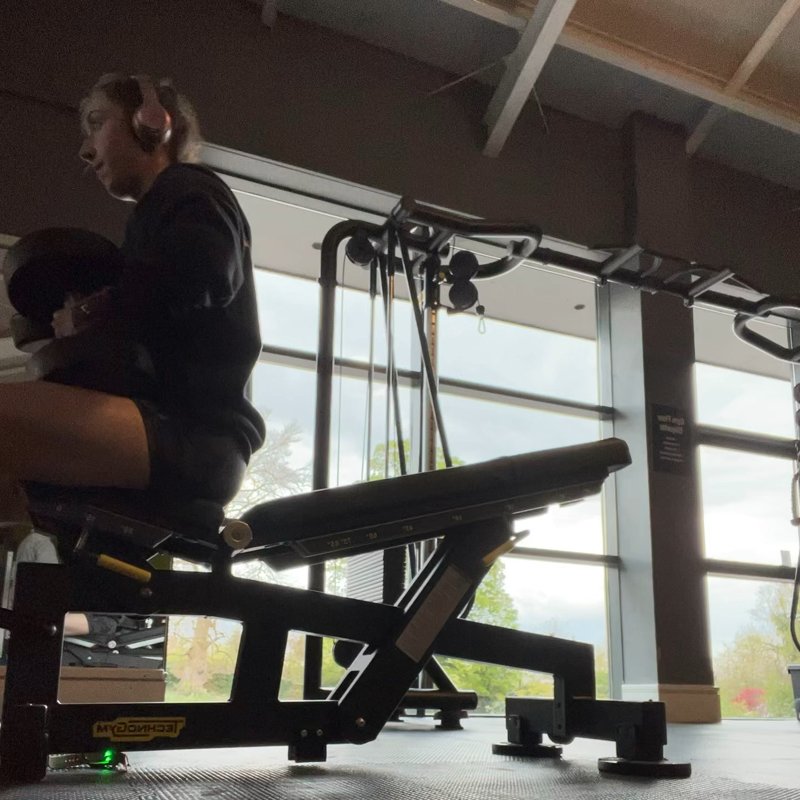 Incline Dumbbell PressAnterior deltoids, pectoralis major
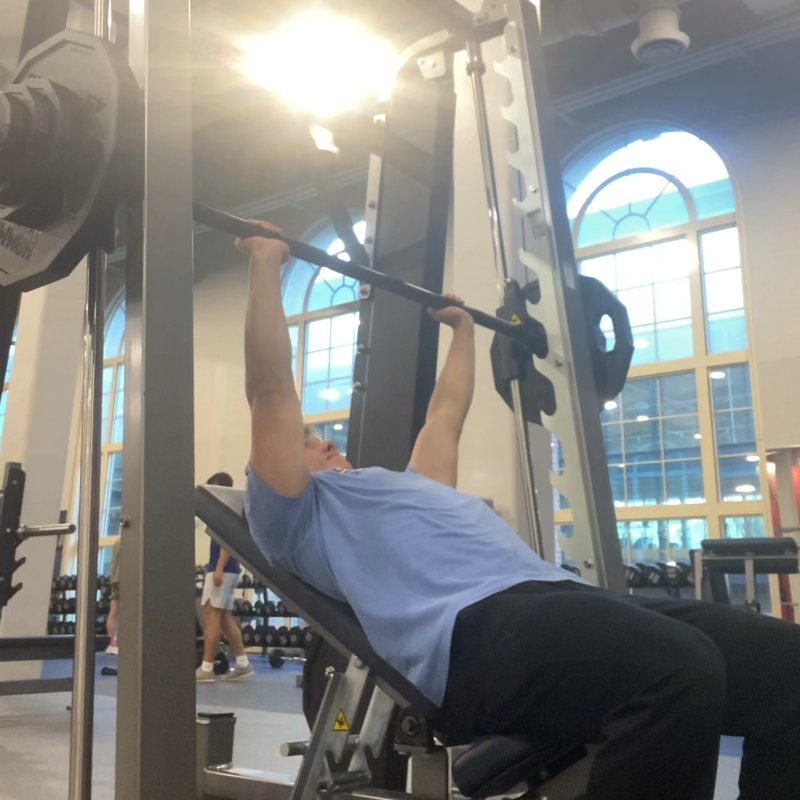 Smith Machine Incline Bench PressAnterior deltoids, pectoralis major
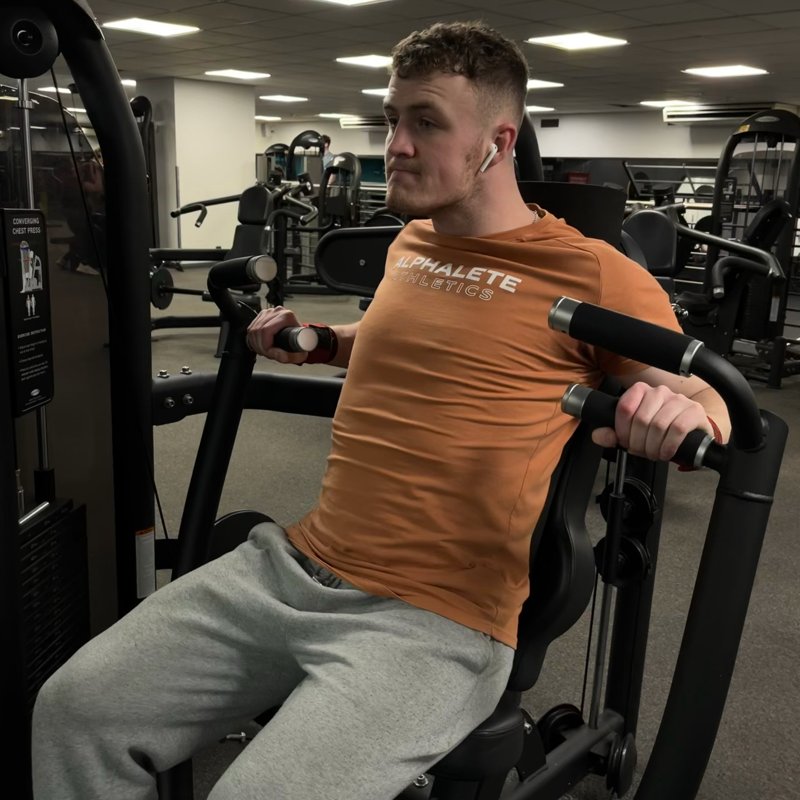 Chest Press MachineAnterior deltoids, pectoralis major
 Incline Bench PressAnterior deltoids, pectoralis major
 Dumbbell Bench PressAnterior deltoids, pectoralis major
- Rodríguez-Ridao et al. 2020. Int J Environ Res Public Health 17(19):7339.
- Trebs, Brandenburg and Pitney 2010. J Strength Cond Res 24(7):1925-1930.
- Coratella et al. 2020. Eur J Sport Sci 20(5):571-579.
- Chaves et al. 2020. Int J Exerc Sci 13(6):859-872.
- Haugen et al. 2023. BMC Sports Sci Med Rehabil 15:103.
- Hernández-Belmonte et al. 2023. Med Sci Sports Exerc 55(12):2316-2327.
- Schoenfeld et al. 2021. Sports 9(2):32.