How to Do the Incline Bench Press
An incline bench press is a barbell bench press on a 15 to 45 degree bench. Lower the bar to your upper chest, just below your collarbones, with your forearms vertical, then press it back up over your shoulders. It trains the upper chest, front delts and triceps. Most lifters do 3 to 4 sets of 6 to 10 reps.
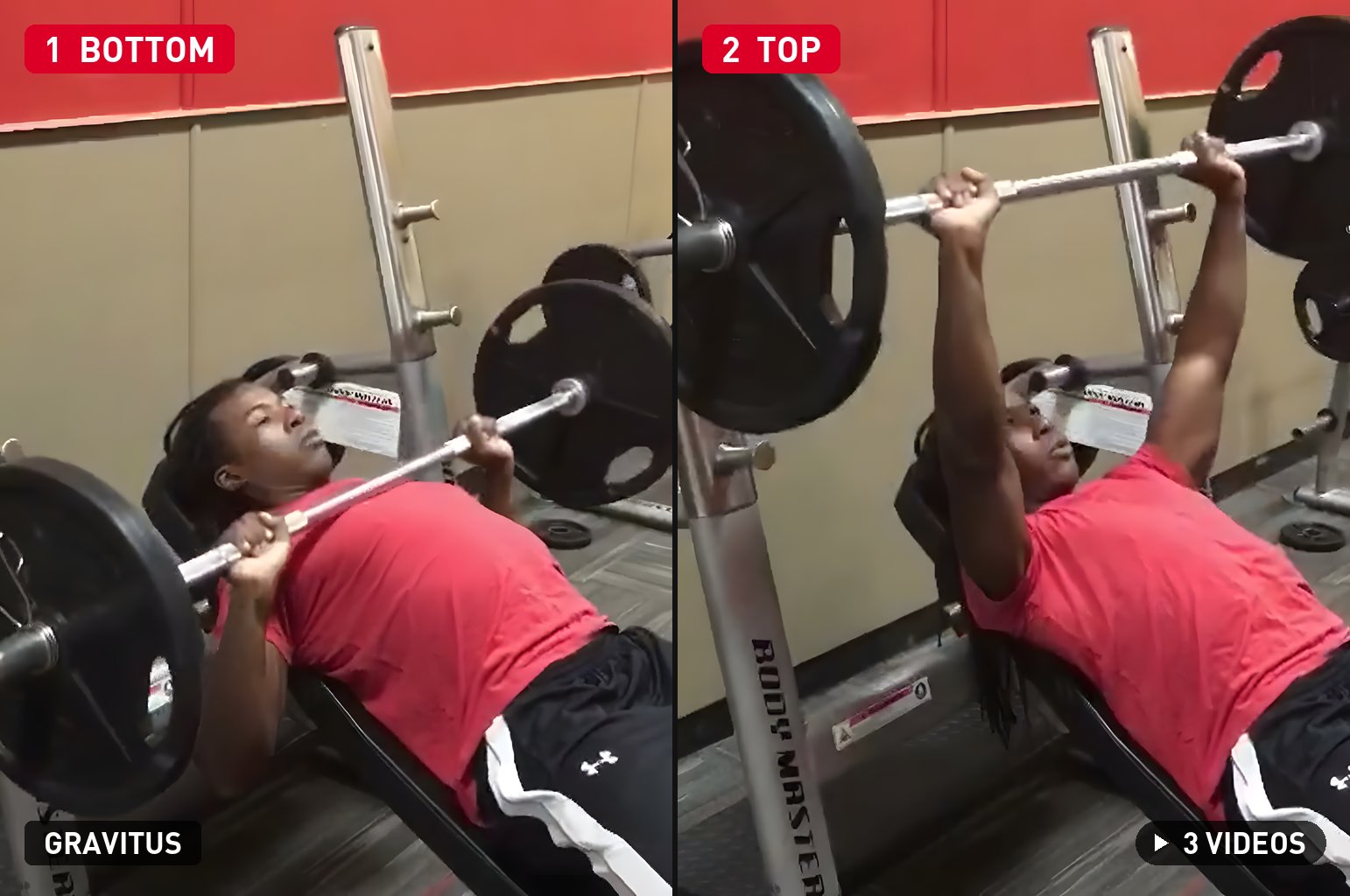
- 1Bottom. The bar touches the upper chest, just below the collarbones, with the forearms vertical and the shoulder blades pinned to the bench.
- 2Top. Press up and slightly back until the bar sits over your shoulders, then lower over 2 to 3 seconds.
Watch 3 video demonstrations
Find more video demonstrations in the Gravitus app
How to do an incline bench press
- Set the bench to 30 degrees, or use a fixed incline bench. Sit so the racked bar is above your eyes or forehead, then plant your feet flat.
- Grip the bar slightly wider than your shoulders. Pull your shoulder blades back and down, and keep your head, upper back and glutes on the bench.
- Straighten your arms to lift the bar off the hooks and bring it forward until it sits over your shoulders, arms vertical.
- Lower over 2 to 3 seconds until the bar touches your upper chest, just below your collarbones. Your elbows stay 45 to 60 degrees out from your sides, with your forearms vertical.
- Press up and slightly back until your arms are straight and the bar is over your shoulders again. After the last rep, press to lockout and move the bar back onto the hooks.
Where the bar touches, grip width and arch
A barbell makes you steer the bar yourself, so where it lands depends on your setup, not on a track. On a Smith machine incline press the bench position under the bar sets the touch point; with a free bar you set it by grip width and by keeping your forearms vertical. Grip width changes less than most lifters think: in flat bench studies, chest activity was the same with narrow, medium and wide grips (Saeterbakken 2017), and wide and medium grips lifted about 5% more than a narrow one (Larsen 2021). Pick the width that puts your forearms vertical and keep it the same every session. For the bench itself, 30 degrees is a good default and anything from 15 to 45 degrees trains the upper chest; the incline dumbbell press guide shows what each angle changes.
How much weight should you incline bench press?
On Gravitus, the median man lifts 130 lb (60 kg) for 10 reps on the incline bench press, and the median woman 55 lb (25 kg).
- Most lift
- 110 to 155 lb
- Top 10% lift
- 180 lb or more
- Starting out
- under 110 lb
- Most lift
- 45 to 70 lb
- Top 10% lift
- 85 lb or more
- Starting out
- under 45 lb
- Most lift
- 50 to 70 kg
- Top 10% lift
- 82.5 kg or more
- Starting out
- under 50 kg
- Most lift
- 20 to 32.5 kg
- Top 10% lift
- 37.5 kg or more
- Starting out
- under 20 kg
Incline vs flat bench: how much less can you lift?
Most lifters incline bench about 80% of their flat bench. We compared the best estimated max of 17,000+ men and 1,700+ women who log both lifts in Gravitus (Sep 2026). The median man's incline max was 80% of his flat max, and the median woman's was 79%. A 225 lb (100 kg) flat bench predicts about 180 lb (80 kg) on the incline for one rep.
Lab studies with a set bench angle agree. At 30 degrees, trained lifters' max was 22% below flat, and at 45 degrees 29% below (Rodríguez-Ridao 2020). National and international bench press athletes lifted 18% less for 6 reps on a 25 degree incline than on a flat bench (Saeterbakken 2017). A steeper bench widens the gap, so if your ratio is well under 73%, check your bench angle before your upper chest.
Incline bench press muscles worked
Incline bench claims the research does not back
- "Arch as hard as you can." A big arch lifts your chest toward the ceiling and flattens the incline you set. On a flat bench, arching raised trained lifters' max by 4.2 kg (about 9 lb) but shortened how far the bar traveled at every load, with the same upper and lower chest activity (Bartolomei 2024). Keep the arch small and your glutes on the seat.
- "A wide grip works the chest harder." Chest activity was the same with narrow, medium and wide grips (Saeterbakken 2017). A narrow grip lifted about 5% less than wide or medium (Larsen 2021). Grip width changes how much you lift, not which part of the chest works.
- "Lower the bar to your neck for more upper chest." The guillotine press flares the elbows to 90 degrees and puts the load on the front of the shoulder, with nowhere to go if you miss. Stop just below your collarbones.
- "Incline pressing trains the triceps like a flat bench." It trains them less. Triceps activity was about a third lower on a 25 degree incline, and lifters used 18% less weight (Saeterbakken 2017). Keep a flat press or a triceps exercise in the week.
Incline bench press vs flat bench press vs incline dumbbell press
| Attribute | Incline bench press | Flat bench press | Incline dumbbell press |
|---|---|---|---|
| Weight you can lift | 80% of your flat bench | Most | Less than a bar |
| Upper chest growth | More | Less | More |
| Triceps | Less than flat | Most | Less than a bar |
| Bar touches | Just below the collarbones | Lower chest | Dumbbells beside the upper chest |
| Best for | Heaviest upper chest loads, small jumps | Whole chest, heaviest loads | One arm at a time, free wrists |
Do an incline press and a flat press in the same week. Over 8 weeks, incline pressing grew the upper chest more than flat pressing (Chaves 2020). Between a barbell and dumbbells on the incline, pick the one you can keep adding weight to. The incline vs flat bench comparison covers programming both.
Sets, reps and progression
Do incline bench presses once or twice a week, first or second in a chest, push or upper-body workout. Stop each set 1 to 2 reps short of failure, closer only with safety pins set or a spotter behind you.
A barbell lets you add small amounts. Add reps first: when every set reaches 10, add 5 lb (2.5 kg), which is 2.5 lb (1.25 kg) per side, and drop back to 6 reps. Keep the bench on the same notch, or the new number means nothing.
Common mistakes
-
Bar landing on your neckThe front of the shoulder takes the load. Bring the bar down to just below your collarbones.
-
Bar drifting down the chestLower chest is where a flat bench lands. On an incline your forearms slant and the shoulders take the strain. Keep your forearms vertical and aim just below your collarbones.
-
Hips lifting off the seatIt flattens the angle you set and turns the lift into a flat press. Keep your glutes on the seat and your feet flat.
-
Grip too narrow or too wideYour forearms should be vertical when the bar touches. Move your hands until they are, and use the same ring marks every set.
-
No safeties and no spotterMany fixed incline benches have no safety arms. Press in a power rack with the pins set just below your touch point, or have a spotter stand behind you.
Incline bench press variations
Questions people ask
What muscles does incline bench press work?
The chest, most of all its upper (clavicular) head, and the front delts, with the triceps straightening the elbows. The biceps, rotator cuff and serratus anterior steady the shoulder.
Does incline bench work shoulders?
Yes, the front delts. They help at every bench angle and do more as the bench rises. Their activity peaked at 60 degrees (Rodríguez-Ridao 2020). Keep the bench at 45 degrees or lower to keep the chest doing most of the work.
How much incline for incline bench press?
15 to 45 degrees, with 30 a good default. Upper chest activity was highest at 30 degrees in one study, and at 60 degrees the front delts took over (Rodríguez-Ridao 2020). Use the same notch every session so your log compares like with like.
Where should the bar touch on incline bench press?
On your upper chest, just below your collarbones, with your forearms vertical. That is higher than on a flat bench, and it moves higher still as the bench gets steeper.
Should you arch your back on incline bench press?
A little. Pull your shoulder blades back and lift your chest, but keep your glutes and upper back on the bench. A big arch flattens the incline and shortens the press (Bartolomei 2024).
How much less can you incline bench than flat bench?
About 20% less. For the median Gravitus lifter who logs both, the incline max was 80% of the flat max, and the middle half of lifters fell between 73% and 87%. A steeper bench widens the gap.
How much weight should I incline bench press?
For 10 reps, the median on Gravitus is 130 lb (60 kg) for men and 55 lb (25 kg) for women. The strongest quarter lifts 155 lb (70 kg) and 70 lb (32.5 kg) or more.
Log every set and see your percentile on every lift, incline bench press included.
Get GravitusRelated exercises
 Bench PressAnterior deltoids, pectoralis major
 Incline Dumbbell PressAnterior deltoids, pectoralis major
 Smith Machine Incline Bench PressAnterior deltoids, pectoralis major
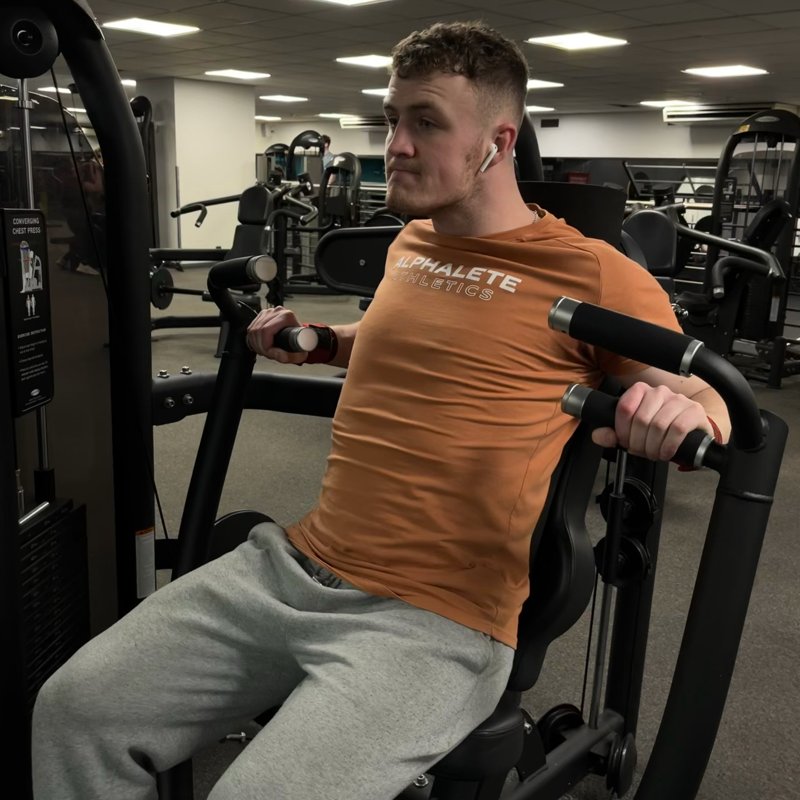 Chest Press MachineAnterior deltoids, pectoralis major
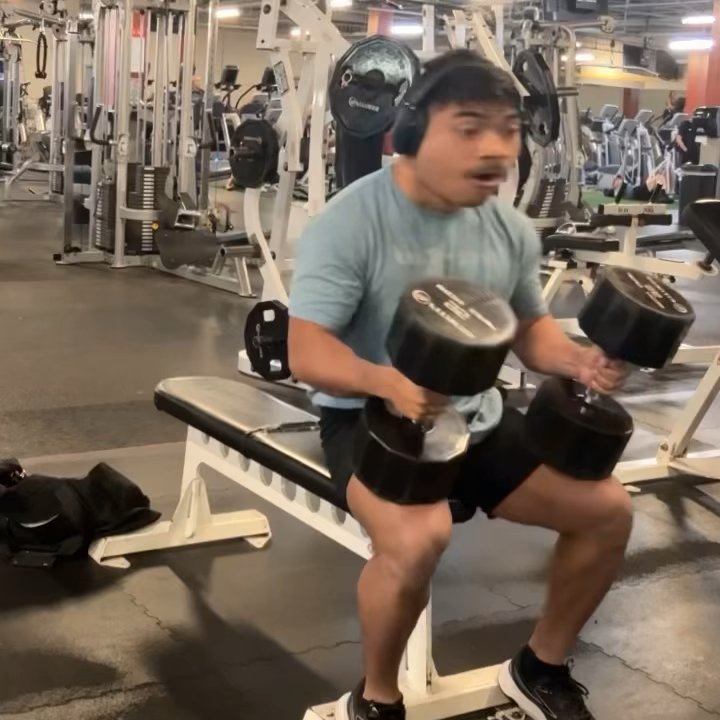 Dumbbell Bench PressAnterior deltoids, pectoralis major
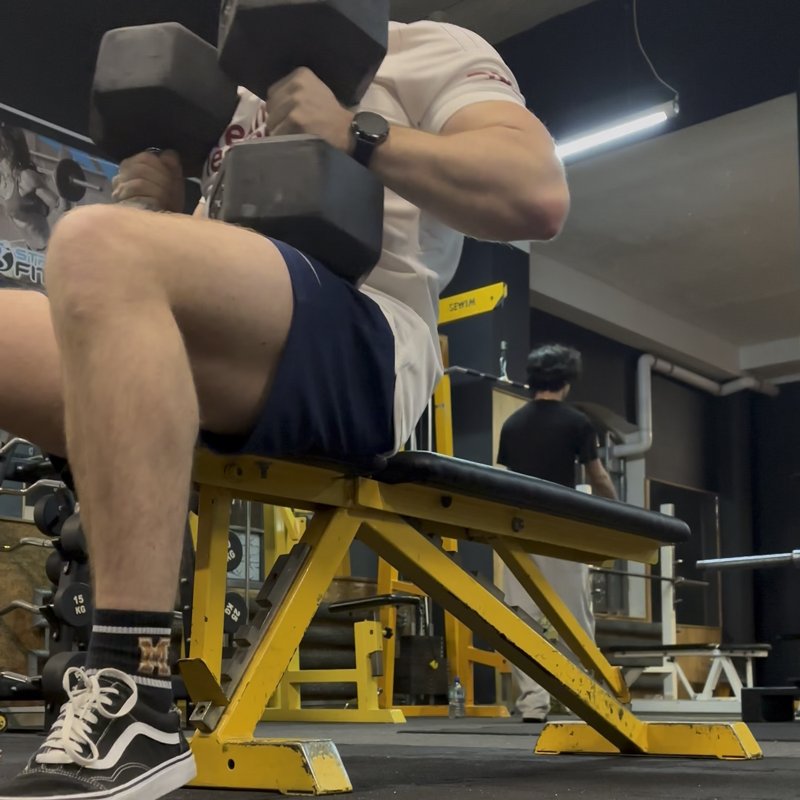 Dumbelll Bench PressAnterior deltoids, pectoralis major
- Saeterbakken, Mo, Scott and Andersen 2017. J Hum Kinet 57:61-71.
- Rodríguez-Ridao et al. 2020. Int J Environ Res Public Health 17(19):7339.
- Chaves et al. 2020. Int J Exerc Sci 13(6):859-872.
- Larsen et al. 2021. Front Sports Act Living 2:637066.
- Bartolomei et al. 2024. J Strength Cond Res 38(7):1200-1205.