How to Do the Good Morning Exercise
The good morning is a barbell hip hinge, named for the bow it looks like. With the bar across your upper back, keep your knees softly bent and push your hips back until they stop moving, then stand up. It trains the hamstrings, glutes and spinal erectors. Most lifters do 3 sets of 8 to 12 reps.
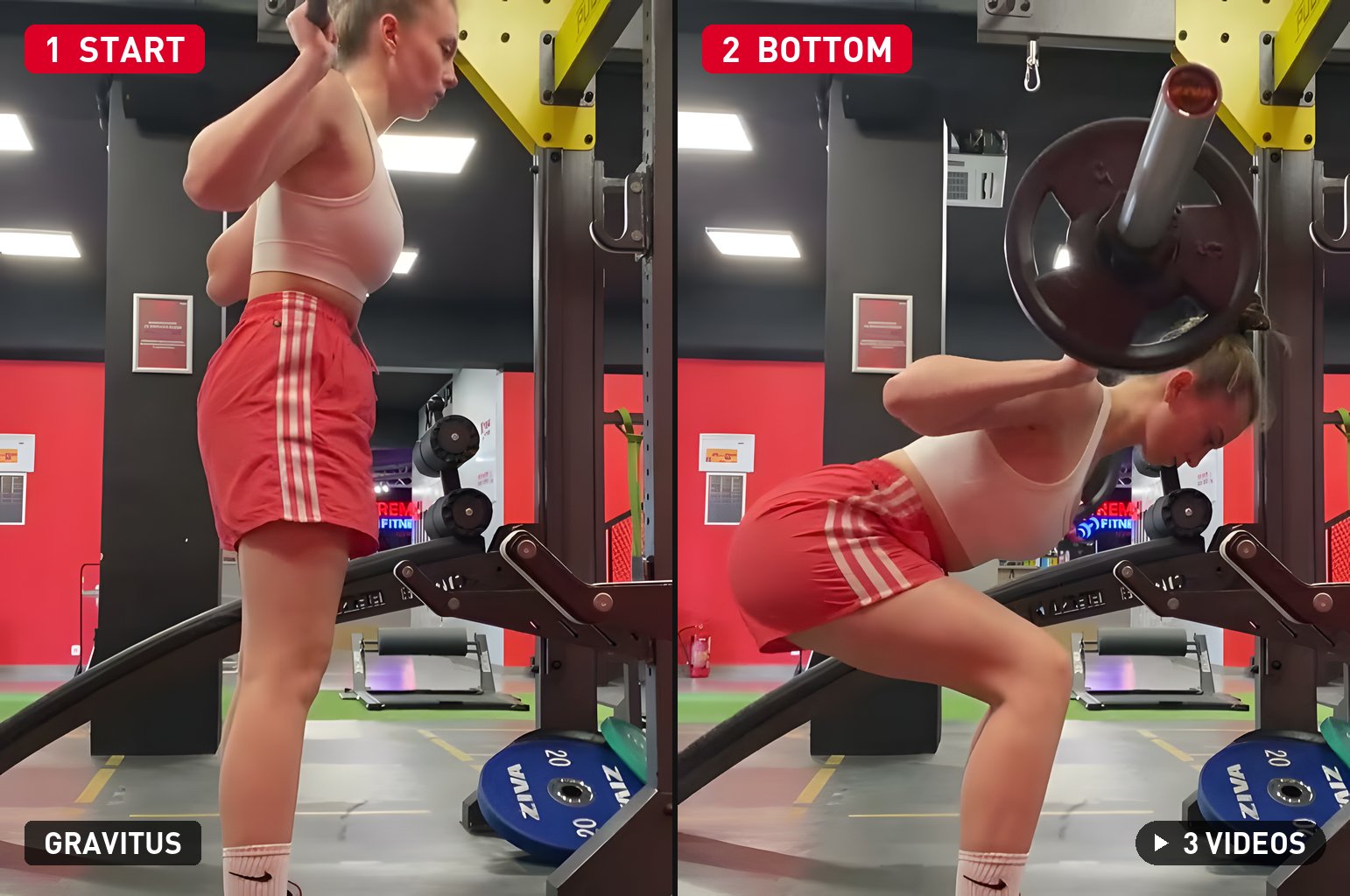
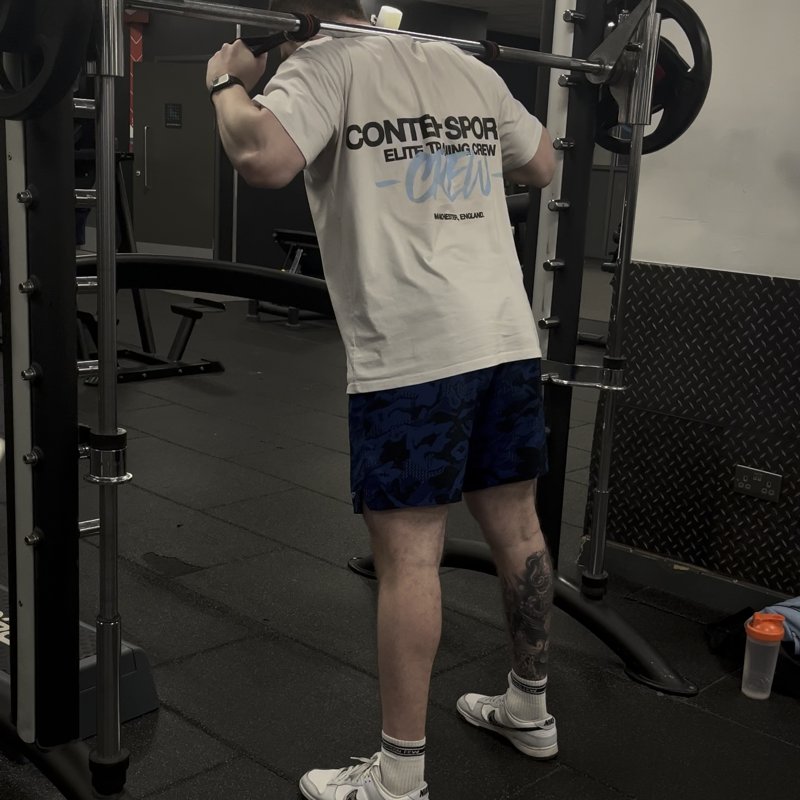
- 1Start. Bar on your upper back, feet hip-width apart, knees soft and abs braced.
- 2Bottom. Push your hips back with your back held still until they stop moving, then drive them forward to stand up.
Watch 3 video demonstrations
Find more video demonstrations in the Gravitus app
How to do a good morning
Your hamstrings set the depth, not the floor. Left to choose their own depth, 15 experienced lifters stopped with their hips bent about 75 degrees, above parallel (Vigotsky 2015).
- Set the bar in a rack at upper-chest height, as you would for a squat, and step under it.
- Rest the bar on your upper traps with your hands just outside your shoulders. Stand up, take two steps back and set your feet hip-width apart.
- Unlock your knees into a soft bend, brace your abs and pull your elbows down to pin the bar to your back.
- Push your hips straight back and let your chest lower toward the floor. Keep your back in the shape it had standing.
- Stop when your hips stop moving back, usually with your torso above parallel. Drive your hips forward and stand tall.
What a heavier bar changes
In one study, 15 trained men did single good mornings at 50, 60, 70, 80 and 90% of their max (Vigotsky 2015). Their hip bend and lower back rounding stayed the same at every load. Their knees did not: they bent more as the bar got heavier, which shortens the hamstrings. Each curve is scaled to its own peak.
Set your knee bend with the empty bar and keep it as you add weight. When your knees start to bend more, the rep is turning into a squat. Even at 90% of max, the hamstrings stretched further than at the peak of a sprint (Vigotsky 2015).
How much weight should you use for good mornings?
On Gravitus, the median man lifts 105 lb (47.5 kg) for 10 reps on the good morning, and the median woman 65 lb (30 kg).
- Most lift
- 75 to 135 lb
- Top 10% lift
- 175 lb or more
- Starting out
- under 75 lb
- Most lift
- 45 to 85 lb
- Top 10% lift
- 105 lb or more
- Starting out
- under 45 lb
- Most lift
- 35 to 60 kg
- Top 10% lift
- 80 kg or more
- Starting out
- under 35 kg
- Most lift
- 20 to 37.5 kg
- Top 10% lift
- 47.5 kg or more
- Starting out
- under 20 kg
Muscles worked
Good morning claims the research does not back
Most good morning guides repeat the same four claims. None holds up well:
- Lower until your torso is parallel to the floor. Experienced lifters left to pick their own depth stopped with their hips bent about 75 degrees, above parallel (Vigotsky 2015). Go as low as your hamstrings allow without your back rounding further.
- Your back stays perfectly flat. Even trained lifters' lower backs flexed 25 to 28 degrees by the bottom, and that did not change from 50% to 90% of max (Vigotsky 2015). The goal is to keep the shape you start with, not to stop all movement.
- Good mornings build a stronger lower back. Your erectors work hard to hold the bar, but a review of training studies found free-weight lifts did little for lumbar extension strength. Machines that pin the pelvis did (Steele 2015).
- Good mornings beat RDLs for hamstrings. At 85% of max, hamstring activity was highest in the RDL and the glute-ham raise, not the good morning (McAllister 2014).
Good morning vs RDL vs back extension
| Attribute | Good morning | Romanian deadlift | Back extension |
|---|---|---|---|
| Load sits | On your upper back | In your hands | On your chest, or none |
| Grip | Not a limit | Often the limit | Not a limit |
| Works most | Hamstrings, glutes, erectors | Hamstrings, glutes | Glutes, erectors, hamstrings |
For hamstrings, the RDL. It drew more hamstring activity than the good morning at 85% of max (McAllister 2014). Pick the good morning when your grip gives out on RDLs or you want a second hinge. Back extensions are the lighter option.
Sets, reps and progression
Do good mornings once or twice a week, after squats or as the hinge on a day without deadlifts. Warm up with a set of 10 on the empty bar. Stop each set 2 to 3 reps short of failure, before your back starts to round.
Add reps before weight. When every set reaches 12, add 5 lb (2.5 kg) and drop back to 8. Lower over 2 to 3 seconds on every rep.
Common mistakes
-
Bending the knees more on the way downIt turns the rep into a squat and your hamstrings stretch less. Set a soft bend at the top and keep it.
-
Rounding your back to get lowerDepth comes from your hips. Stop when they stop moving back.
-
Bar on your neckRest it on your upper traps and pull your elbows down so it cannot roll.
-
Adding weight too fastHeavier loads bent lifters' knees more and cut the hamstring stretch (Vigotsky 2015). Add 5 lb (2.5 kg) at a time.
-
Bouncing out of the bottomLower under control and reverse without a rebound. Your lower back is holding the bar the whole time.
Good morning variations and alternatives
Questions people ask
Are good mornings bad for your back?
Not with a weight you can control. Your lower back holds your spine still against the bar, and the risk rises when it rounds further under a heavy load. Start with the empty bar and add weight only while your knee bend and back shape stay the same.
Are good mornings or RDLs better?
For hamstrings, RDLs. At 85% of max they drew more hamstring activity than good mornings (McAllister 2014). Good mornings need no grip and work your spinal erectors hard, so they make a useful second hinge.
Are good mornings good for glutes?
Yes. The glutes and hamstrings straighten your hips on the way up. For the most glute work, pair them with hip thrusts.
Are good mornings the same as back extensions?
No. Both are hip hinges, but a back extension pins your legs to a bench and uses a plate or your bodyweight. A good morning puts a barbell on your back while you stand, so it takes far more load.
How much weight to use for good mornings?
For 10 reps, the median on Gravitus is 105 lb (47.5 kg) for men and 65 lb (30 kg) for women. The strongest quarter lifts 135 lb (60 kg) and 85 lb (37.5 kg) or more.
Log every set and see your percentile on every lift, good morning included.
Get Gravitus