Weighted Hyperextension: The Ultimate Guide
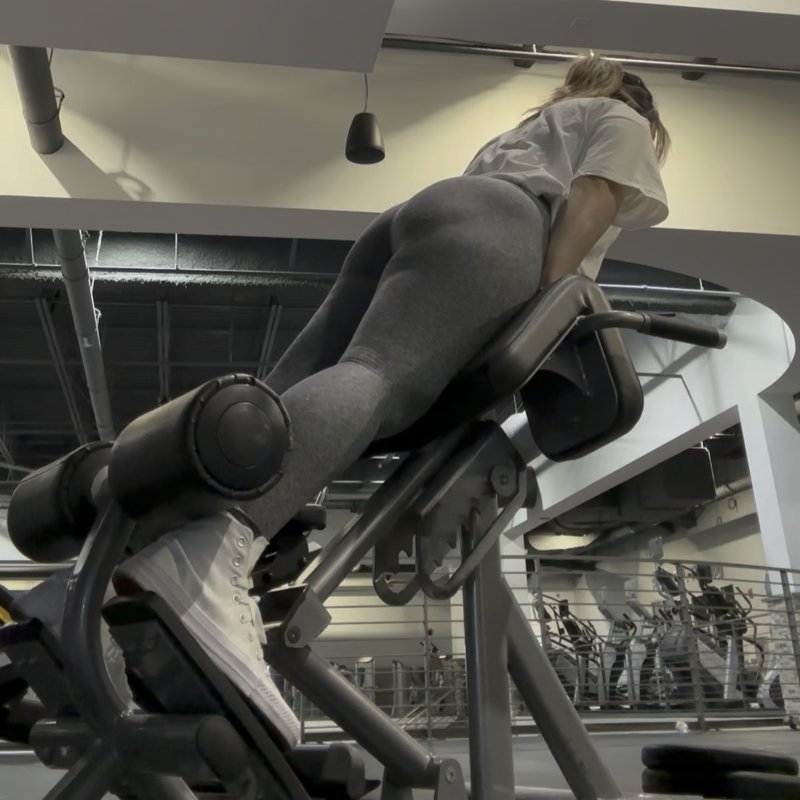
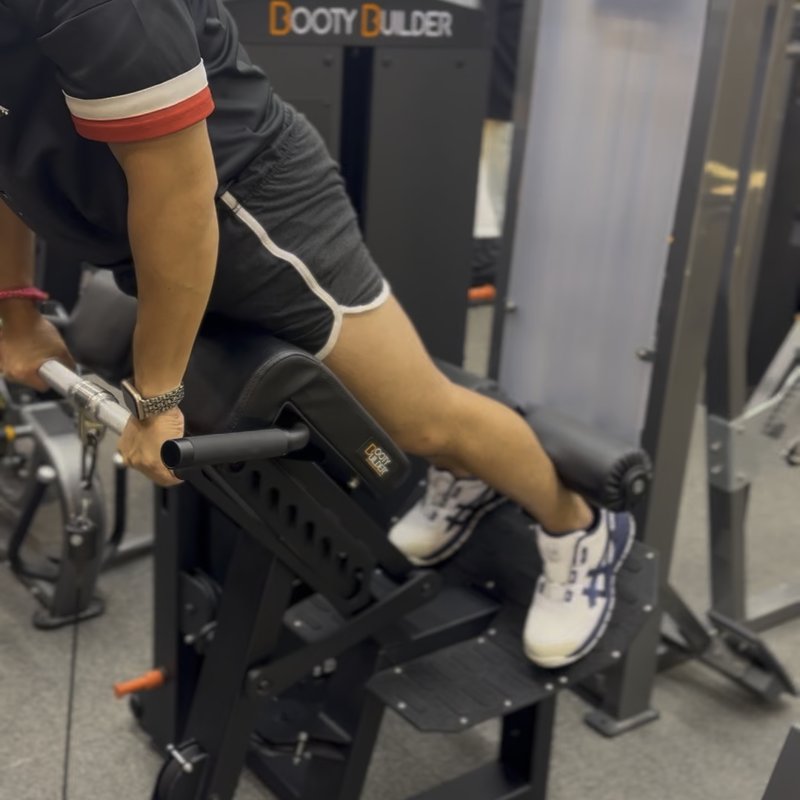
A weighted hyperextension is a back extension done holding a plate or dumbbell. Lock your feet on a 45 degree bench with the pad just below your hip bones, bend at the hips until your torso hangs down, then rise to a straight line. It trains the glutes, hamstrings and spinal erectors. Most lifters do 3 sets of 10 to 15 reps.
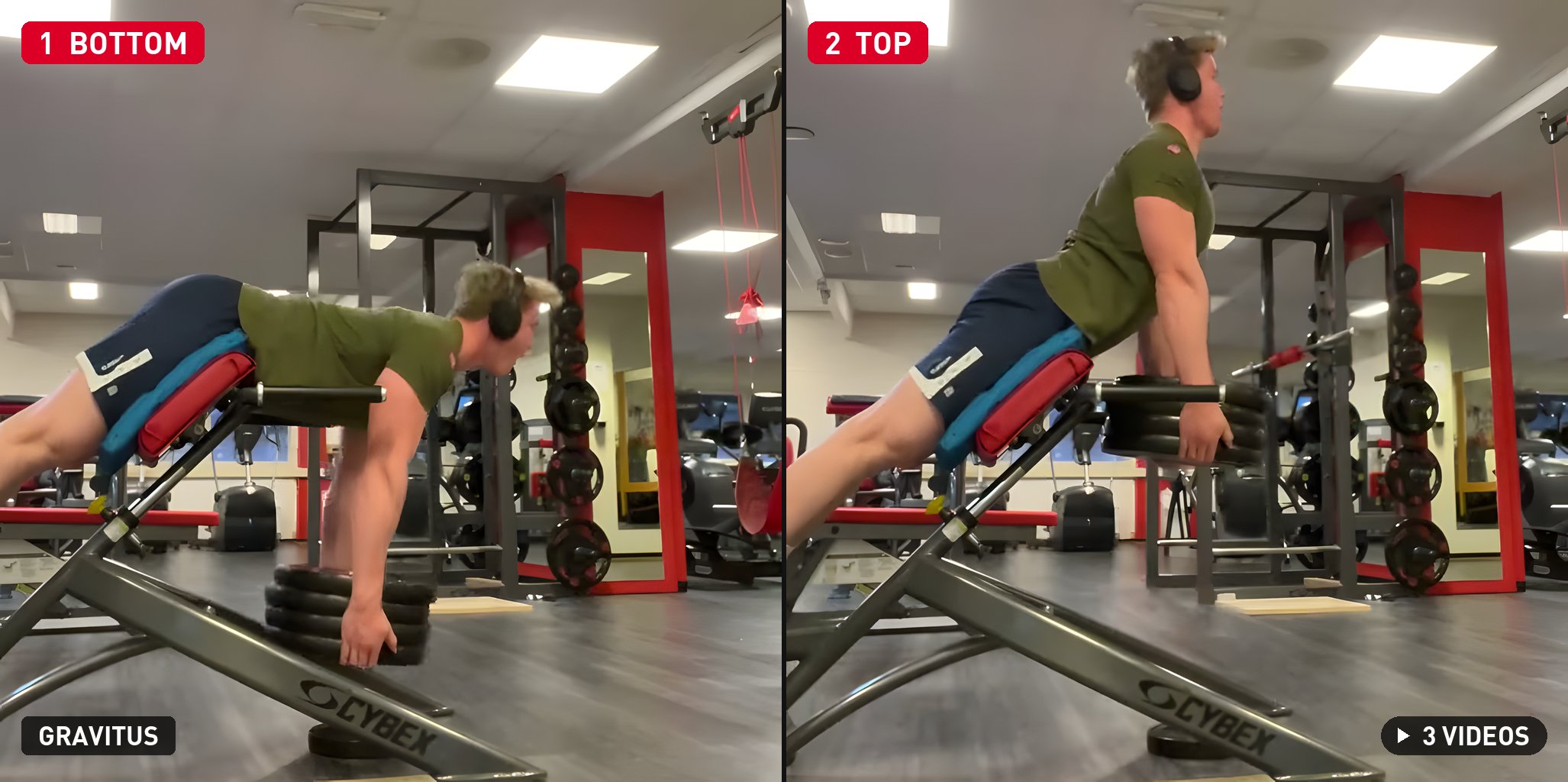
- 1Bottom. Pad below your hip bones, heels locked under the rollers. Bend at the hips until your torso hangs down, here with plates held in your hands.
- 2Top. Squeeze your glutes and rise until your body forms one straight line, then lower under control. Do not arch past the line.
Watch 3 video demonstrations
Find more video demonstrations in the Gravitus app
How to do a weighted hyperextension
- Set the pad so its top edge sits just below your hip bones, on the tops of your thighs. Your hips need room to bend over it.
- Lock your heels under the rollers. Hold a plate flat against your upper chest with your arms crossed over it, or hold a dumbbell or plates in your hands.
- Bend at the hips and lower your torso over 2 seconds until it hangs about straight down, or as far as you can stay in control.
- Squeeze your glutes and rise until your body forms one straight line from your head to your heels.
- Stop at the straight line. Arching past it adds lower back work, not glute work.
Glutes or lower back: what actually changes
Your glutes work hard in every version. Even on a setup built to tire the lower back, the glutes showed the clearest fatigue (Larivière 2011). What your setup changes is how much the lower back joins in: in the one study that tested spine and foot position, both changed lower back activity and neither changed glute activity (Mayer 2002). For glutes, keep your spine still and stop at a straight line. For lower back, let your back round at the bottom and arch it as you rise, with a lighter plate.
How much weight should you use for weighted hyperextensions?
On Gravitus, the median man lifts 45 lb (20 kg) for 10 reps on the weighted hyperextension, and the median woman 35 lb (16 kg).
- Most lift
- 30 to 65 lb
- Top 10% lift
- 110 lb or more
- Starting out
- under 30 lb
- Most lift
- 25 to 50 lb
- Top 10% lift
- 70 lb or more
- Starting out
- under 25 lb
- Most lift
- 14 to 30 kg
- Top 10% lift
- 50 kg or more
- Starting out
- under 14 kg
- Most lift
- 11 to 22.5 kg
- Top 10% lift
- 32.5 kg or more
- Starting out
- under 11 kg
Where to hold the weight
| Attribute | Plate at your chest | Weight in your hands | Plate behind your head |
|---|---|---|---|
| Lever | Short | Short, it hangs under your shoulders | Longer |
| Most weight you can use | Limited by plate size | Most, until your grip fails | Least |
| Best for | Starting out | Heavy sets, easy to set down | Progressing without more plates |
The further the weight sits from your hips, the harder the same plate feels. Start with a plate at your chest. Plates held in your hands hang under your shoulders, so they feel about the same and let you go heavier. Move the plate behind your head when you run out of weight. Without weights, hands behind the head instead of crossed only added upper back (lower trapezius) activity (Park 2014). The bench matters more than the hold: lower back activity rose as the bench got more horizontal (Mayer 1999). On a 45 degree bench the rep is hardest as your torso passes horizontal, about two thirds of the way up.
Muscles worked
Hyperextension vs Romanian deadlift vs reverse hyperextension
| Attribute | Weighted hyperextension | Romanian deadlift | Reverse hyperextension |
|---|---|---|---|
| What moves | Torso over fixed legs | Torso, standing | Legs under a fixed torso |
| Glutes | Same as the RDL | Same as the hyper | Less than the hyper |
| Hamstrings | More than both | Less than the hyper | Less than the hyper |
| Lower back | Same as the RDL | Same as the hyper | More back load, less rounding |
| Loaded with | A plate or dumbbell | A barbell, heaviest | A machine |
The hyperextension is not a lower back isolation exercise. At 6-rep loads it matched the Romanian deadlift for glute and lower back activity and beat it for hamstrings (Andersen 2021). It also drew more glute and hamstring activity than the reverse hyperextension, which loaded the lower back more with less rounding, 20 vs 31 degrees (Lawrence 2019). Use the RDL for heavy loads and the hyperextension to add hip work without a bar.
Hyperextension claims the research does not back
Three claims show up in most hyperextension guides:
- Hyperextensions isolate the lower back. At 6-rep loads, the 45 degree hyperextension drew as much lower back activity as the Romanian deadlift, as much glute activity and more hamstring activity (Andersen 2021).
- They build a stronger lower back. After 12 weeks of 45 degree hyperextensions holding plates, lifters used more weight but their isolated lower back strength did not increase (Mayer 2003). Eight weeks on a variable-angle bench raised back endurance by 42%, not strength (Verna 2002). In a review, only machines that lock the pelvis in place reliably strengthened the lower back muscles (Steele 2015).
- Turn your feet out to hit the glutes. Turning the hips out lowered lower back activity. It did not raise glute activity (Mayer 2002).
No study has shown that holding the plate behind your head is unsafe. It is a longer lever, so use a lighter plate.
Sets, reps and progression
Do hyperextensions once or twice a week, after your squats or deadlifts. Stop each set 1 to 2 reps short of failure. Sets taken close to failure build muscle across a wide range of reps (Schoenfeld 2021), so pick a range you can keep strict.
Get to 15 controlled bodyweight reps before you add weight. Then add reps first: when every set reaches 15, move up one plate, 5 to 10 lb (2.5 to 5 kg), and drop back to 10. When you run out of plates, move the weight from your chest to behind your head.
Common mistakes
-
Pad too highIt covers your hips, so the bend comes from your lower back. Lower it until the edge sits just below your hip bones.
-
Arching past straight at the topIt adds lower back work, not glute work. Stop when your body forms a straight line.
-
Bouncing out of the bottomMomentum does the hard part of the rep. Lower over 2 seconds and start each rep from a stop.
-
Letting the plate slide downThe lever changes mid-set. Pin the plate to your upper chest with both arms.
-
Adding weight too soonBuild to 15 bodyweight reps first, then add the smallest plate you have.
Weighted hyperextension variations
Questions people ask
How do I make hyperextensions work glutes instead of lower back?
Set the pad just below your hip bones, keep your spine still and stop when your body forms a straight line. Your glutes work hard in every version; what you control is how much the lower back joins in. Arching raised lower back activity by 25% without changing glute activity (Mayer 2002).
Where should I hold the weight on a weighted back extension, chest or behind the head?
Start at your chest. Behind the head is a longer lever, so the same plate is harder; use it when you run out of plates. Plates held in your hands hang under your shoulders and feel about like a plate at the chest.
Is weighted hyperextension better than Romanian deadlift?
Not for the lower back. At 6-rep loads the two drew the same lower back and glute activity, and the hyperextension drew more hamstring activity (Andersen 2021). The Romanian deadlift loads far heavier, so most lifters do both.
How to add weight to hyperextensions?
Hold a plate flat against your upper chest with your arms crossed, hold a dumbbell or plates in your hands, or hold a plate behind your head for a harder lever. Add weight only after 15 controlled bodyweight reps.
What muscles does the weighted back extension work?
The glutes and hamstrings extend your hips, and the spinal erectors hold or extend your spine. The adductor magnus helps at the bottom, and your core and upper back hold the plate in place.
How much weight should I use for weighted hyperextensions?
For 10 reps, the median on Gravitus is 45 lb (20 kg) for men and 35 lb (16 kg) for women. The strongest quarter lifts 65 lb (30 kg) and 50 lb (22.5 kg) or more.
Log every set and see your percentile on every lift, weighted hyperextension included.
Get GravitusRelated exercises
- Andersen et al. 2021. J Sports Sci Med 20(2):181-187.
- Mayer et al. 2002. Arch Phys Med Rehabil 83(11):1543-1546.
- Mayer et al. 1999. Arch Phys Med Rehabil 80(7):751-755.
- da Silva et al. 2009. J Rehabil Med 41(3):136-142.
- Larivière et al. 2011. Med Sci Sports Exerc 43(1):157-164.
- Park and Yoo 2014. J Electromyogr Kinesiol 24(6):972-976.
- Lawrence, Chin and Swanson 2019. J Strength Cond Res 33(8):2053-2056.
- Mayer et al. 2003. J Strength Cond Res 17(2):356-361.
- Verna et al. 2002. Spine 27(16):1772-1777.
- Steele, Bruce-Low and Smith 2015. Br J Sports Med 49(5):291-297.
- Schoenfeld et al. 2021. Sports 9(2):32.