How to Do an Ab Wheel Rollout
An ab rollout is a core exercise done kneeling behind an ab wheel. Hold the handles under your shoulders, brace and roll the wheel forward until your body is nearly straight, then pull it back without letting your lower back sag. It trains the rectus abdominis and obliques, with the lats helping. Most people do 3 sets of 6 to 12 reps.
Find more video demonstrations in the Gravitus app
How to do an ab wheel rollout
- Kneel on a mat or pad with the wheel on the floor in front of your knees. Grip both handles with your hands under your shoulders and your arms straight.
- Tuck your pelvis slightly, as if pulling your belt buckle toward your ribs, and brace your abs. Keep that position for the whole rep.
- Roll the wheel forward over 2 to 3 seconds. Let your hips and shoulders move forward together, so your body stays in one line from knees to head.
- Stop just before your lower back starts to arch or your hips start to sag. At first that may be only halfway out.
- Pull the wheel back toward your knees with your abs and lats, keeping your arms straight, until your hips are over your knees again.
How far to roll out
Roll out only as far as you can keep your lower back from arching. The rollout is hard because your abs have to stop your spine from bending backwards as the wheel moves away, and the further out you go, the longer that lever gets. When your back sags, the load moves off your abs and onto your lower back.
Start with a range you can control for 6 reps, even if it is short. Roll toward a wall so the wheel stops at your limit, and move further from the wall as you get stronger. The goal is a full rollout with your arms overhead and your body just above the floor.
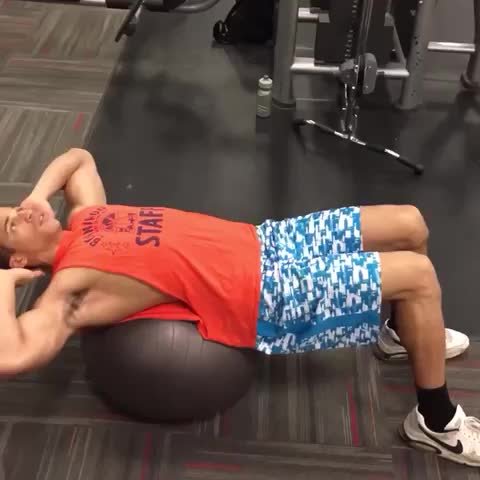
In a study of 10 exercises, the stability-ball roll-out drew 63% of maximum upper rectus abdominis activity and 53% for the lower rectus, among the highest of any exercise tested, while the rectus femoris, a hip flexor, worked at under 10% (Escamilla 2010).
From your first rollout to standing
Move up a step when you can do 3 sets of 10 to 12 controlled reps. No study has measured the standing rollout, so its difficulty is a matter of leverage: with your feet as the pivot instead of your knees, the lever from pivot to hands is far longer and more of your body is over the wheel. Most people need months of full kneeling rollouts first.
Muscles worked
Kneeling vs standing vs stability-ball rollout
| Attribute | Kneeling rollout | Standing rollout | Stability-ball rollout |
|---|---|---|---|
| Pivot | Your knees | Your feet | Your knees |
| Difficulty | Hard | Very hard | Moderate |
| Range | As far as your back stays flat | Very short at first | Short, the ball sets it |
| Measured in studies | Yes, as a wheel roll-out | No | Yes |
| Best for | Most lifters | Advanced lifters with full kneeling reps | Beginners |
Kneeling, for nearly everyone. It already draws some of the highest ab activity measured (Escamilla 2006), and you can make it harder by rolling further before you ever need to stand. A barbell with round plates works the same as a wheel if your gym has none.
Sets, reps and progression
Do rollouts 2 to 3 times a week, at the end of a session. Stop each set 1 to 2 reps before your back starts to sag. Sets taken close to failure build muscle across a wide range of reps (Schoenfeld 2021), but a sagging rep is not a rep.
Add range before reps. When you can do 3 sets of 12 at your current range, roll a few inches further and drop back to 6. Once full kneeling reps are easy, add a pause at the far end, then try standing rollouts to a wall.
Common mistakes
-
Lower back saggingYou have rolled past your strength. Stop shorter, or roll toward a wall so the wheel cannot go too far.
-
Hips staying backOnly your arms move and the rep turns into a lat stretch. Let your hips travel forward with your shoulders.
-
Hips piking up on the way backLeading with your hips takes the abs out of it. Keep your body in one line and pull with your abs.
-
Bending the elbowsKeep your arms straight so your trunk does the work, not your triceps.
-
Dropping to the floor at the far endRoll out over 2 to 3 seconds and stop just above the floor. Control matters more than range.
-
Holding your breathBreathe in at the start, brace, and breathe out as you roll back.
Ab rollout variations
Questions people ask
What are the benefits of the ab wheel?
It is one of the hardest ab exercises you can do with one cheap tool. Wheel and ball roll-outs drew some of the highest rectus abdominis and oblique activity measured (Escamilla 2006, Escamilla 2010), with little hip flexor or lower back activity (Escamilla 2010). It trains your abs to stop your spine from arching, and you can keep making it harder by rolling further.
What muscles do ab rollouts work?
Mainly the rectus abdominis and obliques, with the lats pulling the wheel back (Escamilla 2006). The hip flexors and lower back stayed under 10% of their maximum in a ball roll-out (Escamilla 2010).
Is the kneeling or standing ab rollout better?
Kneeling, for most people. It is the version studied, and it already draws very high ab activity (Escamilla 2006). Standing rollouts are much harder because your feet are the pivot. Build to full-range kneeling reps with a flat back before you try them.
Is the ab wheel better than crunches?
It is harder, and works the abs differently. A rollout device drew more ab activity and less hip flexor activity than the crunch in one study (Youdas 2008). In another, the crunch drew more activity while lifting and the rollout more while lowering (Bird 2006). Use both, or the rollout once crunches stop being hard.
Are ab rollouts bad for your lower back?
Not if your back stays flat. Lower back muscle activity was low in a ball roll-out (Escamilla 2010). The risk comes from rolling too far and letting your back sag. If you feel it in your lower back, shorten the range.
Can I do ab rollouts every day?
You can, but 2 to 3 hard sessions a week is enough. Treat it like a weighted exercise, and wait a day if your abs are still sore.
Will the ab wheel give me a six-pack?
It strengthens the muscle, but visible abs come from lower body fat. Six weeks of ab exercise, 5 days a week, did not reduce belly fat or waist size (Vispute 2011).
Log every set and Gravitus charts your reps, times and records from week to week.
Get GravitusRelated exercises


- Escamilla et al. 2006. Phys Ther 86(5):656-671.
- Escamilla et al. 2010. J Orthop Sports Phys Ther 40(5):265-276.
- Youdas et al. 2008. J Strength Cond Res 22(6):1939-1946.
- Bird et al. 2006. J Strength Cond Res 20(2):436-440.
- Vispute et al. 2011. J Strength Cond Res 25(9):2559-2564.
- Schoenfeld et al. 2021. Sports 9(2):32.