How to Do Hanging Leg Raises
A hanging leg raise is a core exercise done hanging from a pull-up bar. Your hip flexors lift your legs to hip height, then your abs curl your pelvis up toward your ribs. It trains the rectus abdominis, hip flexors and obliques. Most lifters do 3 sets of 8 to 15 reps, starting with bent knees.
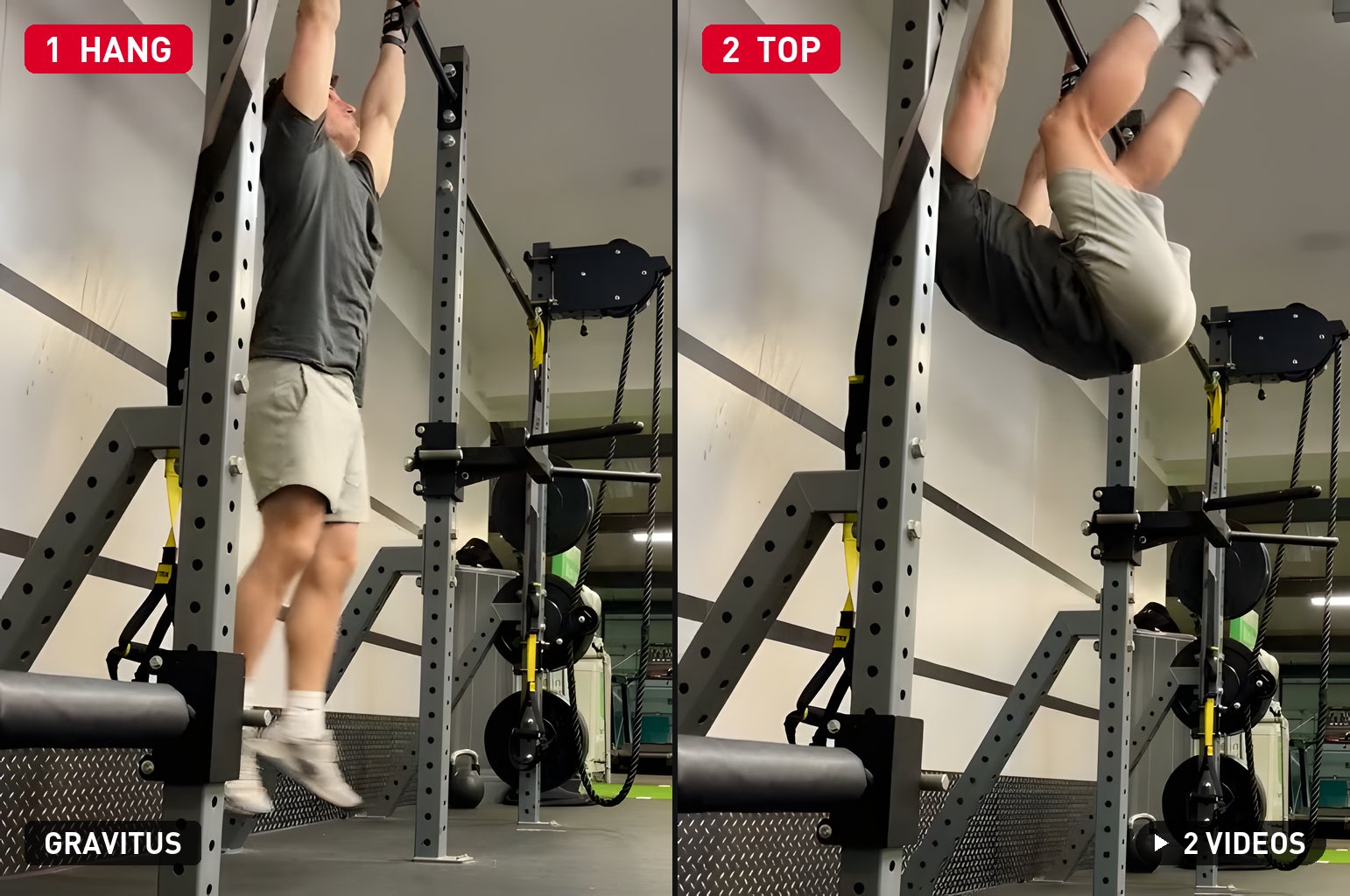
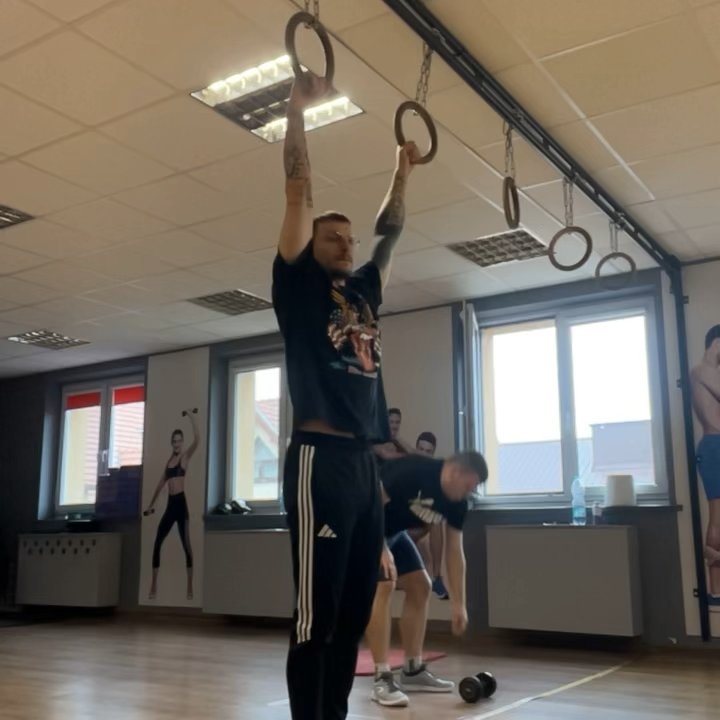
- 1Hang. Overhand grip on a pull-up bar, arms straight, shoulders pulled down and legs still.
- 2Top. Knees above your hips and pelvis curled toward your ribs, so your lower back rounds. Bent knees, as here, make it easier.
Watch 1 video demonstration
How to do a hanging leg raise
- Hang from a pull-up bar with an overhand grip, hands shoulder width apart, arms straight and feet off the floor.
- Pull your shoulders down away from your ears and hold your legs together. Stop any swing before the first rep.
- Lift your legs in front of you until your thighs are level with your hips. Keep your knees bent if straight legs are too hard.
- Keep going by curling your pelvis toward your ribs until your lower back rounds. Breathe out and hold for a second.
- Lower over 2 to 3 seconds to a still hang, without letting your legs swing behind you.
Lift your legs, then curl your pelvis
Lifting your legs is hip flexion, a job for the psoas, which was most active in hard hip flexion efforts (Juker 1998). Your abs flex the spine, so they only shorten when your pelvis curls at the top. Before that they stop the hip flexors from tipping your pelvis forward: lifting both legs needed ab activity, and lifting one leg did not (Andersson 1997). Done strictly, the rep is hard on the abs. The straight-leg hanging raise drew more than 130% of a max-effort test in the rectus abdominis and 88% in the external obliques (McGill 2015).
From knee raise to toes to bar
Your hip flexors have to lift the weight of your legs, and the further that weight sits from your hips, the harder it is. Bending your knees pulls your shins and feet in, so the same raise gets easier. Straightening them makes it harder without adding any weight. Move up a step when you can do 3 sets of 15 strict reps.
Muscles worked
Hanging leg raise claims the research does not back
Four claims that most hanging leg raise guides repeat, including our old one:
- Leg raises train the lower abs, crunches the upper. The rectus abdominis is one muscle, and it works along its whole length. EMG found no difference between its upper and lower parts in curl-ups or leg raises (Lehman 2001). One ultrasound study saw the lowest segment change most in a leg raise, but the crunch changed the muscle 36% more overall (Gomirato 2023).
- Hanging decompresses your spine. Not while you lift your legs. The straight-leg hanging raise compressed the spine with about 3,000 N, more than the body saw plank (McGill 2015).
- If you feel it in your hip flexors, you are doing it wrong. The hip flexors lift your legs in every version, so you will feel them. Feeling only your hip flexors means you stop before your pelvis curls.
- Leg raises burn belly fat. Six weeks of ab exercise, 5 days a week, did not reduce belly fat or waist size (Vispute 2011). Visible abs come from lower body fat.
Hanging leg raise vs captain's chair vs cable crunch
| Attribute | Hanging leg raise | Captain's chair raise | Kneeling cable crunch |
|---|---|---|---|
| Moves at | Your hips first, your spine at the top | Your hips first, your spine at the top | Your spine |
| Limited by | Grip, swinging | Hip flexors, abs | Your abs |
| Make it harder | Straighter legs, then a dumbbell between your feet | Straighter legs, ankle weights | A heavier pin |
| Easy to cheat by | Swinging | Stopping at hip height | Bowing at the hips |
The hanging leg raise if your grip holds, the captain's chair if it gives out first. We found no study comparing the two. Both are mostly hip flexion with an ab curl at the top, so pair them with a crunch that curls your spine under load.
Sets, reps and progression
Do hanging leg raises at the end of a session, 2 to 3 times a week. Stop each set 0 to 2 reps short of failure. Sets taken close to failure build muscle across a wide range of reps (Schoenfeld 2021), so pick a range you can keep strict.
There is no plate to add, so progress by lever. When every set reaches 15 strict reps, move one step up the progression and drop back to 8. Past toes to bar, hold a light dumbbell between your feet.
Common mistakes
-
SwingingMomentum lifts your legs, not your muscles. Come to a still hang before every rep, and bend your knees if you cannot.
-
Stopping at hip heightYour hip flexors did the rep and your abs only held on. Curl your pelvis toward your ribs at the top.
-
Dropping your legsThe lowering half is half the work. Take 2 to 3 seconds to lower to a still hang.
-
ShruggingYour shoulders creep up to your ears. Pull them down before the first rep and keep your arms straight.
-
Straight legs too soonYou swing or arch to get them up. Stay with bent knees until you can do 3 sets of 15 strict reps.
-
Letting grip end the setYour hands give out before your abs. Use lifting straps, or switch to a captain's chair.
Hanging leg raise variations
Questions people ask
Do hanging leg raises work lower abs?
They work your whole rectus abdominis, which is one muscle. EMG found no upper vs lower difference in leg raises (Lehman 2001). One ultrasound study saw the lowest segment change most in a leg raise (Gomirato 2023), but no training study has tested whether that grows the lower abs more.
Do hanging leg raises work hip flexors?
Yes. Lifting your legs to hip height is hip flexion, the job of the iliopsoas and rectus femoris. Your abs hold your pelvis still on the way up and curl it at the top.
Are hanging leg raises bad for your back?
Not for most people, but they load it. The straight-leg version compressed the spine with about 3,000 N, more than the body saw plank (McGill 2015). If your back hurts, bend your knees, stop the swing and curl only as far as you control.
How many hanging leg raises should I be able to do?
On Gravitus, as of September 2026, the median best set logged as hanging leg raises is 12 reps for both men and women, and the top 10% have done 20 or more (4,000+ men, 800+ women). Count only strict reps with your legs at hip height or higher.
Why are hanging leg raises so hard?
You lift the weight of both legs on a long lever while hanging by your hands. Straight legs put that weight far from your hips, and grip often fails before your abs. Bend your knees to shorten the lever.
Are hanging leg raises enough for abs?
Not on their own. Most of the rep is hip flexion, and your spine only curls at the top. Add a crunch, which curls your spine through its whole range. The crunch changed the rectus abdominis 36% more than a leg raise (Gomirato 2023).
Log every set and Gravitus charts your reps, times and records from week to week.
Get GravitusRelated exercises

- McGill, Andersen and Cannon 2015. J Sports Sci 33(4):419-426.
- Andersson et al. 1997. Eur J Appl Physiol 75(2):115-123.
- Juker et al. 1998. Med Sci Sports Exerc 30(2):301-310.
- Escamilla et al. 2006. Phys Ther 86(5):656-671.
- Lehman and McGill 2001. Phys Ther 81(5):1096-1101.
- Gomirato and Grenier 2023. Int J Exerc Sci 16(1):1077-1086.
- Vispute et al. 2011. J Strength Cond Res 25(9):2559-2564.
- Schoenfeld et al. 2021. Sports 9(2):32.