How to Do a Crunch
A crunch is a bodyweight ab exercise done on your back with your knees bent. Curl your ribs toward your hips until your shoulder blades leave the floor, with your feet free and your hands off your neck. It trains the rectus abdominis, with the obliques helping. Most people do 3 sets of 12 to 25 reps.
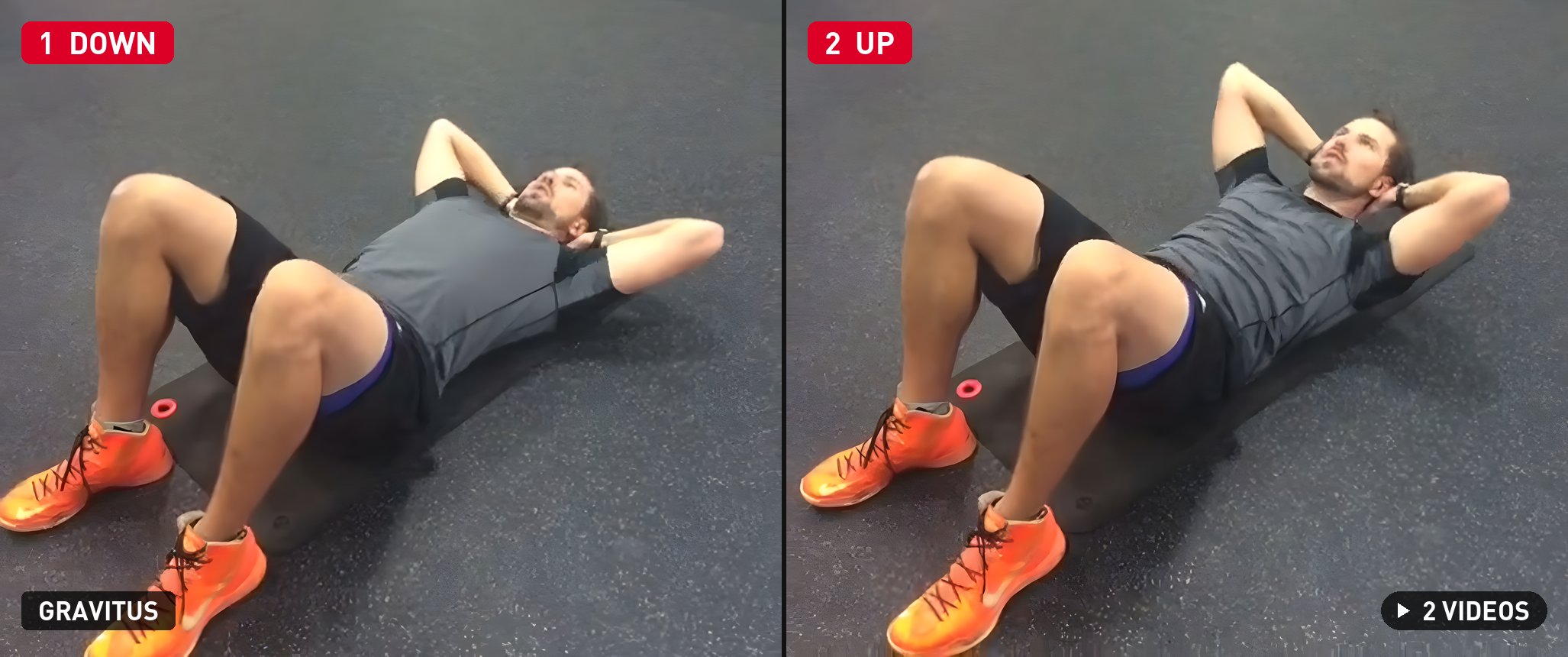
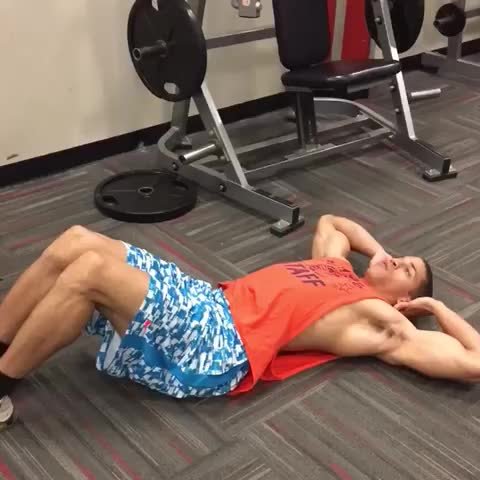
- 1Down. On your back, knees bent and feet flat and free. Fingertips behind your ears, elbows wide.
- 2Up. Curl your ribs toward your hips until your shoulder blades leave the floor. Your hands hold your head; they do not pull it.
Watch 2 video demonstrations
How to do a crunch
- Lie on your back on a mat with your knees bent and your feet flat on the floor, hip width apart. Leave your feet free; do not hook them under anything.
- Rest your fingertips behind your ears with your elbows wide, or cross your arms on your chest.
- Let your lower back settle toward the floor and keep a fist's space between your chin and your chest.
- Breathe out and curl your ribs toward your hips, lifting your head, shoulders and shoulder blades off the floor. Hold for a second.
- Lower over 2 seconds until your shoulder blades touch down, then start the next rep without bouncing.
How high to curl up
Curl until your shoulder blades leave the floor, then stop. Your abs curl your spine, and past that point the rest of the way up comes from your hips: you are doing a sit-up. In one study, sit-ups worked the psoas, a hip flexor, at 15 to 35% of its maximum and the curl-up at under 10% (Juker 1998). Going higher did not help the abs either. In curl-up holds, sliding the hands 10 cm along the floor drew the most lower rectus abdominis activity, and curling further, to 15 cm, drew the least upper rectus activity (Parfrey 2008).
Neither, on purpose. Your lower back flattens toward the floor as you curl. In a leg-lift hold, tilting the pelvis back drew more rectus abdominis activity than tilting it forward, but no more than a neutral pelvis (Workman 2008). There is no need to press hard or hold an arch.
Your arms set the difficulty
The weight you lift in a crunch is your upper body. The further your arms sit from your hips, the further that weight sits from the point you curl around, so the same crunch gets harder without adding anything. Changing arm position to add load raised activity in all four ab muscles measured in one curl-up study (Crommert 2021). Move one step up when 3 sets of 25 strict reps come easy. Past arms overhead, hold a plate on your chest: in a loaded crunch study, ab activity was highest at the heaviest load (Moraes 2009).
Muscles worked
Crunch claims the research does not back
Four claims that most crunch guides repeat:
- Crunches only work your upper abs. The rectus abdominis is one muscle. EMG found no difference between its upper and lower parts in curl-ups (Lehman 2001), and in an ultrasound study the crunch changed the muscle 36% more than a leg raise did (Gomirato 2023).
- Hook your feet for a better crunch. The opposite. Holding the feet down lowered activity at every ab site measured and raised hip flexor activity (Parfrey 2008).
- Crunches wear out your spinal discs. The worry comes from lab tests on pig neck segments, bent 86,400 times under load until their discs herniated (Callaghan and McGill 2001). A set of crunches is a few dozen bends. If bending forward already hurts your back, do a plank or a dead bug instead.
- Crunches burn belly fat. Six weeks of ab exercise, 5 days a week, did not reduce belly fat or waist size (Vispute 2011). Visible abs come from lower body fat.
Crunch vs sit-up vs kneeling cable crunch
| Attribute | Crunch | Sit-up | Kneeling cable crunch |
|---|---|---|---|
| Moves at | Your spine | Your spine, then your hips | Your spine |
| Hip flexors | Little | A lot | Little, if your hips stay still |
| Make it harder | Arms overhead, a plate on your chest | Arms overhead, a plate on your chest | A heavier pin |
| Easy to cheat by | Pulling on your head | Hooking your feet, swinging up | Bowing at the hips |
The crunch, for ab work with nothing but the floor. The sit-up adds hip flexor work: sit-ups drew 15 to 35% of the psoas maximum against under 10% for a curl-up (Juker 1998). Once bodyweight crunches stop being hard, the kneeling cable crunch lets you keep adding weight.
Sets, reps and progression
Crunch 2 to 3 times a week, at the end of a session. Stop each set 0 to 2 reps short of failure. Sets taken close to failure build muscle across a wide range of reps (Schoenfeld 2021), so pick a range you can keep strict.
Make each rep harder before you pile on reps. When every set reaches 25 strict reps, move your arms one step up the ladder above and drop back to 12. Past arms overhead, hold a plate on your chest, starting at 5 lb (2.5 kg) and adding 5 lb (2.5 kg) at a time.
Common mistakes
-
Pulling on your headYour neck bends and your abs do less. Rest your fingertips at your ears without lacing them, or cross your arms on your chest.
-
Hooking your feetYour hip flexors take over. Holding the feet down lowered ab activity (Parfrey 2008). Leave them free.
-
Sitting all the way upPast your shoulder blades the lift comes from your hips. Stop when your shoulder blades leave the floor.
-
Bouncing off the floorMomentum does the first part of the rep. Lower over 2 seconds and touch down lightly.
-
Jamming your chin to your chestNodding your head is not a crunch. Keep a fist's space under your chin and move your ribs.
-
Holding your breathBreathe out as you curl up and in as you lower.
Crunch variations
Questions people ask
Are crunches bad for your back?
Not for most people. The fear of disc damage comes from pig neck segments bent 86,400 times under load (Callaghan and McGill 2001), far more than a set of crunches. If bending forward already hurts your back, swap in a plank or a dead bug. Leave your feet free so your hip flexors stay out of it (Parfrey 2008).
Do crunches work lower abs?
Yes. The rectus abdominis is one muscle, and EMG found no difference between its upper and lower parts in curl-ups (Lehman 2001). In an ultrasound study, the crunch also changed the muscle 36% more than a leg raise did (Gomirato 2023).
Are crunches and sit ups the same?
No. A crunch curls your spine and stops when your shoulder blades leave the floor. A sit-up keeps going until you are upright, and your hip flexors do that part. Sit-ups worked the psoas at 15 to 35% of its maximum and the curl-up at under 10% (Juker 1998).
How many crunches should I do a day?
Do 3 sets of 12 to 25, 2 to 3 times a week, ending each set 0 to 2 reps short of failure. On Gravitus, as of September 2026, the median best set logged as crunches is 20 reps for both men and women, and the top 10% have done 50 or more (men) or 40 or more (women) (2,800+ men, 1,000+ women). Once 25 come easy, make each rep harder instead of doing more.
Should I do crunches everyday?
You can, but you do not need to. In one trial, 7 ab exercises for 2 sets of 10, 5 days a week for 6 weeks, raised curl-up reps to 47 against 32 in a group that did nothing (Vispute 2011). For most people, 2 or 3 hard sessions a week, with harder arm positions as you improve, is enough.
Do crunches burn belly fat?
No. Six weeks of ab exercise, 5 days a week, did not reduce belly fat or waist size (Vispute 2011). Crunches strengthen the muscle under the fat, and lower body fat is what makes it visible.
Why do crunches hurt my neck?
You are pulling on your head or jamming your chin down. Rest your fingertips at your ears without lacing them, or cross your arms on your chest, and keep a fist's space under your chin. Lead with your ribs, not your head.
Log every set and Gravitus charts your reps, times and records from week to week.
Get GravitusRelated exercises

- Juker et al. 1998. Med Sci Sports Exerc 30(2):301-310.
- Parfrey et al. 2008. Appl Physiol Nutr Metab 33(5):888-895.
- Workman et al. 2008. J Strength Cond Res 22(5):1563-1569.
- Crommert et al. 2021. J Strength Cond Res 35(2):428-435.
- Moraes et al. 2009. Phys Ther Sport 10(2):57-62.
- Escamilla et al. 2006. J Orthop Sports Phys Ther 36(2):45-57.
- Lehman and McGill 2001. Phys Ther 81(5):1096-1101.
- Gomirato and Grenier 2023. Int J Exerc Sci 16(1):1077-1086.
- Callaghan and McGill 2001. Clin Biomech 16(1):28-37.
- Vispute et al. 2011. J Strength Cond Res 25(9):2559-2564.
- Schoenfeld et al. 2021. Sports 9(2):32.