How to Do a Kneeling Cable Crunch
A kneeling cable crunch is a weighted ab exercise on a high pulley. Kneel facing the stack, hold a rope beside your head and curl your ribs toward your hips while your hips stay over your knees. It trains the rectus abdominis, with the obliques helping. Most lifters do 3 to 4 sets of 10 to 15 reps.
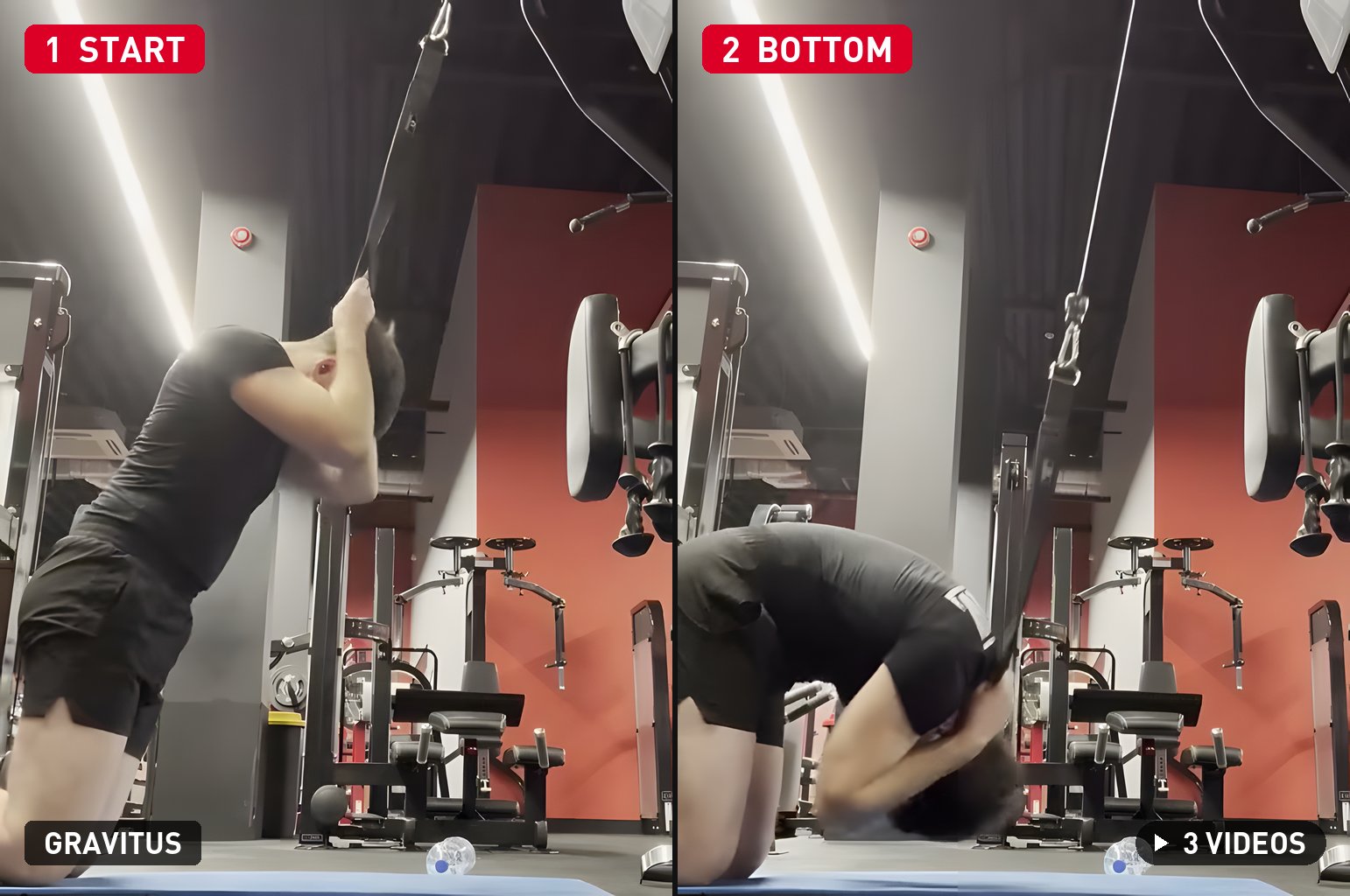
- 1Start. Pulley on the top setting, knees about a foot (30 cm) behind it. Hold the rope beside your head with your hips over your knees.
- 2Bottom. Round your back and curl your ribs toward your hips until your elbows reach your thighs. Your hips stay where they are.
Watch 3 video demonstrations
Find more video demonstrations in the Gravitus app
How to do a kneeling cable crunch
- Set the pulley to the top notch and clip on a rope.
- Hold one end of the rope in each hand and kneel facing the stack, knees about a foot (30 cm) behind the pulley, so the cable runs close to straight down.
- Pull your hands to the sides of your head, beside your ears. Tilt forward slightly until the weight lifts off the stack. From here your hips stay over your knees.
- Breathe out and curl your ribs toward your hips, rounding your back, until your elbows reach your thighs. Squeeze for a second.
- Uncurl over 2 to 3 seconds until you are back upright, without letting the plates touch.
Curl your spine, don't bow at the hips
A crunch is spinal flexion: your ribs move toward your pelvis. Bowing at the hips is hip flexion, a job for the psoas. In one study the psoas worked at under 10% of its maximum in a curl-up and at 15 to 35% in sit-ups, which bend at the hips (Juker 1998). The crunch drew some of the highest rectus abdominis and oblique activity of 9 ab exercises tested (Escamilla 2006).
Where you kneel changes the crunch
The weight stack pulls with the same force all rep, but not with the same leverage. Your abs work hardest when the cable runs at a right angle to your torso, so where you kneel moves the hard part of the rep. The curves are modelled for a top pulley with the rope at your neck, each scaled to its own hardest point, and show the pull of the cable only.
Kneel close, so the cable runs close to straight down, and tilt forward slightly at the top until the weight lifts. If the cable pulls you toward the stack when you are upright, shuffle in. Facing away loads the stretched top of the rep, though no study has compared the two.
How much weight should you use for kneeling cable crunches?
On Gravitus, the median man lifts 100 lb (45 kg) for 10 reps on the kneeling cable crunch, and the median woman 65 lb (30 kg).
- Most lift
- 75 to 150 lb
- Top 10% lift
- 180 lb or more
- Starting out
- under 75 lb
- Most lift
- 45 to 100 lb
- Top 10% lift
- 125 lb or more
- Starting out
- under 45 lb
- Most lift
- 32.5 to 67.5 kg
- Top 10% lift
- 82.5 kg or more
- Starting out
- under 32.5 kg
- Most lift
- 20 to 45 kg
- Top 10% lift
- 57.5 kg or more
- Starting out
- under 20 kg
Muscles worked
Cable crunch claims the research does not back
Four claims that most cable crunch guides repeat, including our old one:
- Cables give constant tension. The stack pulls with the same force, but its leverage on your spine changes through the rep. Kneeling close, the top of the rep is almost unloaded and the rep gets harder as you curl, as the chart above shows.
- Kneeling keeps your hip flexors out of it. Only if your hips stay still. Bowing forward at the hips is hip flexion in any position, and sit-ups that bend at the hips drew far more psoas activity than a curl-up (Juker 1998).
- Crunches hit the upper abs, leg raises the lower abs. The rectus abdominis thickened along its whole length in a crunch, a sit-up and a leg raise, and the crunch changed it 36% more than the leg raise did (Gomirato 2023).
- Abs need high reps, not weight. In a loaded crunch study, ab activity was highest at the heaviest load (Moraes 2009). Train them like any other muscle.
Ab work does not burn belly fat either. Six weeks of ab exercise, 5 days a week, did not reduce belly fat or waist size (Vispute 2011). Visible abs come from lower body fat.
Kneeling vs standing cable crunch vs hanging leg raise
| Attribute | Kneeling cable crunch | Standing cable crunch | Hanging leg raise |
|---|---|---|---|
| Moves at | Your spine | Your spine, and your hips if you let them | Your hips first, your spine at the top |
| Load | Any pin on the stack | The stack, limited by balance | Your legs |
| Easy to cheat by | Bowing at the hips | Bending at the hips and knees | Swinging |
Kneeling, for loading the abs. It fixes your hips so the curl comes from your spine. No study has compared kneeling and standing cable crunches. The hanging leg raise is mostly hip flexion, with the abs curling your pelvis at the top, so use it alongside the crunch, not instead of it.
Sets, reps and progression
Do cable crunches at the end of a session, 2 to 3 times a week. Stop each set 0 to 2 reps short of failure. Sets taken close to failure build muscle across a wide range of reps (Schoenfeld 2021), so pick a range you can keep strict.
Add reps before weight. When every set reaches 15 with your hips still, move up one pin and drop back to 10.
Common mistakes
-
Bowing at the hipsYour hip flexors take over and your back stays flat. Keep your hips over your knees and round your back.
-
Pulling with your armsYour lats drag the rope down. Pin your hands beside your head and keep them there.
-
Kneeling too far backThe cable pulls you toward the stack at the top. Shuffle in until it runs close to straight down.
-
Going too heavyThe load outgrows your abs and you hinge to move it. Drop a pin until the curl comes from your spine.
-
Tucking only your chinNodding your head is not a crunch. Move your ribs toward your hips.
-
Letting the stack pull you upUncurl over 2 to 3 seconds without letting the plates touch.
Cable crunch variations
Questions people ask
Are standing cable crunches better than kneeling?
Not for your abs, and no study has compared them. Kneeling fixes your hips, so it is easier to curl from your spine and load it heavy. Standing lets your hips and knees help, which most lifters use to cheat.
Do cable crunches work lower abs?
Yes. The rectus abdominis is one muscle, and its whole length shortened and thickened in a crunch. The crunch changed it 36% more than a leg raise did (Gomirato 2023).
How far from the cable machine should I kneel for cable crunches?
About a foot (30 cm) behind the pulley, so the cable runs close to straight down. Kneel much further back and the cable pulls you toward the stack at the top, so the first part of the rep has no load.
Why do I feel cable crunches in my hip flexors or lower back?
You are bending at the hips instead of rounding your back. That is the hip flexors' job, and sit-ups that bend at the hips drew far more psoas activity than a curl-up (Juker 1998). Drop a pin, keep your hips over your knees and curl your ribs toward your hips.
Will cable crunches widen my waist?
No study shows that. The rectus abdominis is a thin strap down the front of your belly, and waist size is mostly fat. Six weeks of ab training did not change waist size or belly fat (Vispute 2011).
How heavy should cable crunches be?
For 10 reps, the median on Gravitus is 100 lb (45 kg) for men and 65 lb (30 kg) for women. The strongest quarter lifts 150 lb (67.5 kg) and 100 lb (45 kg) or more.
Log every set and see your percentile on every lift, kneeling cable crunch included.
Get GravitusRelated exercises


- Juker et al. 1998. Med Sci Sports Exerc 30(2):301-310.
- Escamilla et al. 2006. J Orthop Sports Phys Ther 36(2):45-57.
- Gomirato and Grenier 2023. Int J Exerc Sci 16(1):1077-1086.
- Moraes et al. 2009. Phys Ther Sport 10(2):57-62.
- Vispute et al. 2011. J Strength Cond Res 25(9):2559-2564.
- Schoenfeld et al. 2021. Sports 9(2):32.