How to Do a Smith Machine Squat
A Smith machine squat is a back squat with the bar locked on vertical rails. Set your feet under the bar or a small step ahead of it, and squat as deep as your heels stay flat. It mainly trains the quads, with the glutes and adductors helping. Most lifters do 3 to 4 sets of 6 to 12 reps.
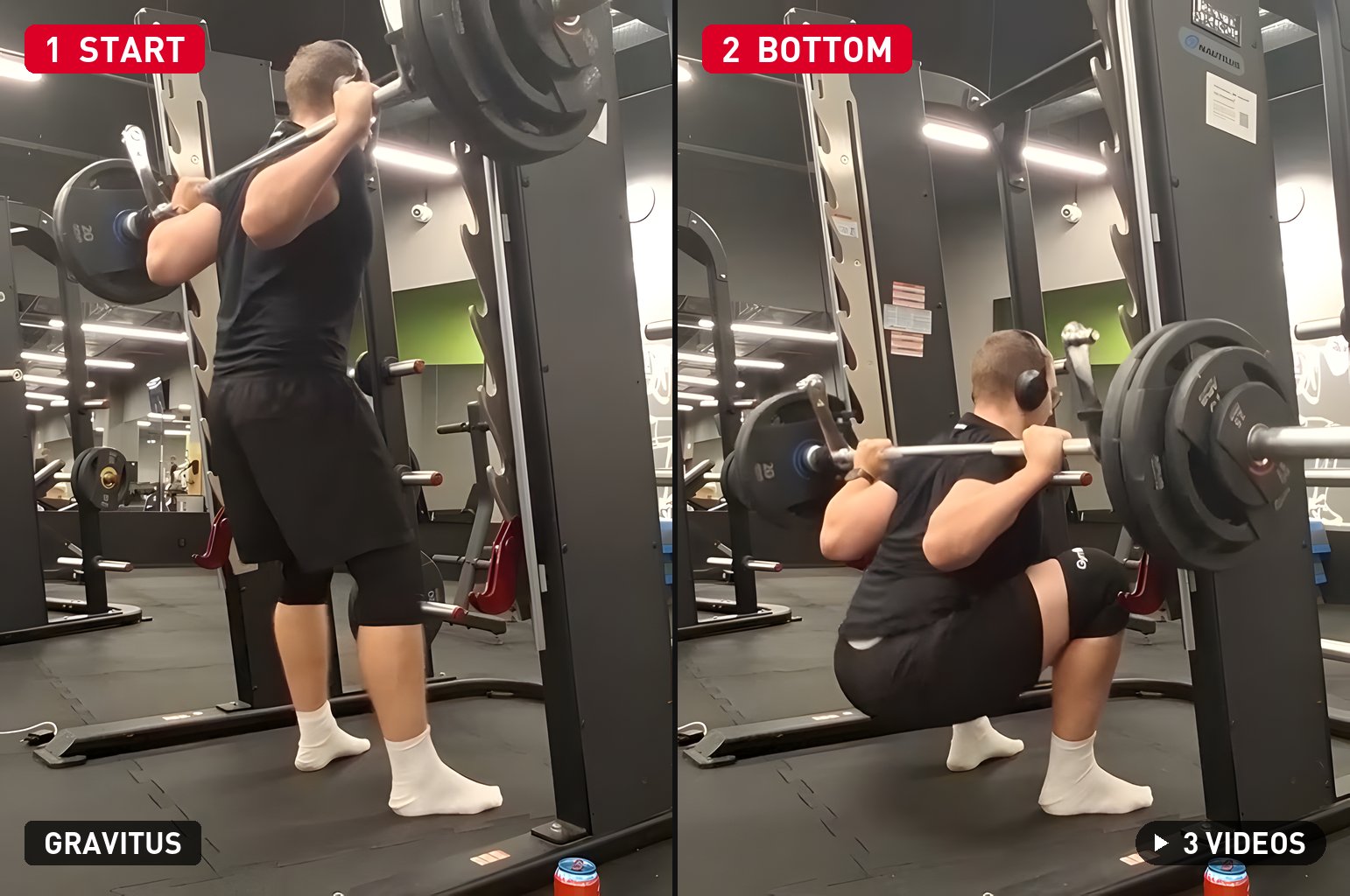
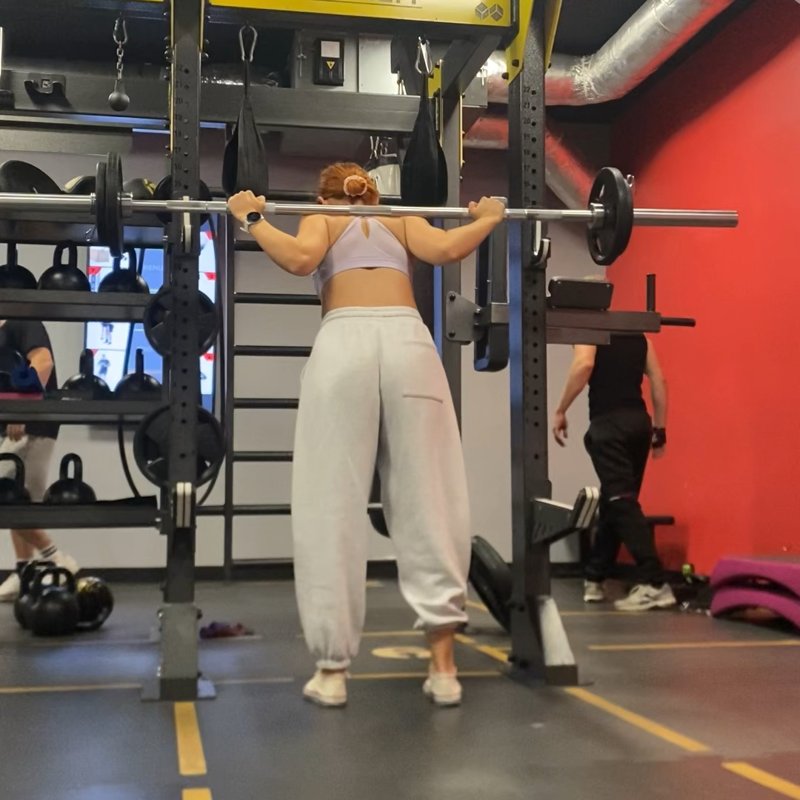
- 1Start. Bar across your upper back, feet shoulder-width with the bar over the middle of your feet. Twist the bar off the hooks and brace.
- 2Bottom. Squat straight down as deep as your heels stay flat, then drive up through your whole foot.
Watch 3 video demonstrations
Find more video demonstrations in the Gravitus app
How to do a Smith machine squat
- Set the hooks at upper-chest height and the safety stops just below the lowest point of your squat.
- Step under the bar and rest it across your upper back, on the muscle below your neck. Grip it just outside your shoulders.
- Place your feet shoulder-width apart, toes turned out slightly, with the bar over the middle of your feet. Stand up and twist the bar off the hooks.
- Brace your abs and squat straight down, letting your knees travel forward over your toes. Go as deep as your heels stay flat and your lower back stays still.
- Drive up through your whole foot to standing. After the last rep, twist the bar back onto the hooks.
Smith machine squat foot placement
No study has measured muscle activity by foot position on a Smith machine, so these come from models and leg press studies. A model of a squat on a fixed bar path found that the further forward the feet went, the lower the load on the knee and the higher the load on the hip (Abelbeck 2002). On the leg press, where high feet do the same job, low feet drew more quad activity and high feet more glute activity (Da Silva 2008). Stance width changed glute and adductor activity but not quad activity (McCaw 1999, Paoli 2009). Start with the bar over your mid-foot, then move your feet forward an inch or two at a time until your heels stay down at full depth.
Do feet forward work the quads more?
No, they do the opposite. Many guides, including an earlier version of this one, say feet out in front of the bar hit the quads. Moving your feet forward keeps your shins upright and your knees behind your toes, which moves the work from your knees to your hips. In a barbell squat study, stopping the knees at the toes cut knee torque by 22% but raised hip torque more than tenfold (Fry 2003). Feet forward on a Smith machine does the same thing, because the rails hold the bar while you lean back into it.
If you want the most quad work, keep the bar over your mid-foot, let your knees travel, and raise your heels on a small plate if your ankles are stiff.
Three other claims that do not hold up:
- You can lift more on a Smith machine. In a lab test, women squatted more on the Smith machine and men about the same as with a free bar (Cotterman 2005). In Gravitus logs, most lifters record less on the Smith than on the back squat (see below).
- Free squats work 43% more muscle. That figure is an average over seven muscles from a study of six people. The inner quad, hamstrings and calves were more active in the free squat; the lower back and abs were not (Schwanbeck 2009).
- The Smith machine builds less muscle. Over 8 weeks, back squats on a Smith machine grew the outer quad as much as free-weight back squats (Marcos-Frutos 2025), and a review of 13 studies found no difference in growth between machines and free weights (Haugen 2023).
How deep to go on a Smith machine squat
Go as deep as your heels stay flat and your lower back stays still, which is at or below parallel for most lifters. The rails make depth easy to repeat: set the safety stops just below your lowest point and the bar cannot drop further.
Depth grows more muscle. Over 12 weeks, deep squats to 120 degrees of knee bend grew the front of the thigh 4 to 7% more than shallow squats to 60 degrees (Bloomquist 2013). Full squats and half squats grew the quads by the same amount, but full squats grew the glutes and adductors 2 to 3 times as much (Kubo 2019).
Your knees will travel past your toes at the bottom with the bar over your mid-foot, and that is fine. Holding them back moves the load onto your hips and lower back (Fry 2003).
How much weight should you Smith machine squat?
On Gravitus, the median man lifts 160 lb (72.5 kg) for 10 reps on the Smith machine squat, and the median woman 80 lb (35 kg).
- Most lift
- 120 to 205 lb
- Top 10% lift
- 245 lb or more
- Starting out
- under 120 lb
- Most lift
- 55 to 105 lb
- Top 10% lift
- 135 lb or more
- Starting out
- under 55 lb
- Most lift
- 52.5 to 92.5 kg
- Top 10% lift
- 110 kg or more
- Starting out
- under 52.5 kg
- Most lift
- 25 to 47.5 kg
- Top 10% lift
- 60 kg or more
- Starting out
- under 25 kg
Smith machine squat vs back squat: how the weights compare
Most lifters log about 80% of their back squat on the Smith machine. We compared the best estimated max of 3,900+ men and 1,400+ women who log both lifts in Gravitus (Sep 2026). The median man's Smith max was 80% of his back squat, and the median woman's was 79%. Only one man in six logged more on the Smith. A 225 lb (100 kg) back squat predicts about 180 lb (80 kg) on the Smith for one rep.
That runs against the lab. When both lifts were tested to a max with the bar counted, women squatted more on the Smith machine and men about the same (Cotterman 2005). Part of the gap in our logs is the bar: a lifter who logs only the plates leaves out up to 45 lb (20 kg) on every set. Strength also carries over poorly. Over 8 weeks, lifters gained the most strength on the equipment they trained on (Marcos-Frutos 2025), so a Smith squat number says little about your free squat.
Smith machine squat muscles worked
Smith machine squat vs back squat vs hack squat
| Attribute | Smith machine squat | Barbell back squat | Hack squat |
|---|---|---|---|
| Bar path | Straight up the rails | You balance it | Fixed sled on an angle |
| Balance needed | Little | Most | Little, back on a pad |
| Where your feet go | Under the bar or a step ahead | Under the bar | Middle of the platform |
| Best for | Hard sets alone, small weight jumps | Free-weight squat strength | Deep quad work, back supported |
A tie for growth. Over 8 weeks, Smith and free-weight back squats grew the quads equally, while strength rose most on the equipment people trained on (Marcos-Frutos 2025). Free squats drew more quad, hamstring and calf activity in a six-person study (Schwanbeck 2009), but that did not turn into more growth. Train the back squat if you want a bigger back squat, and use the Smith for hard sets without a spotter.
Sets, reps and progression
Stop each set 1 to 2 reps short of failure. Sets taken close to failure build muscle across a wide range of reps (Schoenfeld 2021), and the safety stops let you get there without a spotter.
Add reps first. When every set reaches 12 clean reps, add 10 to 20 lb (5 to 10 kg) in total and go back to 6 to 8.
Common mistakes
-
Bar on your neckThe bar presses on bone and slides. Rest it lower, on the muscle across your upper back.
-
Heels liftingYour ankles run out of bend. Move your feet forward an inch or two, or widen your stance a little.
-
Feet too far forwardYour hips take over and your lower back can tuck under at the bottom. Bring your feet back until your knees travel a little past your toes.
-
Stopping above parallelHalf squats grow the glutes and adductors less than full ones. Go as deep as your heels stay flat.
-
No safety stopsA failed rep only ends safely on the stops. Set them just below your lowest point before the first set.
Smith machine squat variations
Questions people ask
What muscles do smith machine squats work?
Mainly the quads, with the glutes and adductors helping. Your spinal erectors and abs hold your trunk still, and your hamstrings and calves steady the knee and ankle.
Should my feet be in front of the bar or under it on a smith machine squat?
Start with the bar over your mid-foot, which gives the most quad work. Move your feet forward an inch or two if your heels lift. Further forward moves the load from your knees to your hips (Abelbeck 2002), so it works the glutes more, not the quads.
Do smith machine squats work glutes?
Yes, and more the deeper you go. Over 10 weeks, full squats grew the glutes 6.7% and half squats 2.2% (Kubo 2019). A wider stance (Paoli 2009) and feet a step forward add more.
Is smith machine squat better than barbell squat?
Not for growth; they build the quads equally (Marcos-Frutos 2025). The Smith is better for hard sets without a spotter. The barbell squat is better if you want a stronger free squat, since strength rose most on the equipment people trained on.
Are smith machines good for squats?
Yes. Set the safety stops, keep the bar over your mid-foot and squat as deep as your heels stay flat. Machine and free-weight training built muscle equally across 13 studies (Haugen 2023).
How much weight should I smith machine squat?
For 10 reps, the median on Gravitus is 160 lb (72.5 kg) for men and 80 lb (35 kg) for women. The strongest quarter lifts 205 lb (92.5 kg) and 105 lb (47.5 kg) or more.
Log every set and see your percentile on every lift, Smith machine squat included.
Get GravitusRelated exercises

- Abelbeck 2002. J Strength Cond Res 16(4):516-524.
- Da Silva et al. 2008. J Strength Cond Res 22(4):1059-1065.
- McCaw and Melrose 1999. Med Sci Sports Exerc 31(3):428-436.
- Paoli et al. 2009. J Strength Cond Res 23(1):246-250.
- Fry et al. 2003. J Strength Cond Res 17(4):629-633.
- Cotterman et al. 2005. J Strength Cond Res 19(1):169-176.
- Schwanbeck et al. 2009. J Strength Cond Res 23(9):2588-2591.
- Marcos-Frutos et al. 2025. Int J Sports Physiol Perform 20(2):292-300.
- Haugen et al. 2023. BMC Sports Sci Med Rehabil 15:103.
- Bloomquist et al. 2013. Eur J Appl Physiol 113(8):2133-2142.
- Kubo et al. 2019. Eur J Appl Physiol 119(9):1933-1942.
- Schoenfeld et al. 2021. Sports 9(2):32.