How to Do a Push-Up
A push-up is a bodyweight press from a straight-body plank. Set your hands just outside your shoulders and lower until your chest nearly touches the floor, elbows 45 to 60 degrees from your sides, then press back up. It moves about 64% of your bodyweight and trains the chest, front delts and triceps. Most people do 3 to 4 sets of 8 to 20 reps.
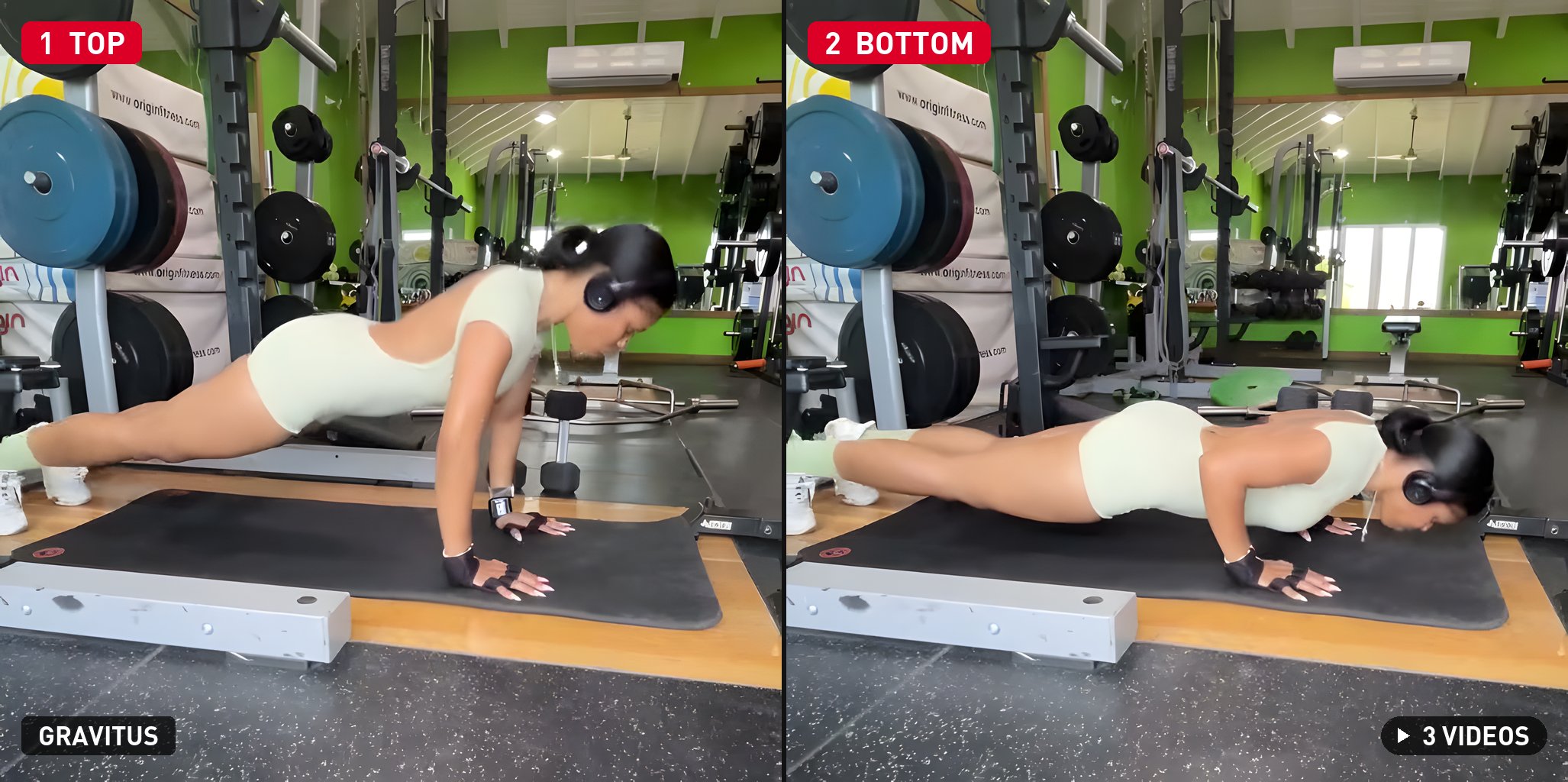
- 1Top. Arms straight, hands just outside your shoulders and one straight line from head to heels.
- 2Bottom. Lower until your chest nearly touches the floor, elbows 45 to 60 degrees from your sides, then press back up.
Watch 3 video demonstrations
Find more video demonstrations in the Gravitus app
How to do a push-up with proper form
- Put your hands on the floor just outside your shoulders, fingers pointing forward, and step your feet back until your body is straight from head to heels.
- Squeeze your glutes and brace your abs so your hips neither sag nor lift. Keep your neck long and look at the floor just ahead of your hands.
- Lower over 1 to 2 seconds, elbows 45 to 60 degrees from your sides, until your chest nearly touches the floor. Your forearms stay close to vertical.
- Push the floor away until your arms are straight, moving your whole body as one piece.
- At the top, push a little further so your shoulder blades spread apart, then start the next rep.
How much of your bodyweight a push-up moves
| Attribute | Bodyweight on your hands | At 80 kg (175 lb) | Use it for |
|---|---|---|---|
| Hands on a 61 cm (24 in) box | 41% | 70 lb (32.5 kg) | First push-ups |
| Knees on the floor | 49% | 85 lb (40 kg) | Building to floor push-ups |
| Hands on a 30 cm (12 in) box | 55% | 95 lb (45 kg) | The step before the floor |
| Standard push-up | 64% | 115 lb (50 kg) | Most working sets |
| Feet on a 30 cm (12 in) box | 70% | 125 lb (55 kg) | When 20 floor reps are easy |
| Feet on a 61 cm (24 in) box | 74% | 130 lb (60 kg) | The next step up |
Peak force on the hands, measured with a force plate in 23 adults with an average body mass of 80 kg (Ebben 2011). An earlier study found 66% for a standard push-up and 53% on the knees (Gouvali 2005). The hands carry more at the bottom of the rep than at the top (Suprak 2011), so half reps skip the heaviest part. Raise your hands to make push-ups easier and your feet to make them harder, and move one row when every set passes 20 reps.
Push-up hand width and elbow angle: what changes
Hand width changes how hard your triceps and elbows work more than whether your chest does the pressing. Your elbow angle follows your hands: with them just outside your shoulders, your elbows sit 45 to 60 degrees from your sides, the same as in the bench press. With elbows straight out at 90 degrees the front of the shoulder takes the strain, and with them pinned to your ribs the rep turns into a close-grip push-up. Hands placed up by your head raised the sideways strain on the inside of the elbow (Donkers 1993), so keep them level with your shoulders.
Push-up vs weighted push-up vs bench press
| Attribute | Push-up | Weighted push-up | Bench press |
|---|---|---|---|
| Load | 64% of your bodyweight | That plus the vest, plate or band | Any weight on the bar |
| Muscle activity | Same as bench at a matched load | Same as bench from 50 to 80% of max | Same |
| Muscle growth | Matched low-load bench over 8 weeks | Band push-ups matched bench strength gains | Baseline |
| Smallest step | A lower box, or feet higher | 2.5 kg (5 lb) more on your back | 2.5 kg (5 lb) of plates |
| Best for | Anywhere, beginners, higher reps | When 20 floor reps are easy | Heaviest loads, a bigger bench |
Push-ups build the chest as well as the bench press when the sets are hard. In 18 men training to failure twice a week for 8 weeks, push-ups grew the chest 18.3% and bench press at 40% of max grew it 19.4% (Kikuchi 2017). In trained lifters, 6-rep band push-ups matched the 6-rep bench for strength gains over 5 weeks (Calatayud 2015), and with a 10 to 30 kg vest, push-ups drew the same muscle activity as bench pressing 50 to 80% of max (van den Tillaar 2019). The bench is easier to load heavy, so add a vest or band once floor push-ups pass 20 reps.
Push-up claims the research does not back
- "Wide push-ups work the chest more." In 40 adults, chest and triceps activity were both higher with the hands close together than with a wide base (Cogley 2005). A wide push-up is the easier version for the arms: the elbow worked at 29% of its maximum wide and 71% with the hands together (Donkers 1993).
- "Push-ups cannot build muscle like the bench press." Matched for effort, push-ups grew the chest and triceps as much as bench press at 40% of max (Kikuchi 2017), and band-loaded push-ups built as much strength as a 6-rep bench (Calatayud 2015). One 4-week study found no growth with either push-ups or bench (Kotarsky 2018), which says more about 4 weeks than about push-ups.
- "A push-up lifts your whole bodyweight." About two thirds of it. The hands took 64% at peak in one force-plate study (Ebben 2011) and 66% in another (Gouvali 2005). Your feet carry the rest.
- "Knee push-ups are a waste of time." They load 49% of your bodyweight (Ebben 2011). In the 8-week study above, the push-up group used knee and hands-raised positions to match the target load, and still grew as much as the bench group (Kikuchi 2017).
Push-up muscles worked
Sets, reps and progression
Do push-ups 2 to 3 times a week and stop each set 1 to 2 reps short of failure. Sets taken close to failure build muscle across a wide range of reps (Schoenfeld 2021), but past 20 reps a set takes a long time for the same result.
Use the bodyweight table above as your progression. If you cannot do 8 full reps, raise your hands on a box or bench. When every set passes 20, lower the box or put your feet on one. Past feet elevated, add a weight vest, a plate on your upper back or a band across your back.
Common mistakes
-
Hips saggingYour lower back arches and the rep gets shorter. Squeeze your glutes and brace your abs before the first rep.
-
Hips piked upMore of your weight moves to your feet, so the rep gets easier. Keep one straight line from head to heels.
-
Elbows flared straight outAt 90 degrees the front of the shoulder takes the strain. Keep your elbows 45 to 60 degrees from your sides.
-
Half repsThe bottom is where your hands carry the most weight (Suprak 2011). Lower until your chest nearly touches, or raise your hands on a box and do full reps.
-
Head reaching for the floorYour chin lands before your chest. Keep your neck long and look just ahead of your hands.
-
Hands too far forwardHands up by your head strain the inside of the elbow (Donkers 1993). Keep them level with your shoulders.
Push-up variations
Questions people ask
What percentage of my bodyweight do I lift in a push-up?
About 64% at the hardest point of a standard push-up, measured with a force plate in 23 adults (Ebben 2011). Doing them from your knees cuts it to 49%, and feet on a 61 cm (24 in) box raise it to 74%. Your hands carry more at the bottom of the rep than at the top (Suprak 2011).
How many pushups should a man be able to do?
Among Gravitus members who log push-ups, the median man's best set was 20 reps and the top 10% reached 50 (10,000+ men, September 2026). The median woman's was 11, with the top 10% at 20. In 1,104 firefighters, men who could do more than 40 had a 96% lower rate of heart disease events over 10 years than men who managed fewer than 10 (Yang 2019).
How far down for a push up?
Until your chest nearly touches the floor, with your upper arms level with your body or just past it. Your hands carry the most weight at the bottom (Suprak 2011), so stopping short makes the rep easier. If you cannot reach it, put your hands on a box and do full reps.
How many wall push-ups equal 1 pushup?
There is no fixed number. No study has measured wall push-ups, but hands on a 61 cm (24 in) box loaded 41% of bodyweight against 64% for a floor push-up (Ebben 2011), and a wall is higher still. Reps do not convert. Instead, move to a lower surface each time you can do 3 sets of 15 to 20.
What muscles does the push-up work?
The chest (pectoralis major) most, with the triceps and front delts helping. The serratus anterior moves the shoulder blades, and the abs, glutes and quads hold your body straight.
Are push-ups better than bench press for building muscle?
Not better, but as good when the sets are hard. Push-ups taken to failure grew the chest 18.3% in 8 weeks against 19.4% for bench press at 40% of max (Kikuchi 2017). The bench press is easier to load heavy, so stronger lifters add a vest or band to their push-ups.
How wide should my hands be for push-ups?
Just outside your shoulders, so your elbows sit 45 to 60 degrees from your sides. Narrower hands raised chest and triceps activity over a wide base (Cogley 2005) and made the triceps work harder (Donkers 1993). A wide push-up is the easier version, not a chest version.
Log every set and Gravitus charts your reps, times and records from week to week.
Get GravitusRelated exercises
- Ebben et al. 2011. J Strength Cond Res 25(10):2891-2894.
- Suprak, Dawes and Stephenson 2011. J Strength Cond Res 25(2):497-503.
- Gouvali and Boudolos 2005. J Strength Cond Res 19(1):146-151.
- Cogley et al. 2005. J Strength Cond Res 19(3):628-633.
- Donkers et al. 1993. J Biomech 26(6):625-632.
- Kikuchi and Nakazato 2017. J Exerc Sci Fit 15(1):37-42.
- Calatayud et al. 2015. J Strength Cond Res 29(1):246-253.
- van den Tillaar 2019. Sports Med Int Open 3(3):E74-E81.
- Kotarsky et al. 2018. J Strength Cond Res 32(3):651-659.
- Schoenfeld et al. 2021. Sports 9(2):32.
- Yang et al. 2019. JAMA Netw Open 2(2):e188341.