How to Do Dips with Proper Form
A dip is a bodyweight press on parallel bars. Start on straight arms, lean forward a little and lower until your shoulders are level with or just below your elbows, then press back up. It trains the triceps, chest and front delts. Most lifters do 3 to 4 sets of 6 to 12 reps.
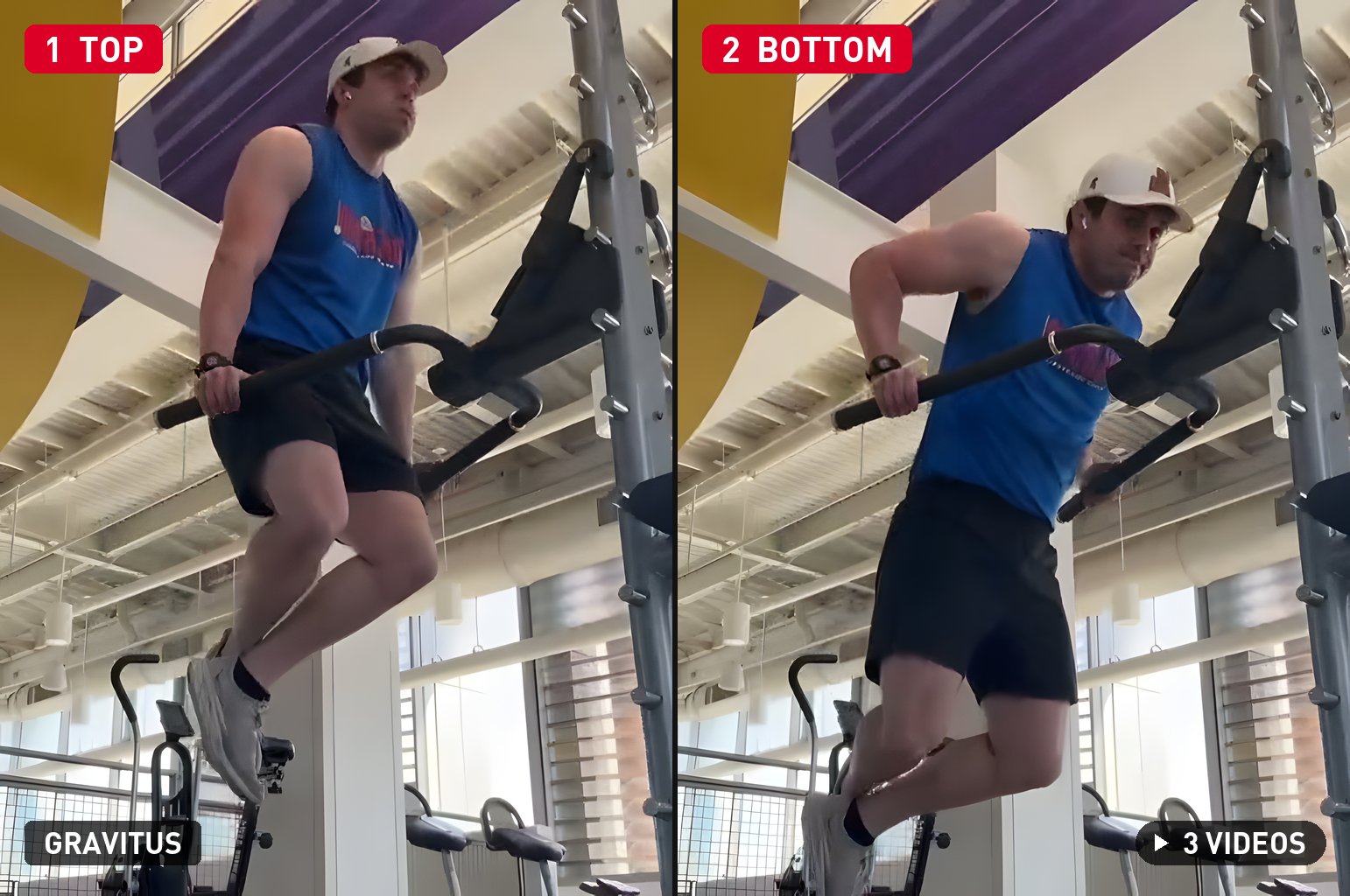
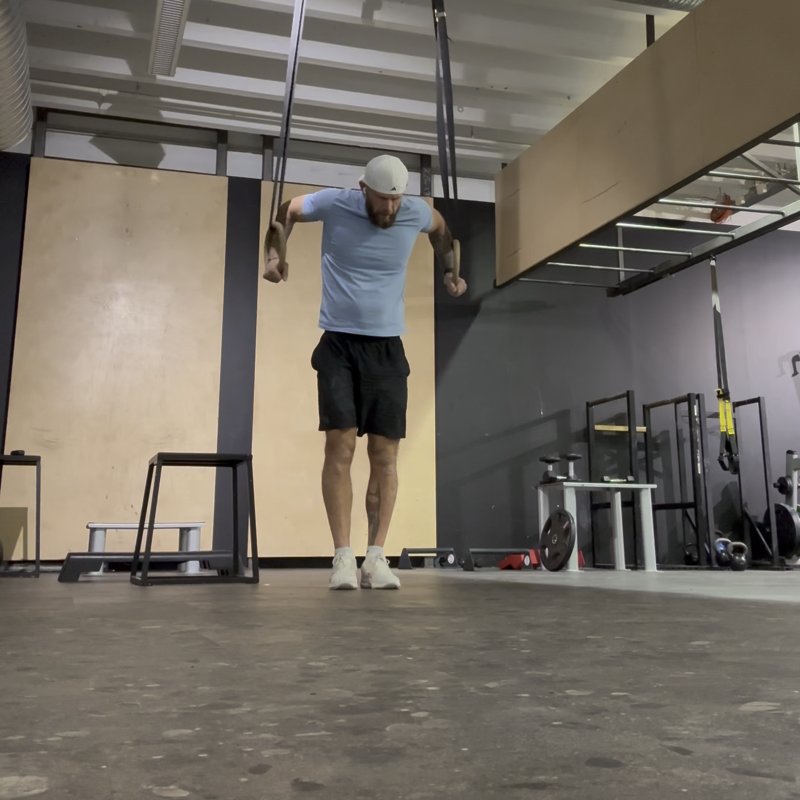
- 1Top. Arms straight on the bars, shoulders pulled down away from your ears, legs still.
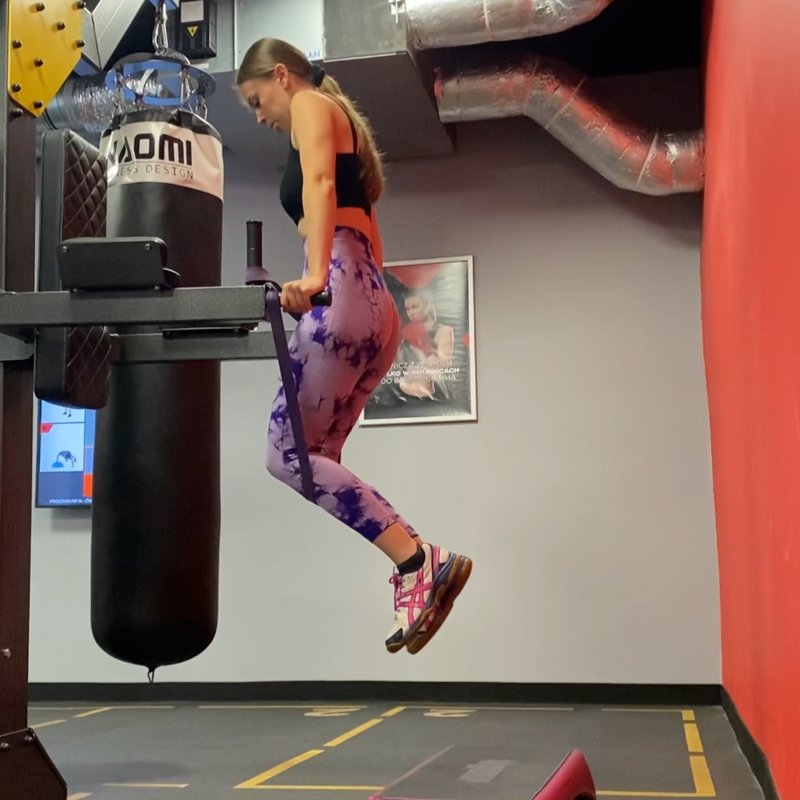
- 2Bottom. Lean forward a little and lower until your shoulders are level with your elbows, then press back to straight arms.
Watch 3 video demonstrations
Find more video demonstrations in the Gravitus app
How to do a dip with proper form
- Grip the parallel bars with your palms facing in, thumbs around the bars. Bars about shoulder width apart suit most people; on a V-shaped station, use the narrow end.
- Jump or step up to straight arms. Pull your shoulders down, away from your ears, and keep your legs still, straight or crossed behind you.
- Bend your elbows and lower over 2 seconds. Let your chest tip forward a little and your elbows travel back, not out to the sides.
- Stop when your shoulders are level with or just below your elbows, or sooner if the front of your shoulder pinches.
- Press through your palms until your arms are straight, without kicking your legs.
How far to lean: chest vs triceps dips
No study has compared an upright dip with a leaning dip, so the chest vs triceps split is a coaching cue, not a measured result. What has been measured is how lean and depth trade off. On bars, the torso can tip forward, which gives you depth with less shoulder extension; on a bench dip it cannot, so more of the depth comes from the shoulder (McKenzie 2022a). The triceps worked hard in every dip in that study. Lean as far as feels natural, about 35 to 40 degrees for most lifters, and lean further if an upright dip bothers the front of your shoulder.
How deep to go, and keeping your shoulders happy
Go down until your shoulders are level with or just below your elbows. That is deep enough. With no depth cue, experienced lifters bent their elbows about 115 degrees at the bottom of a bar dip (McKenzie 2022b), past the 90 degrees most guides quote.
A normal dip already takes the shoulder close to its limit. Bar dips used 88% of the shoulder extension each lifter reached in a maximal stretch test, and bench dips 101% (McKenzie 2022a). That end range strains the front of the shoulder capsule, and pec tears during bar dips have been reported. The authors expect the risk to rise with added weight, deep fatigue or a wide grip (McKenzie 2022a).
Going deeper did not add muscle activity. Across three bottom positions, at elbow angles of 75, 85 and 95 degrees, chest and triceps activity during the press did not differ (Çınarlı 2021). Pick the depth you can reach every rep without pain and keep it the same from set to set.
Stop with your shoulders level with your elbows, bring your hands in to shoulder width or use the narrow end of a V-bar, and lean a little further forward. If it still hurts, switch to an assisted machine or a close-grip bench press for a few weeks.
Bar dip vs bench dip vs ring dip
| Attribute | Bar dip | Bench dip | Ring dip |
|---|---|---|---|
| Setup | Parallel bars, feet off the floor | Hands on a bench behind you, feet on the floor | Gymnastic rings, feet off the floor |
| Shoulder extension at the bottom | 88% of max range | 101% of max range | 69% of max range |
| Torso lean | More than a bench dip | Least, 13 degrees | More than a bench dip |
| Muscle activity | Higher than a bench dip in six of nine muscles | Lowest of the three | Like the bar dip, with more chest, lats and biceps |
| Best for | The default dip | Triceps work, if your shoulders tolerate it | Advanced lifters with solid bar dips |
Use the bar dip as your main version. In 13 experienced men, it drew more muscle activity than the bench dip with less shoulder extension, and the ring dip added activity in only three muscles (McKenzie 2022a). The bench dip is not the gentle option for sore shoulders: it took them furthest into extension.
Muscles worked
Dip claims the research does not back
- "Bench dips are the easy, shoulder-friendly version." They are easier because your feet take some of the weight, but they took the shoulders furthest into extension, 101% of each lifter's tested range against 88% for bar dips (McKenzie 2022a). If your shoulders are the problem, use an assisted machine or a band on the bars instead.
- "Dips are a triceps exercise." The chest and front delts work hard too. In bar dips, chest activity rose along with the triceps compared with bench dips, and ring dips drew the most chest activity of the three (McKenzie 2022a).
- "Your form falls apart when you dip to failure." In 15 trained men who did one set to failure, 25 reps on average, the depth, lean and elbow bend of the last reps matched the first ones, while chest and triceps activity rose (McKenzie 2022b).
- "The deeper, the more muscle it works." Chest and triceps activity during the press did not change between elbow angles of 75 and 95 degrees at the bottom (Çınarlı 2021). Depth past your elbows adds shoulder strain, not measured muscle work.
How to build up to your first dip
All three assisted versions keep the bar dip body position, which loads the shoulder more kindly than a bench dip, while taking weight off your arms (McKenzie 2022a). A band helps most at the bottom, where the rep is hardest.
Sets, reps and progression
Stop each set 1 to 2 reps short of failure, with every rep from straight arms to shoulders level with your elbows. Sets taken close to failure build muscle across a wide range of reps (Schoenfeld 2021). Do dips after your main bench or overhead press, or as the first press on an upper-body day.
If you can do fewer than 6 strict reps, do several sets of 2 to 5 with full rest, then add assisted reps or negatives. Once you can do 15 strict reps in a set, move to weighted dips: start with 5 to 10 lb (2.5 to 5 kg) on a dip belt and drop back to 6 to 10 reps.
Common mistakes
-
Shrugging at the bottomYour shoulders ride up toward your ears and the front of the shoulder takes the strain. Push the bars down and keep your neck long.
-
Sinking as deep as you canPast your elbows you add shoulder strain, not muscle work. Stop with your shoulders level with or just below your elbows.
-
Half reps at the topBending your elbows a few inches keeps the rep easy. Lower until your shoulders reach elbow height on every rep.
-
Elbows flaring outA wide grip may raise the risk of a pec strain (McKenzie 2022a). Keep your elbows travelling back and your hands about shoulder width.
-
Kicking your legsA kick uses momentum from your hips to get you up. Cross your ankles, squeeze your glutes and press.
-
Dropping into the bottomLower over 2 seconds and pause for a moment without bouncing.
Dip variations and progressions
Questions people ask
How many dips should I be able to do?
Among Gravitus lifters who log dips, the median best set was 12 reps for men and 10 for women (Gravitus data from 17,000+ men and 1,500+ women, September 2026). The top 10% reached 22 and 15. These are people who train, so the average across everyone is lower. A set of 10 strict dips puts a man in the bottom quarter of that group and a woman at the median.
Are dips bad for shoulders?
Not for most lifters, but they take the shoulder close to its limit. Bar dips used 88% of each lifter's tested shoulder extension (McKenzie 2022a). Stop with your shoulders level with your elbows, keep them pulled down and your hands about shoulder width, and use an assisted machine if they still hurt.
How deep should I go on dips?
Until your shoulders are level with or just below your elbows. Trained lifters bent their elbows about 115 degrees at the bottom with no cue (McKenzie 2022b). Going deeper did not raise chest or triceps activity in one study (Çınarlı 2021).
Are dips good for chest?
Yes. The chest is a prime mover in the dip, and it worked harder in bar dips than bench dips (McKenzie 2022a). Coaches cue a bigger forward lean for more chest; no study has measured how much it changes.
Are dips a push exercise?
Yes. You press your body away from the bars, so the triceps, chest and front delts do the work. Most programs put dips on push day, after the bench or overhead press.
Are dips horizontal or vertical push?
Most programs count them as a vertical push, since you press straight down. With the usual forward lean of 35 to 40 degrees (McKenzie 2022b), they sit between a vertical press and a decline bench press.
Are dips or push ups better?
Dips are harder, since your arms lift almost your whole bodyweight while a push-up lifts only part of it. Use push-ups to build up, then dips once you can do them strictly. Both train the triceps, chest and front delts.
What muscles do dips work?
The triceps, chest and front delts do most of the work. The lats, traps and serratus anterior hold the shoulders steady, and the rotator cuff and core keep you still on the bars.
Log every set and Gravitus charts your reps, times and records from week to week.
Get Gravitus