How to Do a Lying Single Leg Curl
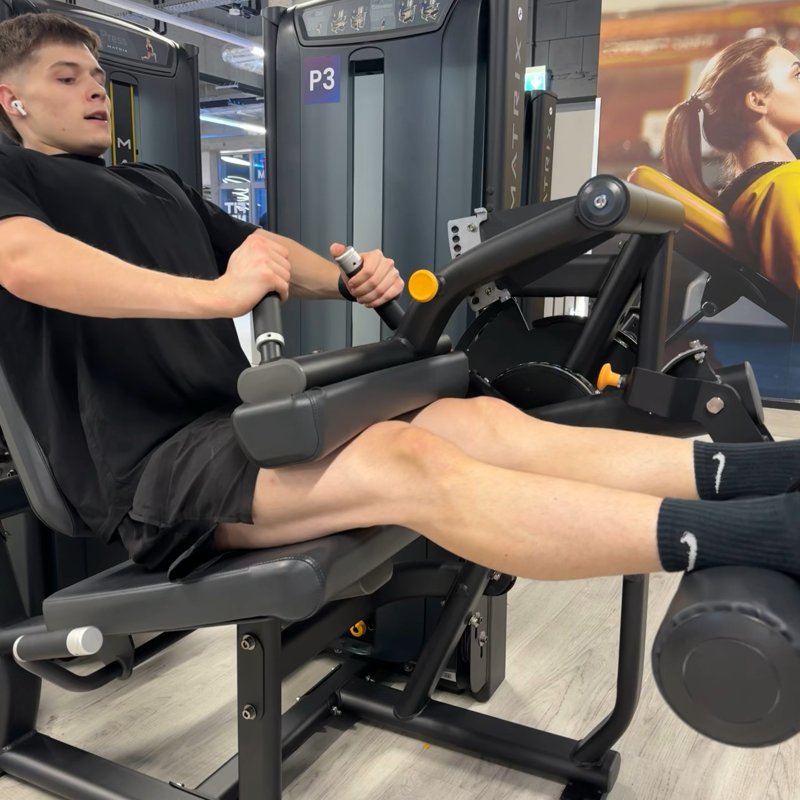
A lying single leg curl is a lying leg curl done one leg at a time. Lie face down with your kneecaps just off the pad, hook one ankle under the roller and curl your heel toward your glute. It trains the hamstrings of each leg on their own, with the calf helping. Most lifters do 3 sets of 8 to 15 reps per leg.
How to do a lying single leg curl
- Set the ankle pad so it will sit on your lower calf, just above your heel, with your leg straight.
- Lie face down with your kneecaps just off the end of the thigh pad and your knees in line with the machine's pivot. Hold the handles.
- Hook your weaker leg under the pad. Let the other leg rest straight on the bench, clear of the roller.
- Press both hips into the bench and curl your heel toward your glute as far as the pad allows. Pause for a second.
- Lower over 2 to 3 seconds until your knee is almost straight, without letting the plates touch. Finish the set, then do the same weight with the other leg.
Setting up for one leg
The machine setup is the same as for two legs: kneecaps off the pad, knee on the pivot, ankle pad just above the heel. Much of what we know about the lying curl comes from one-leg training. In the 12-week study that compared lying and seated curls, each person trained one leg lying and the other leg seated (Maeo 2021). The study on toe position also trained one leg each way (Cadeo 2023).
How much weight should you use for a lying single leg curl?
On Gravitus, the median man lifts 50 lb (22.5 kg) per leg for 10 reps on the lying single leg curl, and the median woman 30 lb (14 kg).
- Most lift
- 40 to 70 lb
- Top 10% lift
- 90 lb or more
- Starting out
- under 40 lb
- Most lift
- 22.5 to 37.5 lb
- Top 10% lift
- 50 lb or more
- Starting out
- under 22.5 lb
- Most lift
- 18 to 30 kg
- Top 10% lift
- 40 kg or more
- Starting out
- under 18 kg
- Most lift
- 10 to 17 kg
- Top 10% lift
- 22.5 kg or more
- Starting out
- under 10 kg
How much should one leg lift compared with two?
Not simply half. In the lab, untrained people were weaker with both legs together than with their two legs added up, while trained weightlifters were stronger together (Howard 1991). Practice decides most of it: one-leg training raises one-leg strength more, and two-leg training raises two-leg strength more (Kassiano 2025).
If you have only ever curled with two legs, start near 40% of your two-leg weight on each leg and let the reps tell you where to go. Use the same pin for both sides, and the weaker leg's reps become your target.
Muscles worked
Lying single leg curl vs lying leg curl vs seated single leg curl
| Attribute | Lying single leg curl | Lying leg curl | Seated single leg curl |
|---|---|---|---|
| Weight you log | One leg | Both legs | One leg |
| Hip position | Bent slightly | Bent slightly | Bent about 90 degrees |
| Shows a side gap | Yes | No | Yes |
| Time per set | Twice as long | Shortest | Twice as long |
| Best for | Evening out sides | Hamstring volume fast | Most hamstring growth |
For size, sitting matters more than one leg or two. Trained one leg at a time for 12 weeks, the seated curl grew the hamstrings 14% and the lying curl 9% (Maeo 2021). Across nine studies, one-limb and two-limb training grew muscle the same (Kassiano 2025). Use the lying single leg curl to even out your sides, or when there is no seated machine.
Sets, reps and progression
Stop each set 0 to 2 reps short of failure. Sets taken close to failure build muscle across a wide range of reps (Schoenfeld 2021). In the 12-week study, the one-leg lying curl was 5 sets of 10 at 70% of max, twice a week (Maeo 2021).
Stack plates are a big jump for one leg. Add reps first: when both legs reach 15, move the pin down one plate and go back to 8 to 10.
Common mistakes
-
Stronger leg firstIt sets a target the weaker leg cannot match. Start every round with the weaker leg.
-
Hips twisting or liftingOne working leg pulls your pelvis up and to the side. Grip the handles, press both hips down and go lighter.
-
Resting leg helpingKeep it straight on the bench and clear of the roller.
-
Kneecap on the padYour knee sits off the pivot and the roller slides along your calf. Slide down until your kneecaps clear the pad.
-
Stopping short of straightThe leg is most stretched when the knee is almost straight. Lower all the way on every rep.
-
Dropping the weightLower over 2 to 3 seconds and keep the plates off the stack between reps.
Single leg curl variations
Questions people ask
What are the benefits of single leg curls?
Each hamstring does its own work, so a weaker side cannot lean on the stronger one, and your log shows the gap. One-leg training raises one-leg strength more than two-leg training (Kassiano 2025). It still builds muscle: done one leg at a time, the lying curl grew the hamstrings 9% in 12 weeks (Maeo 2021). And if one leg is hurt, training the other makes the resting leg stronger too, by 16.4% on average in leg studies (Manca 2017).
Are single leg curls better than double?
Not for muscle size. Nine studies found the same growth from one-limb and two-limb training (Kassiano 2025). Do them one leg at a time to see and close a gap between sides. Do both legs together to get more hamstring work done in less time.
What muscles do single leg curls work?
The hamstrings of the working leg, the semitendinosus most (Mitsuya 2026). The calf helps bend the knee. Your hip does not move, so the glutes do almost nothing.
Should I point or flex my toes on a single leg curl?
Either works. In a study that trained one leg each way for 10 weeks, toes up and toes pointed gave the same hamstring activity, strength and growth (Cadeo 2023). Toes up lets the calf help, so you lift more. Pick one and keep it the same on both legs.
Why is one hamstring weaker than the other?
A small gap between legs is normal, often from a dominant leg or an old injury. Two-leg curls can hide it, because the stronger leg can push more of the pad. Train the weaker leg first, use the same weight on both sides and log each one.
How much weight should I use for single leg curls?
For 10 reps, the median on Gravitus is 50 lb (22.5 kg) per leg for men and 30 lb (14 kg) for women. The strongest quarter lifts 70 lb (30 kg) and 37.5 lb (17 kg) or more.
Log every set and see your percentile on every lift, lying single leg curl included.
Get GravitusRelated exercises



- Maeo et al. 2021. Med Sci Sports Exerc 53(4):825-837.
- Cadeo et al. 2023. Eur J Sport Sci 23(11):2200-2209.
- Mitsuya, Nakazato and Okada 2026. BMC Sports Sci Med Rehabil 18:530.
- Kassiano et al. 2025. Sports Med 55(4):923-936.
- Howard and Enoka 1991. J Appl Physiol 70(1):306-316.
- Manca et al. 2017. Eur J Appl Physiol 117(11):2335-2354.
- Schoenfeld et al. 2021. Sports 9(2):32.