How to Do Cable Kickbacks
A cable kickback is a glute isolation exercise. Buckle an ankle cuff to the lowest pulley, face the stack, lean forward and kick one leg back from the hip until your thigh lines up with your torso. It trains the gluteus maximus, with the hamstrings helping. Most lifters do 3 to 4 sets of 10 to 15 reps per leg.
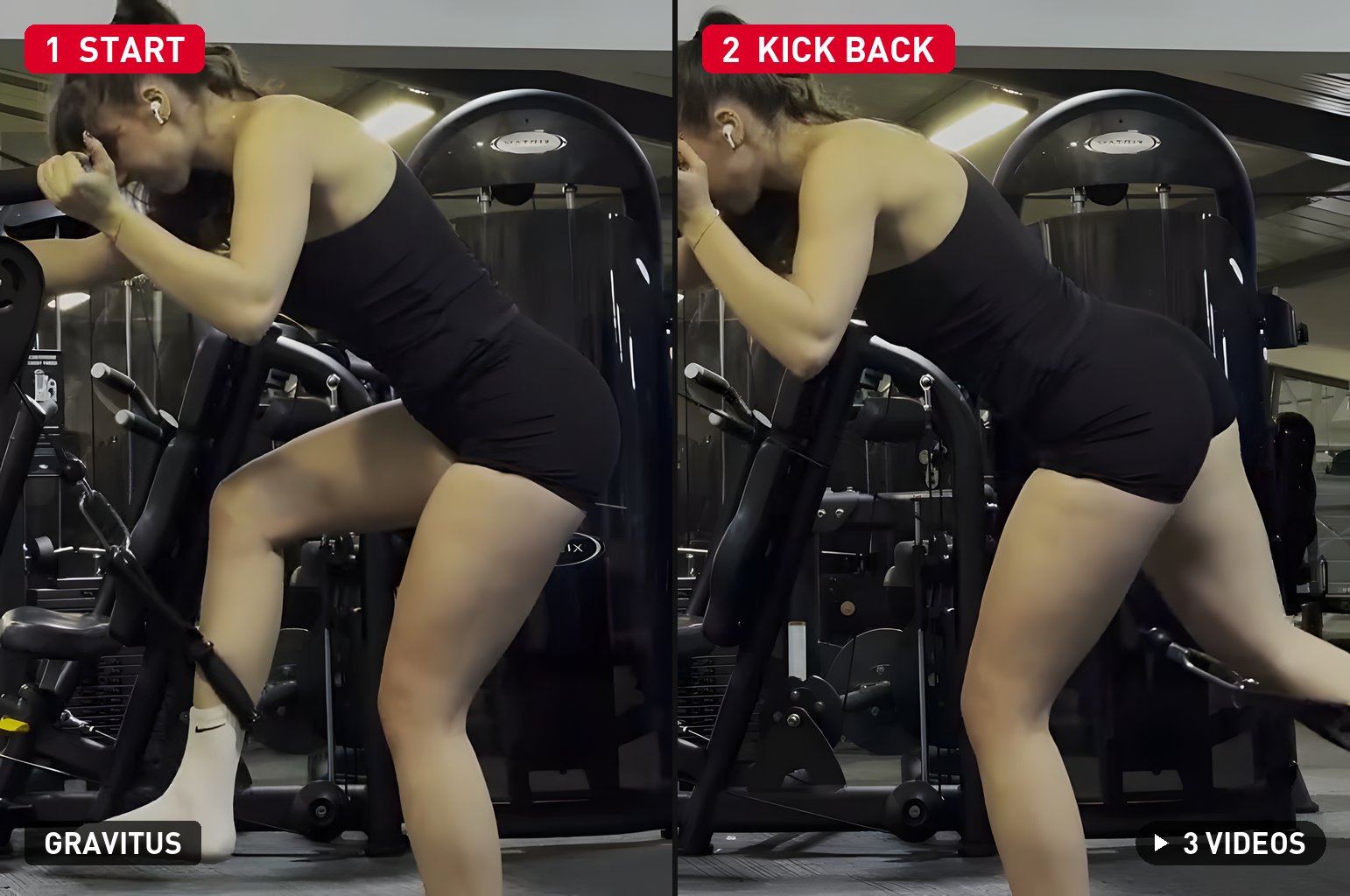
- 1Start. Ankle cuff on the lowest pulley, forearms on the frame, hips hinged forward. Let the cable draw your working knee forward under your hip.
- 2Kick back. Drive the leg back from the hip until your thigh lines up with your torso, then bring it forward under control without arching your back.
Watch 2 video demonstrations
How to do a cable kickback
- Set the pulley to the lowest notch and buckle an ankle cuff around your working ankle.
- Face the stack and step back until the plates lift. Hold the frame or rest your forearms on it, and lean forward 30 to 45 degrees from the hips with your back flat.
- Soften your standing knee and keep your ribs down. Let the cable draw your working knee forward under your hip.
- Kick the leg back from the hip, knee slightly bent, until your thigh lines up with your torso. Hold for a second.
- Bring the leg forward over 2 seconds without letting the plates touch. Finish every rep on one leg before you switch.
Lean forward or stand upright, knee bent or straight
Lean and knee angle decide which muscle does the work more than the weight does. In isometric tests, the glute max contributed the most hip extension torque with the hip bent 45 degrees, and the hamstrings the most with the knee straight (Liu 2022). In prone hip extension, bending the knee past 60 degrees cut hamstring activity, and the glute max became the most active hip extensor (Kwon 2013).
How much weight should you use for cable kickbacks?
On Gravitus, the median man lifts 45 lb (20 kg) for 10 reps on the cable kickback, and the median woman 37.5 lb (17 kg).
- Most lift
- 27.5 to 70 lb
- Top 10% lift
- 100 lb or more
- Starting out
- under 27.5 lb
- Most lift
- 25 to 55 lb
- Top 10% lift
- 80 lb or more
- Starting out
- under 25 lb
- Most lift
- 13 to 32.5 kg
- Top 10% lift
- 45 kg or more
- Starting out
- under 13 kg
- Most lift
- 11 to 25 kg
- Top 10% lift
- 35 kg or more
- Starting out
- under 11 kg
Muscles worked
Why you feel cable kickbacks in your standing leg
Your standing leg holds you up on one foot for the whole set, so its glutes, quads and calves work too. Some burn there is normal. In a band version of the standing kickback, the kicking leg's glute max still worked harder than the standing leg's (Youdas 2014).
If the standing leg is doing most of the work:
- Hold on with both hands, or rest your forearms on the frame, so your arms take care of balance.
- Go lighter. A load you have to fight to stay upright turns the set into a balance drill.
- Rest before the second leg. The leg that just stood is tired when it is its turn to kick. Take 30 to 60 seconds.
- Kneel instead. On all fours with the cuff on a low pulley, balance no longer limits the set.
If you feel it in your hamstrings, bend your knee to about 90 degrees. If you feel it in your lower back, stop the kick lower: your thigh in line with your torso is the top.
Constant tension, toes out and other kickback myths
Four claims that most kickback guides repeat, including our old one:
- Cables give constant tension. The stack pulls with the same force all rep, but its leverage on your hip changes. Leaning forward, it drops near the top of the kick, because the cable's line runs closer to your hip joint. Your leg's own weight adds load there, so the top still feels hard.
- Turning your toes out takes the glutes away. The glute max turns the hip out. Exercises that added hip abduction or external rotation drew more upper than lower glute max activity (Selkowitz 2016). A small turn-out is fine. What to avoid is rotating your whole pelvis open to swing the leg higher.
- A bent knee trains the lower glutes. Straight hip extension already works the upper and lower glute max about equally (Selkowitz 2016). Bending the knee takes work off the hamstrings instead (Kwon 2013).
- Kick as high as you can. Your hip extends only a little past straight. Height beyond that comes from arching your lower back, which is why so many people feel kickbacks there.
Cable kickback vs hip thrust vs donkey kick
| Attribute | Cable kickback | Hip thrust | Donkey kick |
|---|---|---|---|
| Load | One leg, light stack | Both legs, heavy | Bodyweight or a band |
| Equipment | Cable, ankle cuff | Bench and bar, or a machine | None |
| Balance | On one foot | Supported | On all fours |
| Best for | Extra glute volume, one side at a time | Heavy glute work | Warm-ups, home training |
Use a hip thrust, squat or deadlift for heavy glute work, and add kickbacks for extra single-leg volume. No trial has compared the two for glute growth. On a kickback machine at a 6-rep max load, glute activity matched the leg press, while the hamstrings worked about three times harder (Stien 2021).
Sets, reps and progression
Do kickbacks after your main hip exercise. Stop each set 0 to 2 reps short of failure. Sets taken close to failure build muscle across a wide range of reps (Schoenfeld 2021), so pick a range you can keep strict.
Stack jumps of 5 to 10 lb (2.5 to 5 kg) are big for one hip. Add reps first: when every set reaches 15 clean reps, move up one pin and drop back to 10.
Common mistakes
-
Arching your lower backThe leg goes higher, but the extra height comes from your spine. Stop when your thigh lines up with your torso, ribs down.
-
Swinging the legMomentum does the top of the rep. Hold for a second at the top and take 2 seconds on the way forward.
-
Fighting for balanceYour standing leg ends up doing the set. Hold the frame with both hands and go lighter.
-
Rotating the pelvis openYour lower back swings the leg up. Keep both hip bones facing the machine; a small turn of the toes is fine.
-
Standing too close to the stackThe plates rest at the start and the bottom of the rep goes slack. Step back until the plates lift with your knee forward.
Cable kickback variations
Questions people ask
Why do I feel cable kickbacks in my standing leg?
Because it holds you up on one foot for the whole set, and its glutes keep your pelvis level. Some burn is normal. If it outworks the kicking leg, hold the frame with both hands, go lighter and rest before you switch legs.
Why do I feel cable kickbacks in my hamstrings?
The hamstrings extend the hip too, most with the knee straight (Liu 2022). Bend your knee to about 90 degrees; in prone hip extension that cut hamstring activity and left more of the work to the glutes (Kwon 2013).
Why do I feel cable kickbacks in my lower back?
You are kicking past the point where your hip stops, so your lower back arches to lift the leg higher. Stop when your thigh lines up with your torso and keep your ribs down.
What muscles do cable kickbacks work?
Mainly the gluteus maximus, with the hamstrings and adductor magnus helping. The standing leg's glutes, your core and your lower back hold you steady.
Are cable kickbacks effective?
Yes, as an add-on. On a kickback machine at a 6-rep max load, glute activity matched the leg press (Stien 2021). No trial has measured glute growth from cable kickbacks alone, so pair them with a heavier hip exercise.
Are cable kickbacks better than hip thrusts?
No. The hip thrust loads both hips far more heavily. Kickbacks train one side at a time and are easy to add at the end of a session.
Straight leg or bent knee cable kickbacks?
Both work the glutes. A bent knee takes work off the hamstrings (Kwon 2013), so choose it if you feel kickbacks in the back of your thigh. A straighter leg lets the hamstrings help more.
How many sets of cable kickbacks?
3 to 4 sets of 10 to 15 reps per leg, each stopped 0 to 2 reps short of failure, after your main hip exercise.
How much weight should I use for cable kickbacks?
For 10 reps, the median on Gravitus is 45 lb (20 kg) for men and 37.5 lb (17 kg) for women. The strongest quarter lifts 70 lb (32.5 kg) and 55 lb (25 kg) or more.
Log every set and see your percentile on every lift, cable kickback included.
Get GravitusRelated exercises

- Liu et al. 2022. Physiother Theory Pract 38(13):2650-2657.
- Kwon and Lee 2013. J Phys Ther Sci 25(10):1295-1297.
- Selkowitz et al. 2016. J Orthop Sports Phys Ther 46(9):794-799.
- Stevens et al. 2022. Int J Exerc Sci 15(1):1179-1189.
- Stien et al. 2021. J Sports Sci Med 20(1):56-61.
- Youdas et al. 2014. J Sport Rehabil 23(1):1-11.
- Schoenfeld et al. 2021. Sports 9(2):32.