How to Do a Goblet Squat
A goblet squat is a squat with one dumbbell or kettlebell held against your chest. Keep your elbows down, squat straight down between your knees and go as deep as your heels stay flat. It mainly trains the quads, with the glutes and adductors helping. Most lifters do 3 sets of 8 to 15 reps.
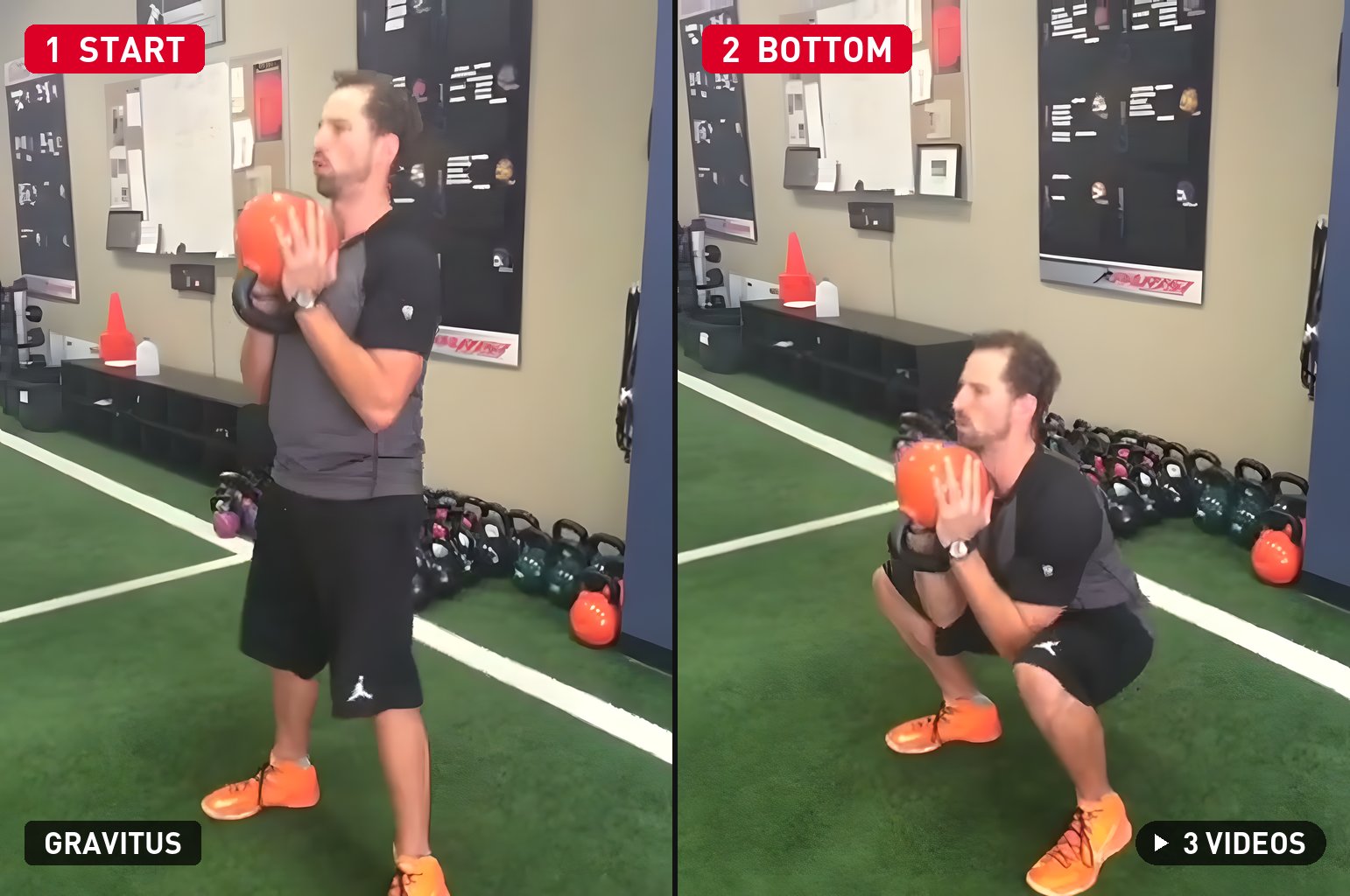
- 1Start. Hold one kettlebell or dumbbell against your chest with your elbows down. Feet shoulder-width, toes turned out slightly.
- 2Bottom. Squat straight down with your chest up until your elbows reach the inside of your knees, then stand up through your whole foot.
Watch 3 video demonstrations
Find more video demonstrations in the Gravitus app
How to do a goblet squat
- Hold one dumbbell upright by its top end, or a kettlebell by the handle or the bell, against your chest with your elbows pointing down.
- Stand with your feet about shoulder-width apart and your toes turned out slightly.
- Take a big breath, brace your abs and squat straight down. Let your knees travel forward and out over your toes.
- Go as deep as you can with your heels flat and your back flat. Your elbows should end up inside your knees.
- Stand up by pushing through your whole foot, keeping the weight against your chest. Breathe out near the top.
Why the weight in front keeps you upright
The weight in front of your chest keeps your torso upright because you have to stay balanced. Your body and the weight together must stay over the middle of your feet. In a back squat the bar already sits over your mid-foot, so your hips can travel back and your chest tips forward. With the weight at your chest, leaning forward would push it out past your toes, so you stay tall and your hips sink straight down.
A lab study measured it: the further forward the load sat, the less lifters bent their trunk and tilted their pelvis, while hip, knee and ankle loading stayed about the same (Goršič 2024).
That upright position is why the goblet squat makes depth easy. Go as deep as you can with your heels flat and your back flat, which is below parallel for most lifters. Over 12 weeks, deep squats to 120 degrees of knee bend grew the front of the thigh 4 to 7% more than shallow squats to 60 degrees (Bloomquist 2013). Full squats and half squats grew the quads by the same amount, but full squats grew the glutes and adductors 2 to 3 times as much (Kubo 2019).
Your knees will travel past your toes at the bottom, and that is fine. In a squat study, stopping the knees at the toes cut knee torque by 22% but raised hip torque more than tenfold (Fry 2003).
Goblet squat stance
Stance width changed glute and adductor activity but not quad activity in squat studies (McCaw 1999, Paoli 2009). Raising the heels added 4 to 5 degrees of ankle and knee range across 14 studies, with no change in hip or trunk range (Ghasemi 2026). Pick the stance where your heels stay down and you reach full depth.
How much weight should you goblet squat?
On Gravitus, the median man lifts 60 lb (27.5 kg) for 10 reps on the goblet squat, and the median woman 40 lb (18 kg).
- Most lift
- 45 to 75 lb
- Top 10% lift
- 95 lb or more
- Starting out
- under 45 lb
- Most lift
- 27.5 to 50 lb
- Top 10% lift
- 60 lb or more
- Starting out
- under 27.5 lb
- Most lift
- 20 to 35 kg
- Top 10% lift
- 42.5 kg or more
- Starting out
- under 20 kg
- Most lift
- 13 to 22.5 kg
- Top 10% lift
- 27.5 kg or more
- Starting out
- under 13 kg
Muscles worked
Goblet squat advice that does not hold up
Many goblet squat guides repeat cues that are wrong for this lift:
- Goblet squats are easier on your lower back. Only because the weight is lighter. At the same load, moving the weight forward reduced trunk lean but raised the load on the lower back (Goršič 2024).
- Sit back as if into a chair. That cue belongs to the back squat. With the weight at your chest, sitting back tips you forward. Squat straight down and let your knees go forward.
- Drive through your heels. Push through your whole foot. The weight in front only balances when the pressure stays over your mid-foot.
- A narrow stance hits the quads, a wide stance the inner quads. Stance width did not change quad activity in either study that tested it (McCaw 1999, Paoli 2009).
- Your hamstrings are a main mover. They steady the knee, but full and half squats did not grow them (Kubo 2019).
Goblet squat vs front squat vs back squat
| Attribute | Goblet squat | Front squat | Back squat |
|---|---|---|---|
| Where the load sits | At your chest | On your front delts | On your upper back |
| Torso | Upright | Upright | Leans forward more |
| What limits the weight | Grip, upper back | Upper back, wrists | Legs, hips |
| Best for | Learning to squat, high reps | Heavy quad work | Heaviest loads |
Use the goblet squat to learn the pattern and for higher reps, then add a barbell once your heaviest dumbbell is easy for your legs. Front and back squats recruited the leg muscles equally, and the front squat put less compression on the knee (Gullett 2009). Six weeks of kettlebell training with goblet squats raised back squat strength less than weightlifting with back squats (Otto 2012).
Sets, reps and progression
Stop each set 1 to 3 reps short of failure, before your heels lift or your back rounds. Sets taken close to failure build muscle across a wide range of reps (Schoenfeld 2021), so higher reps work when your heaviest dumbbell is light for your legs.
Add reps first. When every set reaches 15, move up 5 to 10 lb (2.5 to 5 kg) and go back to 8. When you run out of weight, add a 3-second pause at the bottom or switch to a front squat.
Common mistakes
-
Leaning forwardThe weight drifts past your toes and your lower back takes over. Keep your elbows down and the weight touching your chest.
-
Heels liftingYour ankles run out of bend. Widen your stance a little or put your heels on a small plate.
-
Knees caving inPush your knees out over your toes on the way up. Go lighter if they still drift in.
-
Stopping above parallelHalf squats grow the glutes and adductors less than full ones. Go as deep as your heels and back stay flat.
-
Rounding at the bottomStop just above the point where your lower back tucks under, and work deeper from there.
Goblet squat variations
Questions people ask
What muscles do goblet squats work?
Mainly the quads, with the glutes and adductors helping. Your abs, spinal erectors, upper back and grip hold the weight in place. The hamstrings steady the knee but barely grow from squats (Kubo 2019).
Do goblet squats work glutes?
Yes, and more the deeper you go. Over 10 weeks, full squats grew the glutes 6.7% and half squats 2.2% (Kubo 2019). A wider stance adds glute activity (Paoli 2009).
Are goblet squats better than barbell squats?
Better for learning the squat and for high reps, not for heavy strength. The weight in front keeps your trunk upright (Goršič 2024), but you cannot hold as much as a bar. Six weeks of kettlebell training with goblet squats raised back squat strength less than training with back squats (Otto 2012).
Are goblet squats effective?
Yes, as long as the weight takes your legs close to failure. Sets that end a few reps short of failure build muscle across a wide range of reps (Schoenfeld 2021). When your heaviest dumbbell gets easy, add pauses or move to a barbell squat.
How low should you squat?
As low as your heels and back stay flat, which is below parallel for most lifters. Deep squats grew the thighs more than shallow ones (Bloomquist 2013).
How much weight should I use for goblet squats?
For 10 reps, the median on Gravitus is 60 lb (27.5 kg) for men and 40 lb (18 kg) for women. The strongest quarter lifts 75 lb (35 kg) and 50 lb (22.5 kg) or more.
Log every set and see your percentile on every lift, goblet squat included.
Get GravitusRelated exercises
- Goršič et al. 2024. Sports Biomech 23(2):166-181.
- Bloomquist et al. 2013. Eur J Appl Physiol 113(8):2133-2142.
- Kubo et al. 2019. Eur J Appl Physiol 119(9):1933-1942.
- Fry et al. 2003. J Strength Cond Res 17(4):629-633.
- McCaw and Melrose 1999. Med Sci Sports Exerc 31(3):428-436.
- Paoli et al. 2009. J Strength Cond Res 23(1):246-250.
- Ghasemi et al. 2026. Sports Biomech 25(7):1022-1038.
- Collins et al. 2021. J Strength Cond Res 35(10):2661-2668.
- Gullett et al. 2009. J Strength Cond Res 23(1):284-292.
- Otto et al. 2012. J Strength Cond Res 26(5):1199-1202.
- Schoenfeld et al. 2021. Sports 9(2):32.