How to Do a Glute Bridge
A glute bridge is a bodyweight glute exercise done lying on your back. With your knees bent and feet flat, squeeze your glutes and lift your hips until your body is straight from shoulders to knees. It trains the gluteus maximus, with the hamstrings and core helping. Most people do 3 sets of 12 to 20 reps.
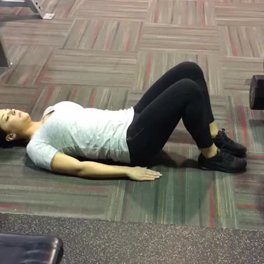
Watch 1 video demonstration
How to do a glute bridge
- Lie on your back on a mat with your knees bent, feet flat and hip width apart, and your arms by your sides, palms down.
- Set your heels close enough to your glutes that your shins will be vertical when your hips are up.
- Brace your abs and tilt your pelvis back slightly, so your lower back sits flat on the floor.
- Squeeze your glutes and push through your whole foot to lift your hips until your body is straight from shoulders to knees.
- Hold the top for 1 to 2 seconds without arching your back, then lower until your glutes lightly touch the floor.
Glute bridge foot placement: what changes
Where your feet go decides how much the hamstrings help. Your glutes do about the same work at any knee bend from 90 degrees up, so move your feet in if you feel the bridge in the back of your thighs. In 25 men, the glutes worked best with the knees bent 90 to 120 degrees and the hamstrings with the knees nearly straight (Ho 2020). Raising your feet on a 10 cm (4 in) step also raised glute activity and lowered hamstring activity in 15 adults (Kim 2025).
Glute bridge claims the research does not back
- "Push through your heels and lift your toes for more glutes." In 20 adults, lifting the toes left glute activity unchanged and lowered hamstring activity (Escamilla 2024). Push through your whole foot. If your hamstrings take over, move your feet closer instead.
- "Walk your feet out to work the glutes harder." It does the opposite. The farther your feet are from your hips, the more the hamstrings do the lifting (Ho 2020).
- "Turn your toes out to work your outer thighs and IT band." The IT band is a strip of connective tissue, not a muscle, so no foot position trains it. Turn your toes out a little if it is more comfortable for your hips.
- "The glute bridge is only a warm-up." The bodyweight version is light: across studies, a two-leg bridge averaged 23% of maximal glute activity, and a single-leg bridge 40% (Macadam 2019). With weight added, it is a real lift. With a barbell on the hips, the bridge drew more glute activity than the barbell hip thrust in 10 men (Kennedy 2024).
Set your feet so your shins are vertical at the top, push through your whole foot, and stop when your body is straight from shoulders to knees. When 3 sets of 20 feel easy, make the bridge harder rather than longer.
From bodyweight to a loaded bridge
A bodyweight bridge only lifts the part of your weight your hips carry, so most people can do far more than 20 reps. Past that point the set takes longer without getting harder. Sets taken close to failure build muscle across a wide range of reps (Schoenfeld 2021), so pick a version you can only do 8 to 20 times. Going single-leg doubles the load on each side with no equipment. After that, add weight across your hips.
Glute bridge muscles worked
Glute bridge vs barbell glute bridge vs hip thrust
| Attribute | Glute bridge | Barbell glute bridge | Barbell hip thrust |
|---|---|---|---|
| Upper back on | The floor | The floor | A bench |
| Load | Bodyweight | A barbell across your hips | A barbell across your hips |
| Range | Short | 15 cm (6 in) of bar travel | 36 cm (14 in) of bar travel |
| Glute activity | Low, 23% of max on average | More than a hip thrust | Less than a barbell bridge |
| Best for | Beginners, home workouts, warm-ups | Heavy work with no bench | Heavy work through a full range |
Start with the bodyweight bridge and keep it as a warm-up once you add load. For heavy glute work, the barbell bridge and the hip thrust each have an edge. At 80% of their hip thrust max, trained men moved the bar 36 cm (14 in) in the hip thrust and 15 cm (6 in) in the bridge (Zabaleta-Korta 2024). The barbell bridge drew more glute activity per rep (Kennedy 2024).
Sets, reps and progression
Do 3 sets of 12 to 20 and pause for 1 to 2 seconds at the top of each rep. Twice a week is enough for most people, and a set or two before squats or deadlifts makes a good warm-up.
Stop each set 0 to 2 reps short of failure. If you can do more than 20 reps, the bridge is too easy to build muscle efficiently. Move to the single-leg version, then add weight across your hips, and go back to 12 reps each time you move up.
Common mistakes
-
Arching at the topYour ribs flare and your lower back takes over. Stop when your body is straight from shoulders to knees and keep your abs braced.
-
Feet too far outThe hamstrings do the lifting and can cramp (Ho 2020). Move your heels in until your shins are vertical at the top.
-
Heels liftingYour feet are too close and your quads take over. Slide them out until your whole foot stays flat.
-
Knees caving inPush your knees out over your toes. A band just above your knees gives you something to push against.
-
Bouncing off the floorLower under control and pause at the top. Each rep should start from a stop.
-
Adding reps foreverPast 20 reps the set gets longer, not harder. Go single-leg or add weight.
Glute bridge variations
Questions people ask
How do I do a glute bridge?
Lie on your back with your knees bent and feet flat, close enough that your shins are vertical at the top. Brace your abs, squeeze your glutes and lift your hips until your body is straight from shoulders to knees. Pause for a second, then lower under control.
What muscles does the glute bridge work?
Mostly the gluteus maximus. The hamstrings and adductors help extend the hip, the gluteus medius keeps your knees in line, and your abs and lower back hold your spine still. Feet farther out or flat on the floor shift more of the work to the hamstrings (Ho 2020, Escamilla 2024).
Is the glute bridge better than the hip thrust?
Not the bodyweight version, which averages 23% of maximal glute activity (Macadam 2019). Loaded with a barbell, the bridge drew more glute activity than the hip thrust (Kennedy 2024), but the hip thrust moves the bar more than twice as far (Zabaleta-Korta 2024). Both build the glutes once they are hard enough.
How many glute bridges should I do a day?
You do not need them every day. 3 sets of 12 to 20, two or three times a week, is plenty. Among 900+ men and 900+ women who log glute bridges on Gravitus, the median best set was 15 reps and the top 10% reached 30 (September 2026). If you can do more than 20, go single-leg or add weight.
Why do I feel glute bridges in my hamstrings or lower back?
If you feel it in your hamstrings, your feet are too far out. The hamstrings work hardest with the knees nearly straight (Ho 2020), so move your heels in until your shins are vertical at the top. If you feel it in your lower back, you are arching at the top. Brace your abs and stop when your body is straight from shoulders to knees.
Log every set and Gravitus charts your reps, times and records from week to week.
Get GravitusRelated exercises
- Ho, Ng, Lee and Luk 2020. Res Sports Med 28(4):484-497.
- Lehecka et al. 2017. Int J Sports Phys Ther 12(4):543-549.
- Escamilla et al. 2024. Bioengineering 11(4):356.
- Kim, Bae and Jeon 2025. J Back Musculoskelet Rehabil 38(5):1125-1132.
- Macadam and Feser 2019. Int J Sports Phys Ther 14(1):14-31.
- Kennedy et al. 2024. Sports Biomech 23(12):2935-2949.
- Zabaleta-Korta and Fernández-Peña 2024. Cult Cienc Deporte 19(59).
- Schoenfeld et al. 2021. Sports 9(2):32.