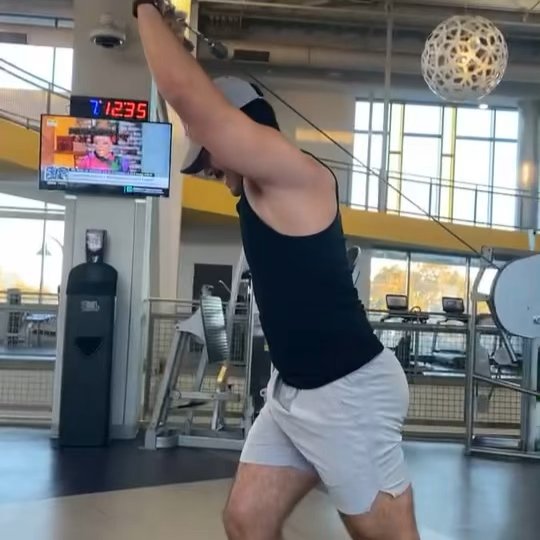
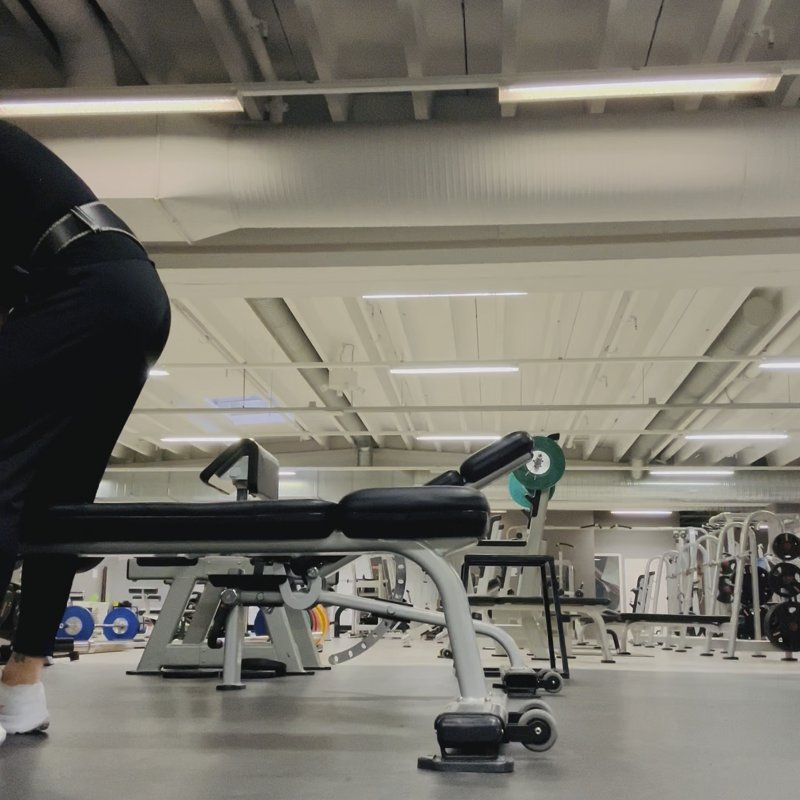
How to Do Dumbbell Tricep Kickbacks
A tricep kickback is an arm isolation exercise done bent forward with your upper arm held by your side. Hold a dumbbell with your elbow bent, then straighten your arm until the dumbbell points back behind you. It trains the triceps, all three heads. Most lifters do 3 sets of 10 to 15 reps with a light dumbbell.
How to do a dumbbell tricep kickback
- Put your left knee and left hand on a flat bench, right foot on the floor. Hold a dumbbell in your right hand with your palm facing in. Your back should be flat and close to parallel with the floor.
- Lift your right upper arm until it is level with your torso, elbow by your side. This is where it stays for the whole set.
- Start with your elbow bent about 90 degrees, so the dumbbell hangs under your elbow.
- Straighten your elbow over about 1 second until your whole arm is in line, pointing back. Hold the lockout for a second.
- Lower over 2 seconds to 90 degrees without letting your upper arm drop. Finish your reps, then switch sides.
Where the kickback is hardest
A dumbbell pulls straight down, so it only loads your triceps when your forearm is away from vertical. At the start, with the dumbbell hanging under your elbow, it has almost no leverage. It gets heavier as your arm straightens, and is hardest at lockout, with your forearm level with the floor.
The hardest point is at lockout, where your triceps are shortest and weakest. That is why kickbacks use far lighter dumbbells than other triceps exercises, and why swinging the weight is so tempting. If you cannot hold the lockout for a second, go lighter.
How much weight should you use for tricep kickbacks?
On Gravitus, the median man lifts 22.5 lb (10 kg) per dumbbell for 10 reps on the tricep kickback, and the median woman 17.5 lb (8 kg).
- Most lift
- 17.5 to 27.5 lb
- Top 10% lift
- 35 lb or more
- Starting out
- under 17.5 lb
- Most lift
- 15 to 22.5 lb
- Top 10% lift
- 27.5 lb or more
- Starting out
- under 15 lb
- Most lift
- 8 to 13 kg
- Top 10% lift
- 16 kg or more
- Starting out
- under 8 kg
- Most lift
- 7 to 10 kg
- Top 10% lift
- 13 kg or more
- Starting out
- under 7 kg
Muscles worked
What the research says about tricep kickbacks
Kickbacks have a reputation as a toning move that does little. The one EMG comparison says otherwise. In 15 women working at 70% of their one-rep max, triceps activity in the kickback did not differ significantly from triangle push-ups or dips, and these three topped eight exercises, ahead of pushdowns and overhead extensions (Boehler 2011). That was a master's thesis funded by the American Council on Exercise, not a journal study, and no growth study has tested kickbacks.
Two claims to correct:
- Kickbacks target the long head. The long head crosses the shoulder, and with your arm by your side or behind you it is short, as in a pushdown. Over 12 weeks, cable extensions done overhead grew the long head 1.5 times as much as the same exercise done with the arm by the side (Maeo 2023). For long head size, add an overhead extension.
- Heavier is better. The load peaks at lockout, so a heavy dumbbell turns the rep into a swing. Pick a weight you can hold at lockout for a second.
Dumbbell kickback vs cable kickback vs rope pushdown
| Attribute | Dumbbell kickback | Cable kickback | Rope pushdown |
|---|---|---|---|
| Hardest point | At lockout, almost nothing at the start | Spread more evenly, set by pulley height | Through the middle of the rep |
| Equipment | One dumbbell, a bench | Low pulley, handle or none | High pulley, rope |
| Load | Lightest | Light | Heaviest |
| Best for | Lockout strength with little equipment | Tension through the whole rep | Loading the triceps heavy |
Use the cable kickback if you have a cable station: the cable keeps pulling at the start, where a dumbbell does nothing. Use the dumbbell kickback at home or in a busy gym. Pair either with an overhead extension for the long head (Maeo 2023).
Sets, reps and progression
Do kickbacks at the end of an upper-body or arm session, after your presses and a heavier triceps exercise. Stop each set 0 to 2 reps short of failure. Sets taken close to failure build muscle across a wide range of reps (Schoenfeld 2021), so pick a range where you can hold every lockout.
Dumbbell jumps are 5 lb (2.5 kg) at most gyms, a big step on a light lift. Add reps first: when every set reaches 15 with a one-second hold at lockout, move up one dumbbell and drop back to 10.
Common mistakes
-
Upper arm droppingThe rep turns into a swing and the triceps barely work. Keep your upper arm level with your torso, and go lighter if it sinks.
-
Swinging the dumbbellMomentum carries it through the hard part at lockout. Lift over 1 second and hold the top.
-
Stopping short of lockoutThe top is where the dumbbell loads your triceps. Straighten your arm fully on every rep.
-
Going too heavyIf you cannot hold the lockout for a second, the dumbbell is too heavy.
-
Rounding your backSupport yourself on a bench with your back flat, so your arm is the only thing moving.
Tricep kickback variations
Questions people ask
What are the benefits of tricep kickbacks?
They load the triceps hardest at full lockout, need only one light dumbbell and a bench, and are easy to learn. In one study of eight triceps exercises, they were among the top three for triceps activity (Boehler 2011).
What muscles do tricep kickbacks work?
The triceps, all three heads. The rear delts hold your upper arm up, and your abs and back keep you still.
Are tricep kickbacks effective?
Yes, as an accessory. Triceps activity matched dips and triangle push-ups in one study (Boehler 2011). Keep your upper arm still and the weight light enough to hold the lockout.
Are cable or dumbbell kickbacks better?
Cable, if you have one. A dumbbell does almost nothing at the start of the rep, while a cable keeps pulling. Both load the lockout. No study has compared them.
Do tricep kickbacks work the long head?
Yes, but not in its stretched position. With your arm by your side the long head is short. Overhead extensions grew the long head 1.5 times as much as arm-by-the-side extensions over 12 weeks (Maeo 2023).
Why are tricep kickbacks so hard?
The load peaks at lockout, where the triceps are shortest and weakest. That is why kickbacks call for much lighter dumbbells than most triceps exercises. Start lighter than you think.
How much weight should I use for tricep kickbacks?
For 10 reps, the median on Gravitus is 22.5 lb (10 kg) per dumbbell for men and 17.5 lb (8 kg) for women. The strongest quarter lifts 27.5 lb (13 kg) and 22.5 lb (10 kg) or more.
Log every set and see your percentile on every lift, tricep kickback included.
Get Gravitus