Cable Lat Pullover: The Ultimate Guide
A cable lat pullover is a lat isolation exercise on a high pulley. Face the stack, hinge forward and sweep a rope or bar from overhead to your hips with a slight fixed bend in your elbows. It trains the lats and teres major, with the triceps long head helping. Most lifters do 3 sets of 10 to 15 reps.
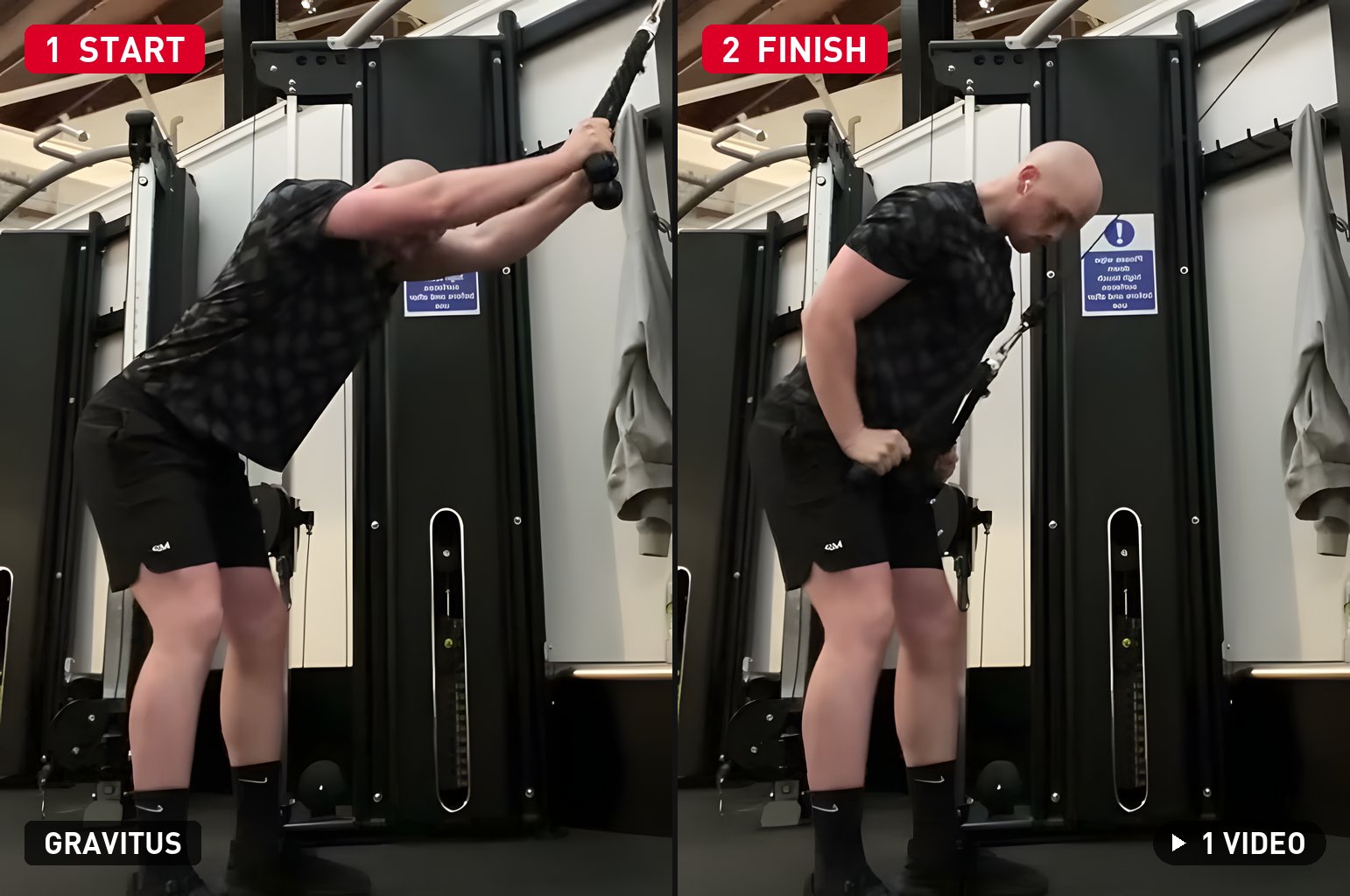
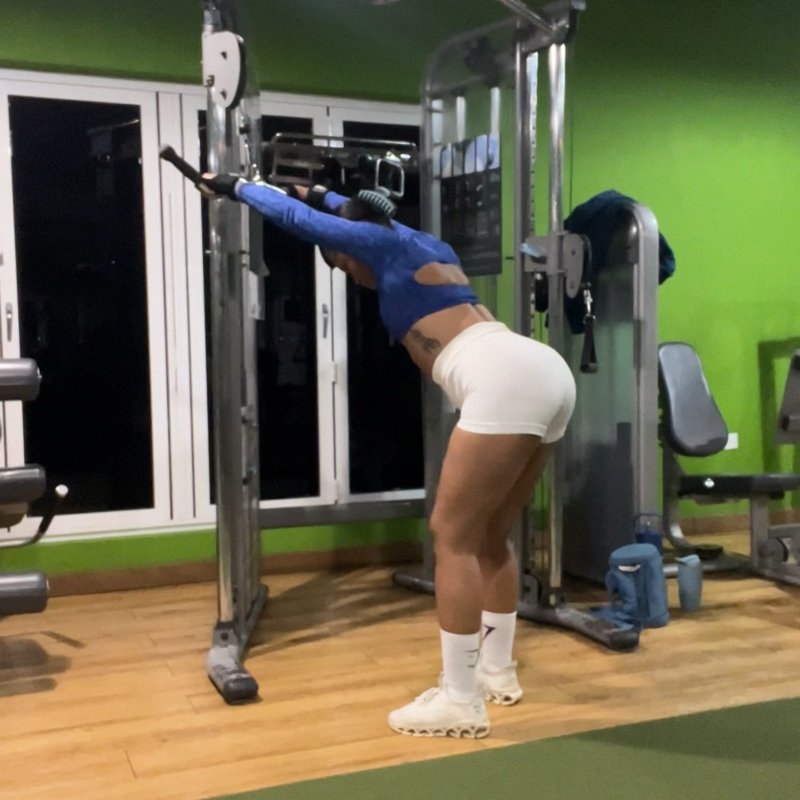
- 1Start. Pulley on the top setting, facing the stack. Hinge forward and reach up with the rope until you feel a stretch under your arms.
- 2Finish. Sweep the rope down in an arc to your hips, moving only at the shoulders, then let it rise under control.
Watch 1 video demonstration
How to do a cable lat pullover
- Set the pulley to the top notch and clip on a rope or a straight bar.
- Face the stack, grab the attachment and step back until the weight lifts with your arms overhead.
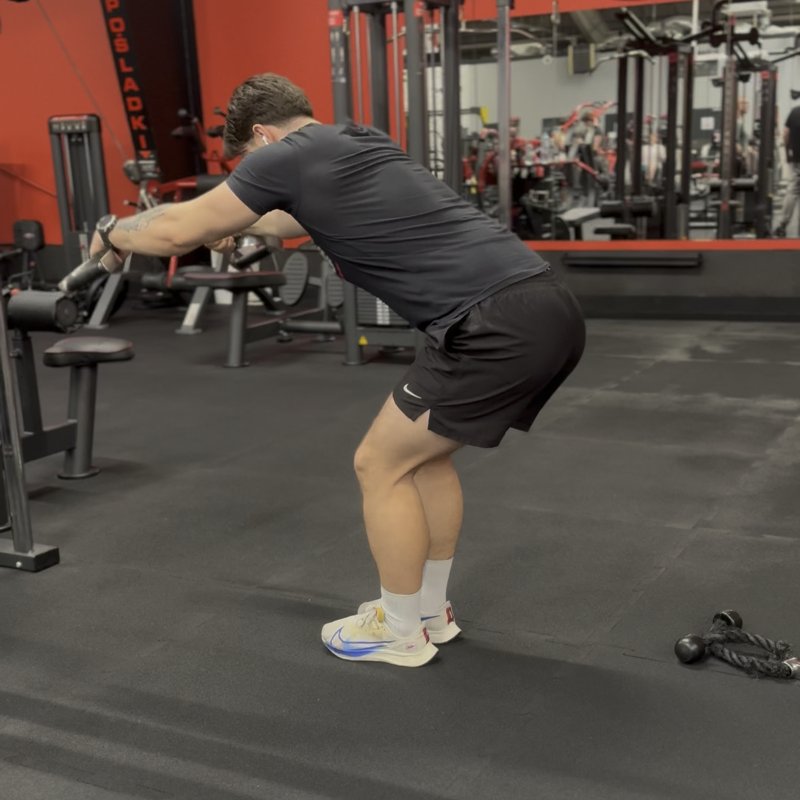
- Hinge forward 30 to 45 degrees with soft knees and brace your abs. Unlock your elbows slightly and keep that bend for the whole set.
- Pull the attachment down in an arc until your hands reach your hips. Only your shoulders move.
- Let it rise over 2 to 3 seconds until your arms are back overhead and your lats are stretched.
Where you stand changes the pullover
A cable pulls with the same force all rep, but not with the same leverage. Your shoulder feels it most when the cable runs at a right angle to your arms, so your distance from the stack moves the hardest part of the rep. The curves below are modelled for a lifter hinged 45 degrees on a top pulley, arms straight.
Start one step back. Lat activity is highest with your arms near your sides (Teixeira 2022), so the second half of the rep is where the lats do most of their work. Step closer for more load in the overhead stretch, or further back for more at your hips.
How much weight should you use for cable lat pullovers?
On Gravitus, the median man lifts 75 lb (32.5 kg) for 10 reps on the cable lat pullover, and the median woman 45 lb (19 kg).
- Most lift
- 55 to 110 lb
- Top 10% lift
- 140 lb or more
- Starting out
- under 55 lb
- Most lift
- 30 to 60 lb
- Top 10% lift
- 80 lb or more
- Starting out
- under 30 lb
- Most lift
- 25 to 50 kg
- Top 10% lift
- 62.5 kg or more
- Starting out
- under 25 kg
- Most lift
- 14 to 27.5 kg
- Top 10% lift
- 37.5 kg or more
- Starting out
- under 14 kg
Muscles worked
Chest or back? What the research says
The cable lat pullover is a back exercise first. Lat activity is highest with your arms near your sides and falls as they go overhead, while the chest works most with the arms between shoulder height and overhead (Teixeira 2022). A standing pullover that finishes at your hips spends its hardest part where the lats work best. A lying barbell pullover is hardest overhead and drew more chest than lat activity (Marchetti 2011).
Three common claims the research does not back:
- It trains the serratus. The one study that measured it found moderate serratus activity in barbell and dumbbell pullovers (Campos 2017). The serratus rotates the shoulder blade up as the arm rises, and the pullover pulls the arm down, so it works as a stabilizer, not the target.
- It expands the ribcage. No study shows pullovers widen an adult ribcage.
- Cables give constant tension. The pull on the cable stays the same, but its leverage on your shoulder changes through the rep. Where you stand decides where it is hardest, as the chart above shows.
Rope or bar?
No study has compared rope and bar pullovers. Use the one that lets you feel your lats and keep your elbows still.
Cable pullover vs straight-arm pulldown vs lying pullover
| Attribute | Cable pullover | Straight-arm pulldown | Lying pullover |
|---|---|---|---|
| Position | Hinged, facing a high pulley | More upright, same pulley | Lying across a bench |
| Hardest point | You choose, by stance | You choose, by stance | Arms behind your head, nothing at the top |
| Works most | Lats, teres major, triceps | Lats, teres major, triceps | Chest more than lats |
The cable pullover and the straight-arm pulldown are the same movement with a different hinge, so pick one. For lats, use a cable version. The lying pullover drew more chest than lat activity (Marchetti 2011), so treat it as a chest and back hybrid.
Sets, reps and progression
Do pullovers after your pulldowns and rows, or first as a lighter warm-up for the lats. Stop each set 0 to 2 reps short of failure. Sets taken close to failure build muscle across a wide range of reps (Schoenfeld 2021), so pick a range you can keep strict.
Add reps before weight. When every set reaches 15 with your elbows still, move up one pin and drop back to 10.
Common mistakes
-
Bending and straightening the elbowsYour triceps take over and it turns into a pushdown. Set a slight bend at the top and keep it to your hips.
-
Rocking the torsoYour hips and back move the weight. Hold the hinge still and go lighter.
-
Cutting the stretch shortLet your arms go back overhead every rep until you feel the stretch under your arms.
-
Standing too far backThe cable goes slack with your arms overhead. Step in until it still pulls at the top.
-
Arching the lower backYour ribs flare and your back takes the strain at the top. Brace your abs before each rep.
Cable pullover variations
Questions people ask
Is a pullover for chest or back?
The standing cable pullover is a back exercise. Lat activity peaks with the arms near your sides and chest activity with the arms higher (Teixeira 2022). The lying barbell pullover works the chest more than the lats (Marchetti 2011).
What muscles do cable pullovers work?
The lats and teres major, with the triceps long head, lower chest and rear delts helping. The core holds the hinge still.
Which is better, lat pulldown or lat pullover?
The pulldown, as your main lat lift, because it loads more weight and trains the biceps too. Add the pullover after it. In one test, lifters produced more force in the pullover than the pulldown with the arms overhead (Teixeira 2022).
Which attachment is best for a cable pullover?
A rope for most lifters, since your hands can pass your hips. A straight bar is steadier. No study has compared them, so use the one you feel in your lats.
Do pullovers increase chest size?
Not by expanding the ribcage; no study shows that. The lying pullover does train the chest muscle (Marchetti 2011), but the bench press drew more chest activity than the pullover (Campos 2014).
How much weight should I use for cable lat pullovers?
For 10 reps, the median on Gravitus is 75 lb (32.5 kg) for men and 45 lb (19 kg) for women. The strongest quarter lifts 110 lb (50 kg) and 60 lb (27.5 kg) or more.
Log every set and see your percentile on every lift, cable lat pullover included.
Get Gravitus