How to Do Single-Leg Extensions
A single-leg extension is a leg extension done one leg at a time. Line your knee up with the pivot, straighten one leg all the way, lower it under control, then switch. It trains the quads of each leg on its own. Most lifters do 3 sets of 10 to 15 reps per leg.
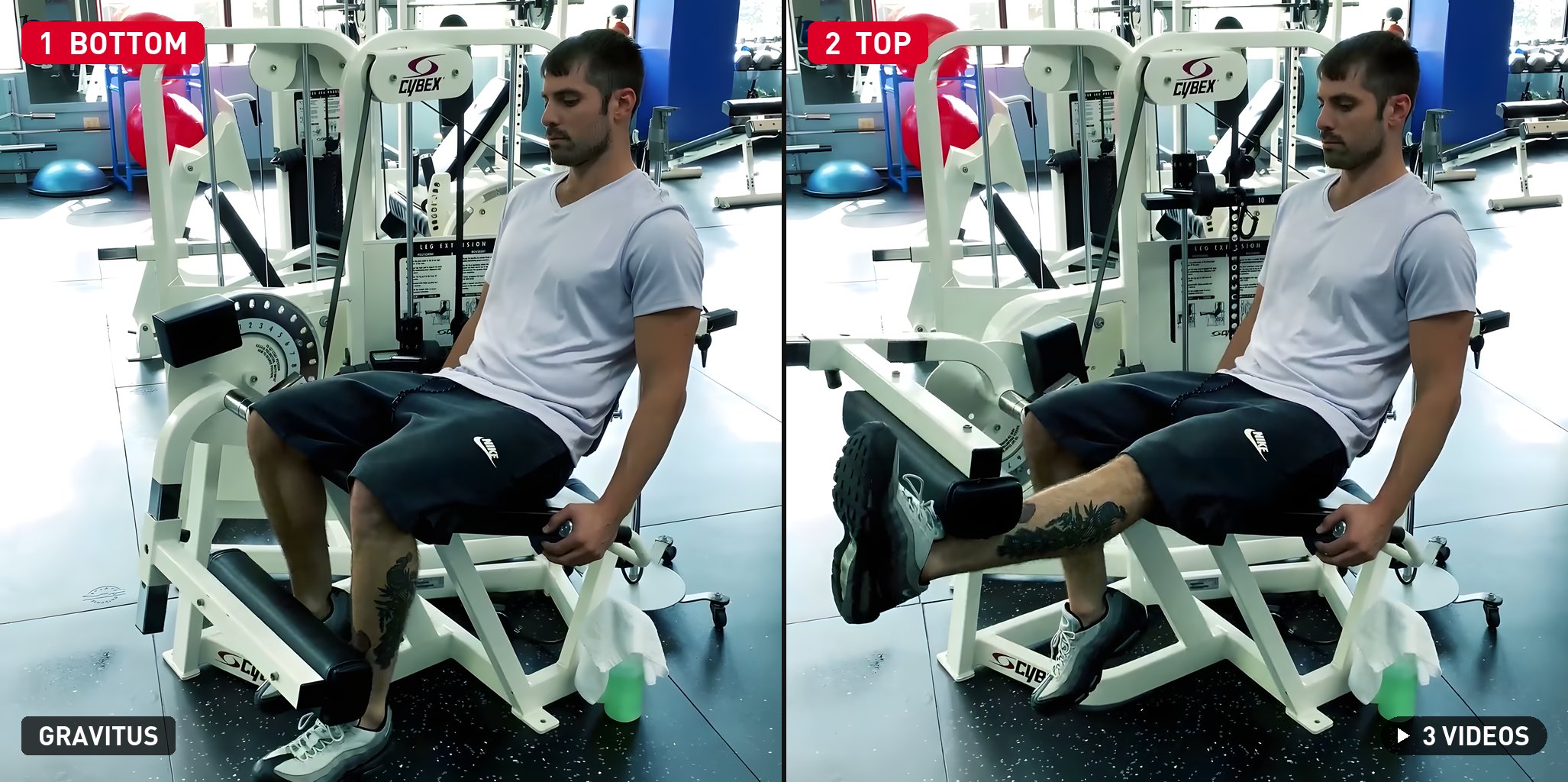
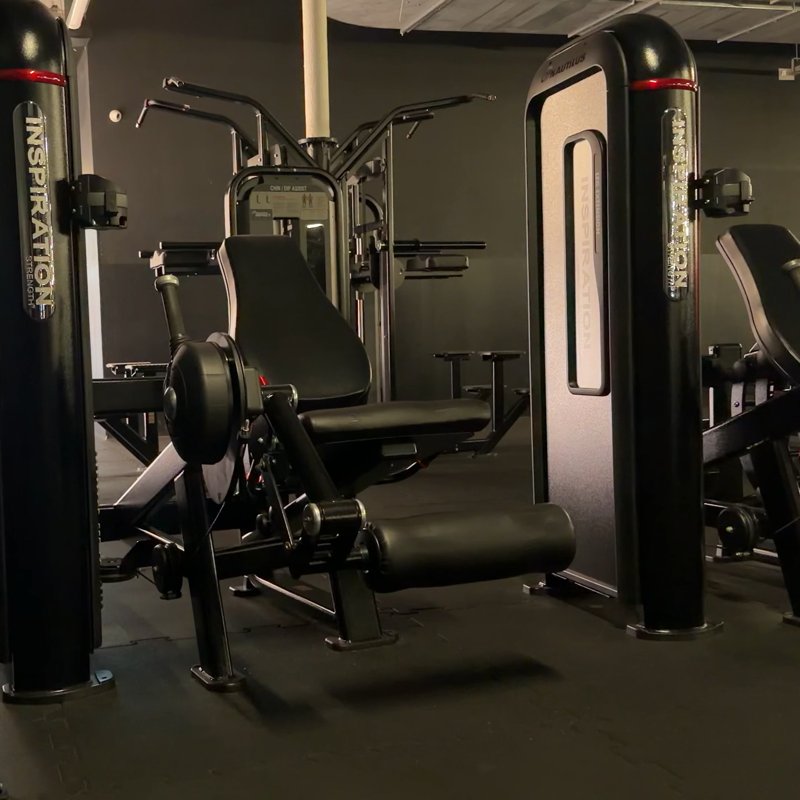
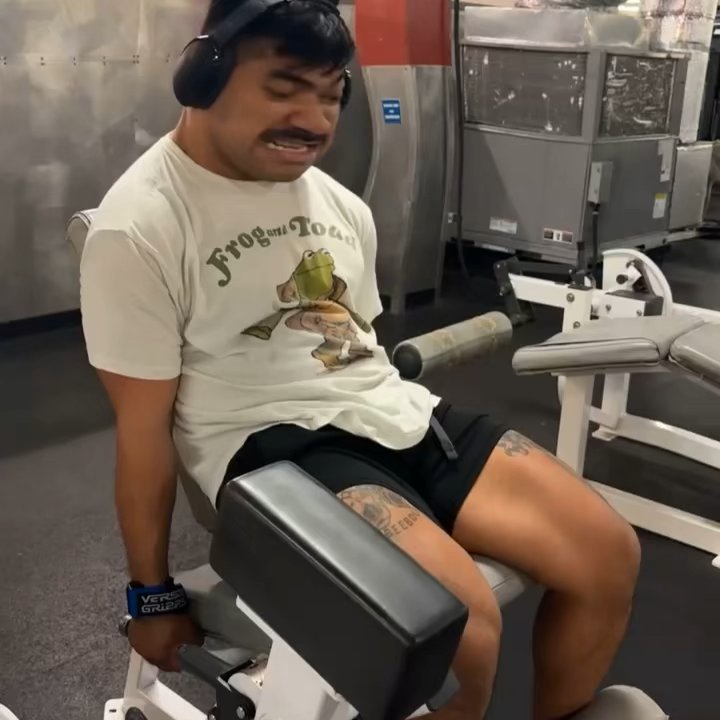
- 1Bottom. Working knee lined up with the pivot, pad just above the ankle, other foot back on the floor and hands on the handles.
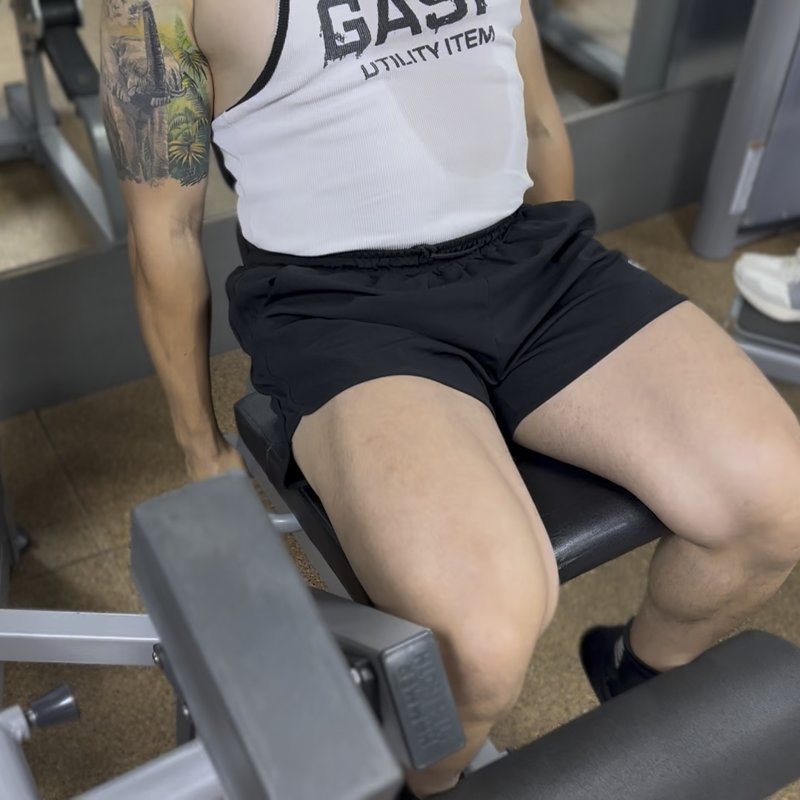
- 2Top. Straighten the working knee all the way and hold for a second, then lower over 2 seconds. The other leg stays off the pad.
Watch 3 video demonstrations
Find more video demonstrations in the Gravitus app
How to do a single-leg extension
- Set the machine as for a two-leg extension, with your knees on the pivot, the pad just above your ankles and the backrest reclined if it moves.
- Take your stronger leg out from under the pad. Tuck it back or rest the foot on the floor, and hold both handles.
- Straighten the working knee all the way and hold the top for a second.
- Lower over 2 seconds until the knee is fully bent, without letting the plates touch.
- Finish the set, note the reps, then do the same weight with the other leg.
Setting up for one leg
The seat, backrest and range of motion work the same as on the two-leg version. Our leg extension guide covers why a reclined backrest grows the rectus femoris more and why the bottom half of the rep matters most. This page covers what changes when one leg works alone.
How much weight should you single-leg extend?
On Gravitus, the median man lifts 80 lb (37.5 kg) for 10 reps on the single-leg extension, and the median woman 45 lb (20 kg).
- Most lift
- 60 to 110 lb
- Top 10% lift
- 140 lb or more
- Starting out
- under 60 lb
- Most lift
- 32.5 to 65 lb
- Top 10% lift
- 80 lb or more
- Starting out
- under 32.5 lb
- Most lift
- 27.5 to 50 kg
- Top 10% lift
- 65 kg or more
- Starting out
- under 27.5 kg
- Most lift
- 15 to 27.5 kg
- Top 10% lift
- 37.5 kg or more
- Starting out
- under 15 kg
One leg vs two legs
Expect a bit under half your two-leg weight on each leg. Gravitus lifters who log both lifts reach a median of 45% of their two-leg leg extension best on one leg, by estimated max. The middle half land between 35% and 56%, and fewer than 1 in 10 reach 75%. If you do 150 lb (70 kg) for 10 on two legs, start near 65 lb (30 kg) on one.
In the lab each leg should manage about half. Before training, the left and right one-leg maxes of untrained women added up to about their two-leg max (Botton 2016). Practice explains the gap: one-leg training raises one-leg strength most and two-leg training raises two-leg strength most (Kassiano 2025). Trained weightlifters even pushed more with both legs together than the two legs added up (Howard 1991). Most lifters train two legs far more often, so they are better at it.
Single-leg extension myths
-
"One leg at a time builds more muscle"Not in the trials so far. Nine studies found the same muscle growth from one-limb and two-limb training (Kassiano 2025). In a knee extension trial, quad size grew 11% with one-leg training and 14% with two-leg training, not a real difference (Häkkinen 1996).
-
"Use 60 to 70% of your two-leg weight per leg"Too heavy for most lifters. The median Gravitus lifter reaches 45% of their two-leg best on one leg, and fewer than 1 in 10 reach 75%. Start near 40% and let the reps tell you.
-
"Both legs share the load evenly on two legs"Nothing makes them. The stronger leg can push more of a shared pad, and in untrained people a two-leg effort was weaker than two one-leg efforts added up (Howard 1991). One leg at a time is the only way to see each side's number.
-
"Stop short of lockout on one leg"Straighten fully, as on the two-leg version. The top is the hardest part of a leg extension, not a rest. Control it instead of snapping into it.
When one leg is weaker
A small strength gap between your legs is normal. It matters most after a knee injury. In 106 athletes returning to pivoting sports after ACL reconstruction, more even quad strength before returning lowered the rate of new knee injuries. The pass mark was a weaker leg at more than 90% of the stronger one, measured one leg at a time (Grindem 2016).
To close a gap, give the weaker leg the first set and use the same weight on both sides. Training one leg also carries over to the other. Across 31 trials, the untrained limb gained 11.9% strength on average when only the opposite limb trained, and 16.4% in the legs (Manca 2017).
Do the weaker leg first, write down its reps, then give the stronger leg the same weight. The gap between the two numbers is what you are trying to shrink.
Muscles worked
Single-leg extension vs leg extension vs Bulgarian split squat
| Attribute | Single-leg extension | Leg extension | Bulgarian split squat |
|---|---|---|---|
| Weight you log | One leg | Both legs, over twice as much | Bodyweight plus dumbbells |
| Shows a side gap | True | False | True |
| Muscles | Quads | Quads | Quads, glutes, adductors |
| Time per set | Twice as long | Shortest | Twice as long |
| Best for | Evening out sides, one sore knee | Quad volume fast | Whole leg, balance |
For quad size, pick the version you will push hard. Growth was the same from one-limb and two-limb training, while strength followed the version trained (Kassiano 2025). The Bulgarian split squat also works one leg, but it adds the glutes and balance, so it does not replace quad isolation.
Sets, reps and progression
Do 3 sets of 10 to 15 reps per leg and stop 0 to 2 reps short of failure. Two legs take twice as long, so single-leg extensions fit best as the last quad exercise of the day, or in place of the two-leg version when you want to check your sides.
Stack plates are a big jump for one leg. A 10 lb (5 kg) plate on a 50 lb (22.5 kg) set is 20% more. Add reps first: when both legs reach 15, move up one plate and go back to 10.
Common mistakes
-
Stronger leg firstIt sets a target the weaker leg cannot match. Start every round with the weaker leg.
-
Resting leg helpingKeep it off the pad. Tuck it back or put the foot on the floor.
-
Hips twisting on the seatWith one leg working, the load pulls your pelvis to that side. Hold both handles and go lighter until both hips stay down.
-
Knee off the pivotLine the working knee up with the pivot dot. The pad should stay in one place on your shin.
-
Starting from half the two-leg weightMost lifters manage less than half on one leg. Start near 40% of your two-leg weight and add from there.
Single-leg extension variations
Questions people ask
Is it better to do single leg extensions?
Not for muscle size. Nine trials found the same growth from one-limb and two-limb training (Kassiano 2025), and a knee extension trial grew the quads about the same either way (Häkkinen 1996). Do them one leg at a time to see and close a gap between sides.
Leg extension one leg or two?
Either builds the quads. Strength follows what you train: one-leg training raised one-leg strength more and two-leg training raised two-leg strength more (Kassiano 2025). Use two legs to save time and one leg when your sides differ, or both across the week.
Should I do leg extensions one leg at a time to fix a muscle imbalance?
Yes, if the gap is in the quads. On a shared pad the stronger leg can do more of the work. Start with the weaker leg, use the same weight on both sides and log each one. A small difference between legs is normal.
What muscles does the single leg extension work?
The four quad muscles of the working leg, the rectus femoris most. Only the knee moves, so the hamstrings and glutes do almost nothing and the other leg rests.
How much weight should I single leg extension?
For 10 reps, the median on Gravitus is 80 lb (37.5 kg) for men and 45 lb (20 kg) for women. The strongest quarter lifts 110 lb (50 kg) and 65 lb (27.5 kg) or more.
Log every set and see your percentile on every lift, single-leg extension included.
Get GravitusRelated exercises
- Kassiano et al. 2025. Sports Med 55(4):923-936.
- Botton et al. 2016. J Strength Cond Res 30(7):1924-1932.
- Häkkinen et al. 1996. Acta Physiol Scand 158(1):77-88.
- Howard and Enoka 1991. J Appl Physiol 70(1):306-316.
- Grindem et al. 2016. Br J Sports Med 50(13):804-808.
- Manca et al. 2017. Eur J Appl Physiol 117(11):2335-2354.