How to Do Seated Hip Abduction
Seated hip abduction is a machine exercise for the side of the hips. Sit with your back on the pad and the pads outside your knees, push your knees apart, then bring them back slowly. It trains the gluteus medius, gluteus minimus and upper glute max. Most lifters do 3 to 4 sets of 12 to 20 reps.
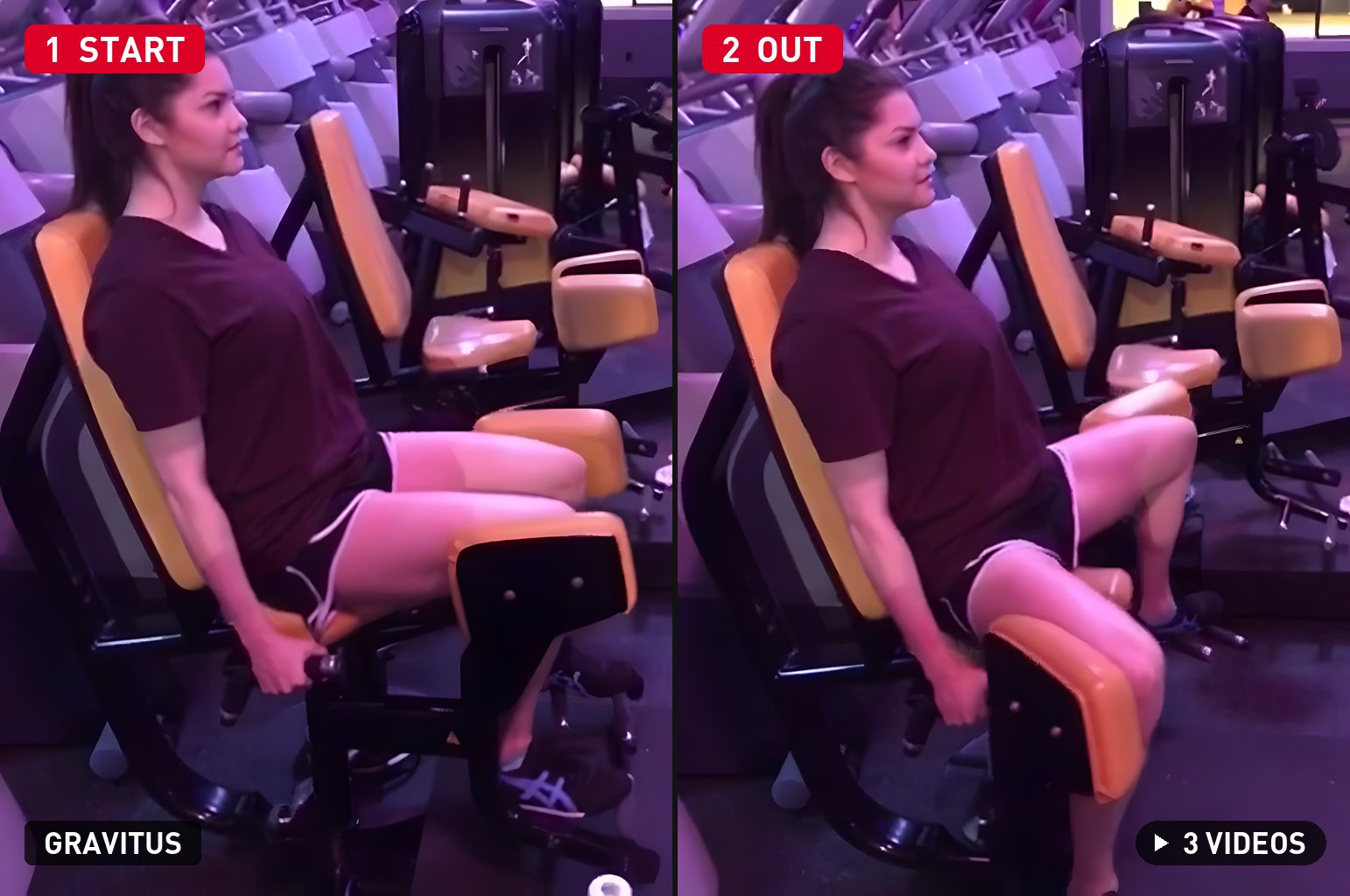
- 1Start. Sit all the way back with your hips over the machine's pivots, the pads on the outside of your knees and your hands on the handles.
- 2Out. Push your knees apart as far as you can control, pause for a second, then let them come back together slowly.
Watch 3 video demonstrations
Find more video demonstrations in the Gravitus app
How to use the seated hip abduction machine
- Set the start lever so your knees begin together, or as close as the machine allows, and pick the weight with the pin.
- Sit all the way back so your hips sit over the pivots, the points the leg arms swing around. Put your feet on the foot bars and the pads on the outside of your knees.
- Hold the handles and pick your torso angle (see below). Keep that angle for the whole set.
- Push your knees apart as far as you can with control. Pause for a second at the widest point.
- Let your knees come back together over 2 to 3 seconds, stopping just before the plates touch.
Should you lean forward, sit upright or lean back?
Your torso angle sets how far your hips are bent, and hip bend changes which muscles push the pads. When 27 men pushed their legs apart at 0 to 80 degrees of hip bend, upper glute max activity nearly tripled as the hips bent further, the TFL at the front of the hip did less, and the gluteus medius stayed about the same (Fujisawa 2014). Sitting upright on the machine puts you near the right edge of the chart. Leaning back moves you left. Leaning forward bends your hips past 90 degrees, further than the study tested.
Sit upright with your back on the pad. Lean forward, chest toward your thighs, if you want more upper glute: the trend points that way, but nobody has measured past 80 degrees. Leaning forward does not target the gluteus medius more, and leaning back gives up upper glute work. Use the same lean every set so your numbers compare.
How much weight should you use on the hip abduction machine?
On Gravitus, the median man lifts 145 lb (65 kg) for 10 reps on the seated hip abduction, and the median woman 120 lb (55 kg).
- Most lift
- 110 to 190 lb
- Top 10% lift
- 240 lb or more
- Starting out
- under 110 lb
- Most lift
- 90 to 165 lb
- Top 10% lift
- 210 lb or more
- Starting out
- under 90 lb
- Most lift
- 50 to 85 kg
- Top 10% lift
- 110 kg or more
- Starting out
- under 50 kg
- Most lift
- 40 to 75 kg
- Top 10% lift
- 95 kg or more
- Starting out
- under 40 kg
Muscles worked
Seated machine vs standing cable vs side-lying abduction
| Attribute | Seated machine | Standing cable | Side-lying |
|---|---|---|---|
| Hip bend | About 90 degrees | Straight | Straight |
| Loaded with | Weight stack, both legs | Cable, one leg | Bodyweight or ankle weight |
| Extra muscle | Upper glute max | TFL, standing leg | TFL |
| Best for | Heavy sets, easy progression | One side at a time | Home, rehab |
Use the machine to load the side glutes. In 11 men, the machine matched side-lying abduction and the clamshell for gluteus medius activity and had the best gluteus medius to TFL ratio of the three (Paz 2022). A band around the knees drew more gluteus medius activity than the machine in 16 untrained women (Brandt 2013), so bands are a fair swap at home.
Sets, reps and progression
Stop each set 0 to 2 reps short of failure. Sets taken close to failure build muscle across a wide range of reps (Schoenfeld 2021), so pick a range where you can still open your knees fully on the last rep.
Add reps first. When every set reaches 20, move the pin down one plate and go back to 12. Train it after your squats or hip thrusts, 2 times a week.
Common mistakes
-
Lining your knees up with the pivotsThe pivots sit under your hips, not your knees. Sit all the way back so the leg arms swing around your hip joints and the pads rest on the outside of your knees.
-
Rocking your torsoThrowing your chest forward as you tire turns the rep into a swing. Pick a lean and hold it for the set.
-
Leaning backIt straightens your hips and hands work to the TFL at the front of the hip. Sit upright or lean slightly forward.
-
Half reps with a heavy stackOpen your knees as wide as you can control. If you cannot pause at the widest point, go lighter.
-
Letting the plates slamBring your knees in over 2 to 3 seconds and stop just before the stack touches.
Seated hip abduction variations
Questions people ask
Does hip abduction grow glutes?
It trains the side glutes, the gluteus medius and minimus, plus the upper glute max. Squats and hip thrusts do little for the side glutes. Nine weeks of either grew the glute max but barely changed the gluteus medius and minimus (Plotkin 2023).
Should I lean forward for hip abduction?
You can. Leaning forward bends your hips more, and more hip bend drew more upper glute max and less TFL activity, with the gluteus medius unchanged (Fujisawa 2014). Sitting upright already gets most of that. Avoid leaning back.
Is seated hip abduction better than standing cable hip abduction?
Not better, different. The machine loads both legs with your hips bent, which brings in the upper glute max. Standing cable abduction works one leg with straight hips, which brings in more TFL and trains your balance on the standing leg.
Is hip abduction isolation or compound?
Isolation. Only the hip joint moves, so it is a single-joint exercise.
Where should you feel hip abduction?
On the side and upper back of your hips. If you feel it mostly at the front of the hip, sit up straighter or lean slightly forward, since the TFL there does more with your hips straight (Fujisawa 2014).
How much weight should I use on the hip abduction machine?
For 10 reps, the median on Gravitus is 145 lb (65 kg) for men and 120 lb (55 kg) for women. The strongest quarter lifts 190 lb (85 kg) and 165 lb (75 kg) or more.
Log every set and see your percentile on every lift, seated hip abduction included.
Get GravitusRelated exercises

- Fujisawa et al. 2014. J Phys Ther Sci 26(2):187-190.
- Selkowitz et al. 2016. J Orthop Sports Phys Ther 46(9):794-799.
- de Almeida Paz et al. 2022. J Bodyw Mov Ther 30:160-167.
- Brandt et al. 2013. Int J Sports Phys Ther 8(6):811-819.
- Plotkin et al. 2023. Front Physiol 14:1279170.
- Schoenfeld et al. 2021. Sports 9(2):32.