How to Do Dumbbell Shrugs
A dumbbell shrug is a trap exercise. Hold a dumbbell in each hand at your sides, keep your arms straight and lift your shoulders straight up toward your ears, then lower them all the way down. It trains the upper and middle traps and the levator scapulae. Most lifters do 3 to 4 sets of 8 to 15 reps.
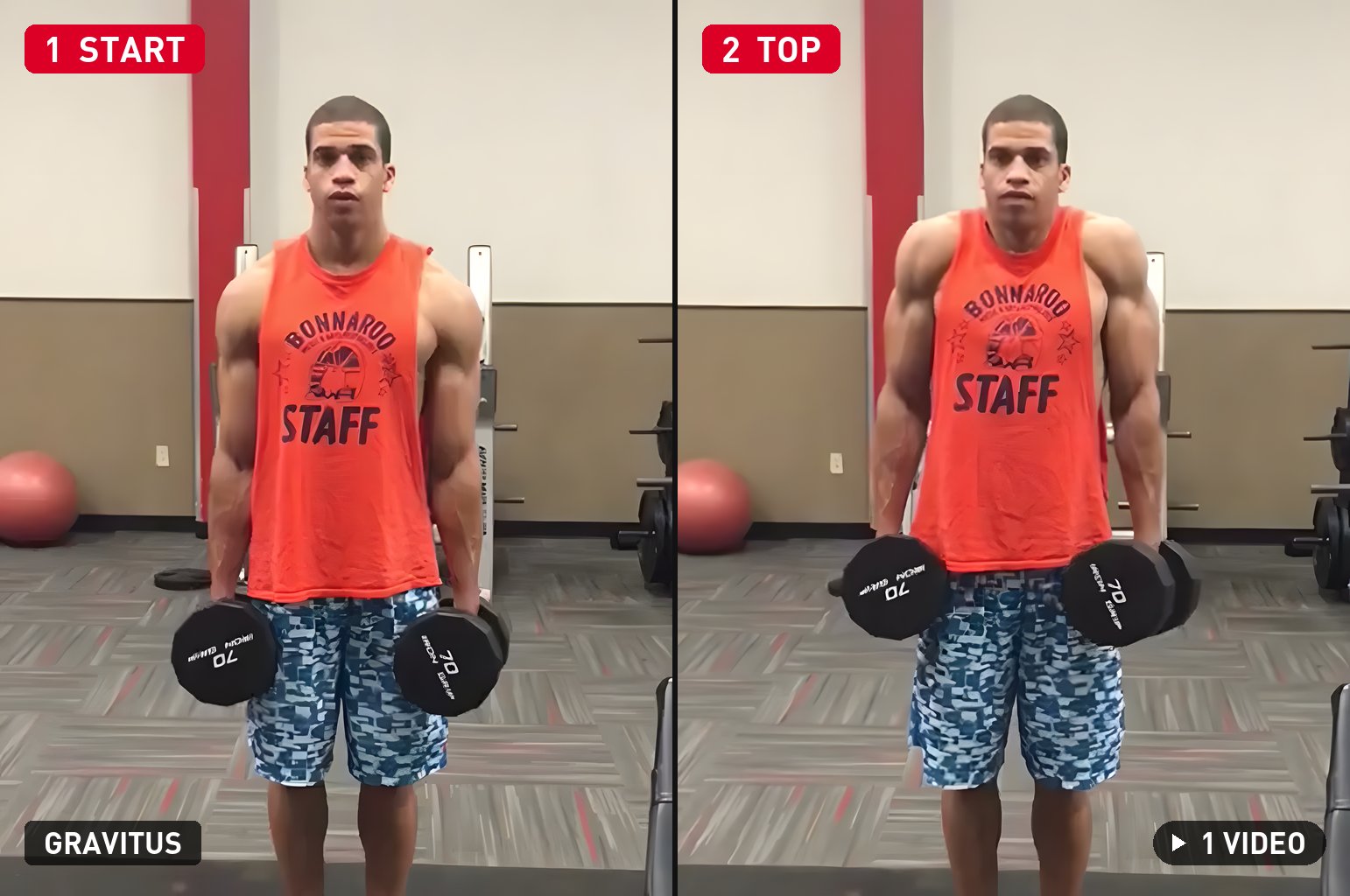
- 1Start. Stand tall with a dumbbell in each hand at your sides, palms in, arms straight and shoulders down.
- 2Top. Shrug your shoulders straight up toward your ears, pause for a second, then lower them all the way down.
Watch 1 video demonstration
How to do a dumbbell shrug
- Stand tall with your feet hip-width apart and a dumbbell in each hand at your sides, palms facing your thighs.
- Let your shoulders sink all the way down. Your arms stay straight and loose for the whole set.
- Shrug your shoulders straight up toward your ears as high as they go. Keep your chin level.
- Pause for a second at the top.
- Lower over 2 seconds until your shoulders are fully down, then start the next rep.
Where your arms hang changes the shrug
Your upper traps attach to the collarbone and raise the shoulder by rotating it, not by pulling straight up (Johnson 1994). Starting with the arms slightly out gets the shoulder blade rotating, which is why upper trap activity rose in Pizzari 2014. For heavy sets, arms at your sides is fine.
How much weight should you use for dumbbell shrugs?
On Gravitus, the median man lifts 65 lb (30 kg) per dumbbell for 10 reps on the dumbbell shrug, and the median woman 32.5 lb (15 kg).
- Most lift
- 50 to 90 lb
- Top 10% lift
- 110 lb or more
- Starting out
- under 50 lb
- Most lift
- 25 to 45 lb
- Top 10% lift
- 60 lb or more
- Starting out
- under 25 lb
- Most lift
- 22.5 to 40 kg
- Top 10% lift
- 50 kg or more
- Starting out
- under 22.5 kg
- Most lift
- 11 to 20 kg
- Top 10% lift
- 27.5 kg or more
- Starting out
- under 11 kg
Shrug claims the research does not back
Most shrug guides repeat the same warnings. Three are wrong or unsupported:
- Rolling your shoulders strains the joint. No study shows it. Rolling adds nothing either: a dumbbell pulls straight down, so only the height you lift it counts. Moving your shoulders forward or back on top of that adds motion with no extra load. Go straight up and down because that is the part that is loaded.
- Shrugs only work the upper traps. The biggest trapezius fibres start at the base of the neck (C7 and T1) and run almost straight across to the shoulder blade (Johnson 1994). In a five-person EMG study, the middle trapezius was the most active region during a shrug (Johnson 2005).
- Arms pinned to your sides gives the most upper trap. Holding the arms 30 degrees out to the sides drew more upper and lower trap activity than a standard shrug, in lifters with healthy and unstable shoulders (Pizzari 2014).
Muscles worked
Dumbbell shrug vs barbell shrug vs farmer's walk
| Attribute | Dumbbell shrug | Barbell shrug | Farmer's walk |
|---|---|---|---|
| Hands | At your sides | In front of your thighs | At your sides, walking |
| Weight jumps | 5 lb per hand | 2.5 lb or less | 5 lb per hand |
| Best for | Choosing your arm position, one side at a time | Heaviest loads | Grip and traps together |
No study has compared dumbbell and barbell shrugs for growth. Use dumbbells to choose where your arms hang and the barbell to load heaviest. A farmer's walk holds the traps still, while a shrug moves them through their full range.
Sets, reps and progression
Stop each set 0 to 2 reps short of failure. Muscles grow across a wide range of reps when sets are taken close to failure (Schoenfeld 2021), so pick a range you can keep strict with a full shrug.
Add reps before weight. When every set reaches the top of your range, move up 5 lb (2.5 kg) per dumbbell and drop back to the bottom. When grip starts to end your sets, use straps.
Common mistakes
-
Cutting the range shortHeavy dumbbells turn the shrug into a twitch. Lower until your shoulders are fully down and lift until they reach your ears.
-
Bending the elbowsYour biceps start to help. Keep your arms straight and loose.
-
Pushing the head forwardYour neck does not need to move. Keep your chin level and look straight ahead.
-
Rolling the shouldersIt adds movement with no extra load. Go straight up and straight down.
-
Bouncing at the bottomLower over 2 seconds and start the next rep from a dead stop.
Dumbbell shrug variations
Questions people ask
What do dumbbell shrugs work?
The upper and middle trapezius lift your shoulders, with the levator scapulae and rhomboids helping. Your forearms hold the dumbbells.
Are dumbbell shrugs effective?
Yes, for the traps. In a 30-person EMG study, a one-arm shrug drew more upper trap activity than any of 10 trapezius and serratus exercises (Ekstrom 2003). In women with neck pain, shrugs drew the highest trapezius activity of five exercises, 102% of a maximal contraction (Andersen 2008).
Are dumbbell shrugs better than barbell shrugs?
Neither has been shown to grow the traps more. Dumbbells let you choose where your arms hang and train one side at a time. The barbell loads heavier with smaller jumps.
Should you roll your shoulders when doing shrugs?
No, but not because it is dangerous. A dumbbell pulls straight down, so rolling forward or back adds motion without adding load. Go straight up and down.
Should dumbbells be at your sides or in front when shrugging?
At your sides, palms in, is the standard and loads heaviest. Holding your arms 30 degrees out to the sides drew more upper trap activity in one study (Pizzari 2014), at the cost of lighter dumbbells.
Are dumbbell shrugs push or pull?
Pull. Your traps pull your shoulders up toward your ears. Put them on a pull, back or shoulder day.
How much weight should I use for dumbbell shrugs?
For 10 reps, the median on Gravitus is 65 lb (30 kg) per dumbbell for men and 32.5 lb (15 kg) for women. The strongest quarter lifts 90 lb (40 kg) and 45 lb (20 kg) or more.
Log every set and see your percentile on every lift, dumbbell shrug included.
Get GravitusRelated exercises
- Johnson, Bogduk, Nowitzke and House 1994. Clin Biomech 9(1):44-50.
- Johnson and Pandyan 2005. Clin Biomech 20(2):155-161.
- Pizzari et al. 2014. Clin Biomech 29(2):201-205.
- Castelein et al. 2016. Man Ther 21:250-255.
- Ekstrom, Donatelli and Soderberg 2003. J Orthop Sports Phys Ther 33(5):247-258.
- Andersen et al. 2008. Phys Ther 88(6):703-711.
- Schoenfeld et al. 2021. Sports 9(2):32.