How to Do Rope Hammer Curls
A rope hammer curl is a cable curl done with a rope on the low pulley and your palms facing each other. Stand close to the stack, keep your elbows at your sides and curl your hands toward your shoulders. It trains the biceps, brachialis and brachioradialis. Most lifters do 3 sets of 8 to 15 reps.

How to do a rope hammer curl
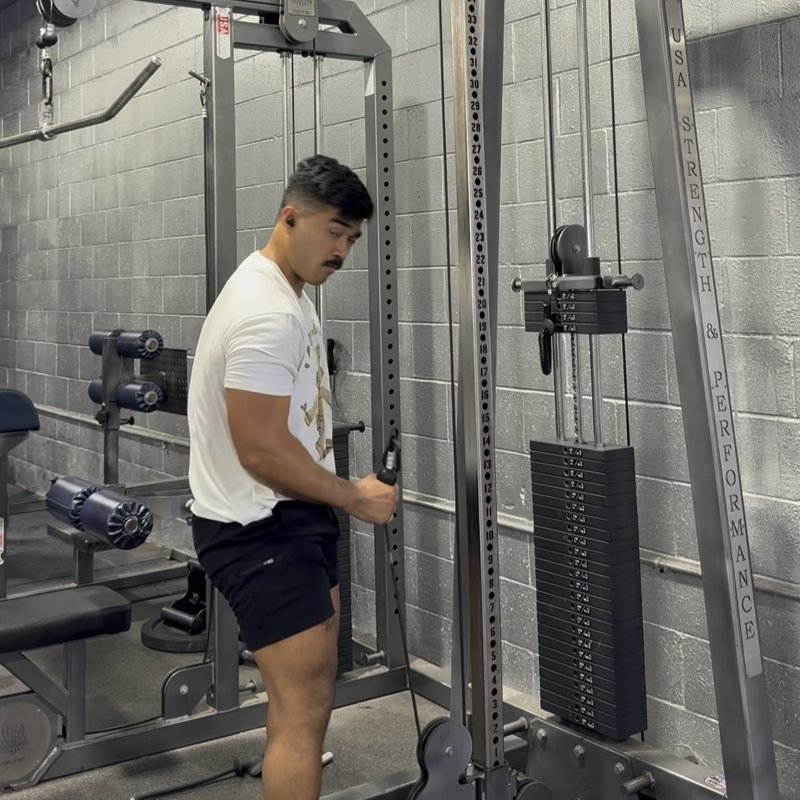
- Set the pulley to the lowest notch and clip on a rope by its middle.
- Take one end in each hand, palms facing each other, with the knobs resting on top of your fists. Stand close, with your hands 6 to 12 in (15 to 30 cm) behind the pulley.
- Pin your elbows to your sides and keep your wrists straight, thumbs pointing up.
- Curl the rope toward your shoulders by bending only at the elbows. Stop when your forearms are close to vertical, before your elbows move forward.
- Lower over 2 to 3 seconds until your arms are fully straight, without letting the plates touch down.
How far to stand from the stack
The stack pulls with the same force all rep, but not with the same leverage. The curl is hardest where the cable runs at a right angle to your forearm, and a cable running along your forearm does no work at all. Stepping back moves the hard part of the rep toward the top and lets the bottom go slack. The curves are modelled for a forearm and hand 14 in (35 cm) long with the elbow at hip height, each scaled to its own hardest point.
Stand close, so the cable runs almost straight down and your arms carry load near the bottom. Full range and bottom-half training grew the biceps and brachialis near the elbow more than top-half partials (Kassiano 2023).
How much weight should you use for rope hammer curls?
On Gravitus, the median man lifts 65 lb (30 kg) for 10 reps on the rope hammer curl, and the median woman 32.5 lb (15 kg).
- Most lift
- 45 to 100 lb
- Top 10% lift
- 130 lb or more
- Starting out
- under 45 lb
- Most lift
- 25 to 50 lb
- Top 10% lift
- 65 lb or more
- Starting out
- under 25 lb
- Most lift
- 22.5 to 45 kg
- Top 10% lift
- 57.5 kg or more
- Starting out
- under 22.5 kg
- Most lift
- 11 to 22.5 kg
- Top 10% lift
- 30 kg or more
- Starting out
- under 11 kg
What the one rope curl study found
The best test of this exact lift had 10 competitive bodybuilders curl their 8-rep max on a cable tower, with a straight bar palms up, the same bar palms down, and a rope palms in. Palms up drew 12% more biceps activity than the rope and 6% more brachioradialis activity. The rope drew 9% more front delt activity than palms up. Biceps and brachioradialis activity did not differ between grips while lowering (Coratella 2023).
Five claims that most rope curl guides repeat, including our old one:
- Cables give constant tension. The stack pulls with the same force, but its leverage on your elbow changes through the rep, as the chart above shows. Where you stand decides where the rep is hardest.
- The rope works the brachioradialis more than a bar curl. It was slightly less active with the rope than with the bar palms up (Coratella 2023).
- The rope targets the brachialis. The brachialis bends the elbow in every grip. Surface electrodes cannot measure it, so no study of these grips has shown the rope working it harder (Coratella 2023).
- Spread the rope at the top for a better squeeze. No study has tested it, and in the one rope study the hands stayed the same distance apart all rep (Coratella 2023). Pulling the ends apart moves your hands out to the sides. It does not turn your palms up, the biceps' other job.
- Keep a bend at the bottom to keep tension. The stretched part of the rep has the strongest growth evidence (Kassiano 2023). Straighten your arms every rep.
Muscles worked
How to hold the rope
Rope hammer curl vs cable curl vs dumbbell hammer curl
| Attribute | Rope hammer curl | Straight-bar cable curl | Dumbbell hammer curl |
|---|---|---|---|
| Palms | Facing in | Facing up | Facing in |
| Biceps activity | The bar draws 12% more | Highest, of the grips tested | Not tested against the rope |
| Hardest point | You choose, by stance | You choose, by stance | Halfway |
| Weight lifters log | About the same as the bar | About the same as the rope | Per dumbbell |
| Best for | Sore wrists, grip variety | Most biceps work | Training anywhere, one arm at a time |
Use the straight bar for the most biceps work per set, and the rope if palms up bothers your wrists or elbows. No trial has compared the rope and the bar, or the rope and dumbbells, for growth. In the closest trial, cable and barbell preacher curls grew the biceps 7% and 8% over 10 weeks (Nunes 2020), so rotating grips across the week is a reasonable plan.
Sets, reps and progression
Stop each set 0 to 2 reps short of failure. Sets taken close to failure build muscle across a wide range of reps (Schoenfeld 2021), so pick a range you can keep strict.
Stack jumps of 5 to 10 lb are big for a small muscle. Add reps first: when every set reaches the top of your range, move up one plate and drop back to the bottom of the range.
Common mistakes
-
Standing too far backThe bottom of the rep goes slack. Step in until the cable runs close to straight down.
-
Swinging the torsoYour back and hips lift the weight, not your arms. Go a plate lighter until you can stand still.
-
Elbows drifting forwardYour front delts take over and the top of the rep goes slack. Keep your elbows at your sides.
-
Stopping short at the bottomKeeping a bend in the elbow skips the stretched part of the rep, the part with the strongest growth evidence (Kassiano 2023). Straighten your arms every rep.
-
Wrists bendingKeep your thumbs in line with your forearms, so your forearm muscles hold the rope instead of your wrist joints.
-
Dropping the weightLower over 2 to 3 seconds without letting the plates touch.
Rope hammer curl variations
Questions people ask
Are rope hammer curls good?
Yes, as a neutral-grip curl with small weight jumps that is easy on the wrists. For the most biceps work per set, a palms-up bar beats it (Coratella 2023), so many lifters use both.
What do rope hammer curls target?
The biceps and the brachialis, with the brachioradialis helping. Your forearms, front delts and core hold you still.
Rope hammer curl which head?
Both heads of the biceps. No study has shown a neutral grip shifting work to the long or the short head, and the standard electrode placement cannot tell them apart (Coratella 2023).
Do cable hammer curls work brachialis?
Yes, as every curl does. The brachialis bends the elbow in any grip, so the rope does not single it out.
Does cable hammer curl train forearms?
It trains the brachioradialis, the forearm muscle on the thumb side near your elbow, and your grip. The brachioradialis was slightly more active with a palms-up bar (Coratella 2023). For the wrist muscles, add wrist curls or reverse wrist curls.
Are rope curls the same as hammer curls?
The same grip, palms facing in, on a cable instead of dumbbells. The cable lets you choose where the rep is hardest by where you stand. Dumbbells are hardest halfway up.
Is the rope hammer curl better than the dumbbell hammer curl?
Neither is better for growth. No trial has compared them, and cable and free-weight curls grew the biceps about equally in the closest one (Nunes 2020). Pick the rope for small jumps and a loaded bottom, dumbbells for training anywhere.
How far should I stand from the cable for rope hammer curls, and should I spread the rope at the top?
Close, with your hands 6 to 12 in (15 to 30 cm) behind the pulley, so the bottom of the rep stays loaded. Spreading the ends is optional. No study has tested it, and it does not turn your palms up.
How much weight should I use for rope hammer curls?
For 10 reps, the median on Gravitus is 65 lb (30 kg) for men and 32.5 lb (15 kg) for women. The strongest quarter lifts 100 lb (45 kg) and 50 lb (22.5 kg) or more.
Log every set and see your percentile on every lift, rope hammer curl included.
Get Gravitus